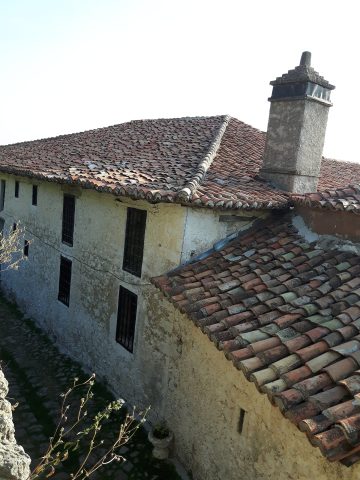
Krujë’s Sultan Mehmed Fatih Mosque is one of those rare places where history feels almost tangible, as if the weight of centuries lingers in the air. Built in the fifteenth century, it bears the name of Mehmed II, the Ottoman sultan known as *Fatih*—the Conqueror—who took Constantinople and reshaped the Mediterranean world. At the time, Krujë was not just another town but the last stronghold of Albanian resistance against Ottoman expansion. The mosque’s construction here was more than an act of faith; it was a statement, marking the end of one era and the beginning of another. Today, it stands on a hillside overlooking the valley where battles once raged, its minaret rising above the old quarter like a quiet sentinel of the past.
The mosque’s architecture is classic Ottoman—modest yet elegant, with a single dome and a portico clad in pale stone. From the outside, it blends seamlessly into the landscape, its proportions harmonious against the backdrop of rolling hills. Inside, the prayer hall is spacious and uncluttered, with a mihrab pointing toward Mecca and a wooden minbar where sermons were once delivered. The walls bear traces of traditional ornamentation, though time and earthquakes have softened their edges. The most striking feature is the intricately carved wooden ceiling, its patterns a testament to the skill of craftsmen who worked here centuries ago. The craftsmanship is understated but precise, a reminder that beauty often lies in restraint.
This mosque is deeply tied to the legacy of Skanderbeg, Albania’s national hero, who led the resistance against the Ottomans for decades. After his death in the late fifteenth century, Krujë fell, and the mosque became one of the first Islamic structures built in the region. For generations, it was more than a place of worship; it was a witness to change. During Ottoman rule, it served the local Muslim community, only to be shuttered under Albania’s communist regime, when religion was suppressed. After the fall of communism in the 1990s, the mosque was restored to the faithful, though it no longer draws the crowds it once did. Today, it functions quietly, a living piece of history in a town where the past is never far away.
Krujë itself is a place where every stone seems to whisper stories. The mosque sits near the fortress where Skanderbeg once ruled, not far from the old bazaar where artisans still sell handmade goods. Walking up the narrow streets from the mosque toward the fortress, you can see the layers of the town unfold: below, tightly packed houses with terracotta roofs; above, the crumbling walls of the citadel; and beyond, the mountains stretching into the distance. The mosque acts as a bridge between these layers, a physical reminder that Krujë has always been a crossroads of different eras and traditions.
Inside, the mosque is peaceful, even when worshippers are present. Light filters through high windows, casting gentle shadows on the walls, while the air carries the scent of aged wood and stone. Unlike grand urban mosques, this one is free of ostentation or tourist crowds. There’s a sense of intimacy here, a feeling of connection to something enduring. On Fridays, when the main prayer is held, locals gather, but on other days, visitors can enter at most times, provided they follow the customs: removing shoes, covering shoulders, and—if you’re a woman—wearing a headscarf.
The mosque has survived not only political upheavals but also natural disasters. Albania is seismically active, and Krujë has been shaken by earthquakes over the centuries. In the twentieth century, the mosque underwent restoration, though care was taken to preserve its original character. Today, it looks much as it did hundreds of years ago, with only minor modern additions, like electric lighting. A small garden surrounds the building, offering a quiet place to sit and reflect. The trees provide shade, and from here, you can take in the view of the valley below, where history and landscape merge.
For those interested in the Balkans’ complex past, the Sultan Mehmed Fatih Mosque is more than just a landmark—it’s a piece of a larger story. It stands as a reminder that Albania has always been a meeting point of civilizations: Byzantine and Ottoman, Christian and Muslim, resistance and submission. Krujë, with its fortress and mosque, embodies this diversity. Even if you’re not religious, the mosque offers a chance to feel history in the details—the cracks in the walls, the call to prayer echoing over the rooftops, the stillness of the courtyard. It’s a place where the past isn’t just remembered; it’s still alive.
A visit to the mosque pairs well with a walk through Krujë’s old town. Nearby is the Skanderbeg Museum, where artifacts from the resistance era are displayed, and the Ethnographic Museum, which offers a glimpse into traditional Albanian life. From there, it’s a short climb to the fortress walls, where the view opens up to the valley and the mountains beyond. On clear days, you can see all the way to the Adriatic Sea to the west and the rugged peaks to the east. In this vast landscape, the mosque feels small but significant—a point of connection between what was and what is.
Krujë today is more than just a historical site; it’s a living town where people go about their daily lives. The Sultan Mehmed Fatih Mosque remains a part of that life, though it doesn’t demand attention like the fortress or the bazaar. It doesn’t seek to impress tourists; it simply exists, a quiet testament to the idea that history doesn’t vanish—it lingers in the stones, in the people, and in the places where the fate of nations was once decided. To stand here is to understand that some stories are never truly finished; they’re just waiting to be rediscovered.