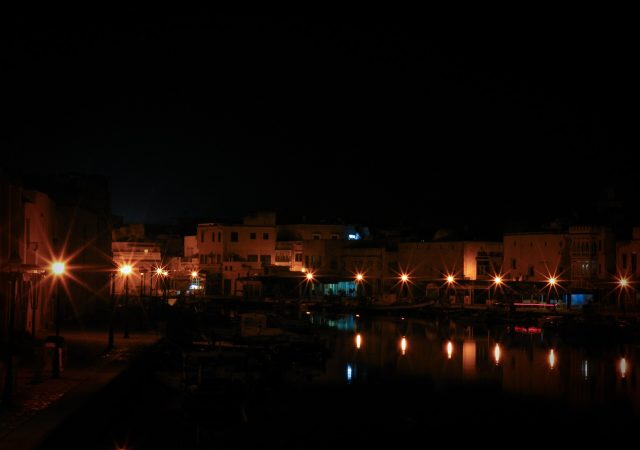
Sidi El Hani Mosque stands quietly on the edge of Bizerta’s old medina, a place where the city’s past lingers in the salt-tinged air. Built in the 17th century, it was named after a revered local saint, Sidi El Hani, whose tomb lies within its walls. The mosque itself is modest in scale, but its presence is deeply woven into the fabric of the neighborhood. Unlike the grander mosques of Tunis or Kairouan, this one feels intimate, almost domestic—a place where daily prayers and community life have unfolded for centuries without fanfare.
The architecture reflects the practical elegance of Ottoman-era Tunisia. The minaret, slender and slightly tapered, rises above the low rooftops, its whitewashed surface catching the Mediterranean light. Inside, the prayer hall is simple: rows of arches supported by square pillars, a mihrab niche pointing toward Mecca, and a wooden minbar from which the imam delivers sermons. The floors are covered with woven mats, worn smooth by generations of worshippers. There are no elaborate mosaics or gilded domes here, just the quiet beauty of function and time.
What makes Sidi El Hani Mosque special is its role as a living part of Bizerta’s rhythm. It’s not a tourist landmark in the usual sense, but a place where locals gather—not just for prayer, but for the small rituals of daily life. In the early mornings, the call to prayer drifts over the narrow streets, mingling with the sounds of fishermen preparing their boats and vendors setting up their stalls. During Ramadan, the mosque becomes a hub of activity, with iftar meals shared in the courtyard and lanterns strung between the palm trees.
The surrounding medina adds to the mosque’s atmosphere. Bizerta’s old town is a maze of whitewashed houses, their blue shutters and doors a nod to the city’s maritime past. The streets are narrow, designed more for donkeys than cars, and the scent of fresh bread from the neighborhood bakery often mixes with the briny breeze from the nearby harbor. Near the mosque, a small souk sells everything from spices to handmade leather goods, its stalls shaded by striped awnings. It’s a place where time moves slowly, where the past isn’t just preserved but still very much alive.
History here isn’t confined to plaques or guided tours. The mosque has witnessed Bizerta’s transformations—from a strategic Ottoman port to a French colonial stronghold, and later, a city navigating its place in independent Tunisia. During the 19th century, when Bizerta was a key naval base, the mosque served as a spiritual anchor for the community amid political upheaval. Even today, its walls seem to hold the echoes of those who passed through: sailors, merchants, and families who shaped the city’s identity.
For visitors, the mosque offers a glimpse into a side of Tunisia that’s often overshadowed by the country’s more famous landmarks. There’s no grand entrance fee or guided tour, just an open door and the quiet invitation to observe. Non-Muslims are welcome to step inside outside of prayer times, though it’s respectful to dress modestly and keep a low profile. The courtyard, with its potted plants and benches, is a good place to sit and watch the world go by—old men playing dominoes, children chasing each other between the arches, the occasional cat napping in a patch of sunlight.
The best time to visit is late afternoon, when the light softens and the heat of the day begins to fade. The mosque’s white walls take on a golden hue, and the call to prayer at sunset adds a layer of tranquility to the scene. It’s a moment that feels timeless, as if the centuries between now and the mosque’s founding have collapsed into something simple and enduring.
Sidi El Hani Mosque isn’t a place you’d find in most travel guides, and that’s part of its charm. It’s not about spectacle, but about the quiet persistence of tradition in a changing world. In a city where the past and present coexist, the mosque stands as a reminder that some things—faith, community, the slow passage of time—are more enduring than the grandest monuments.