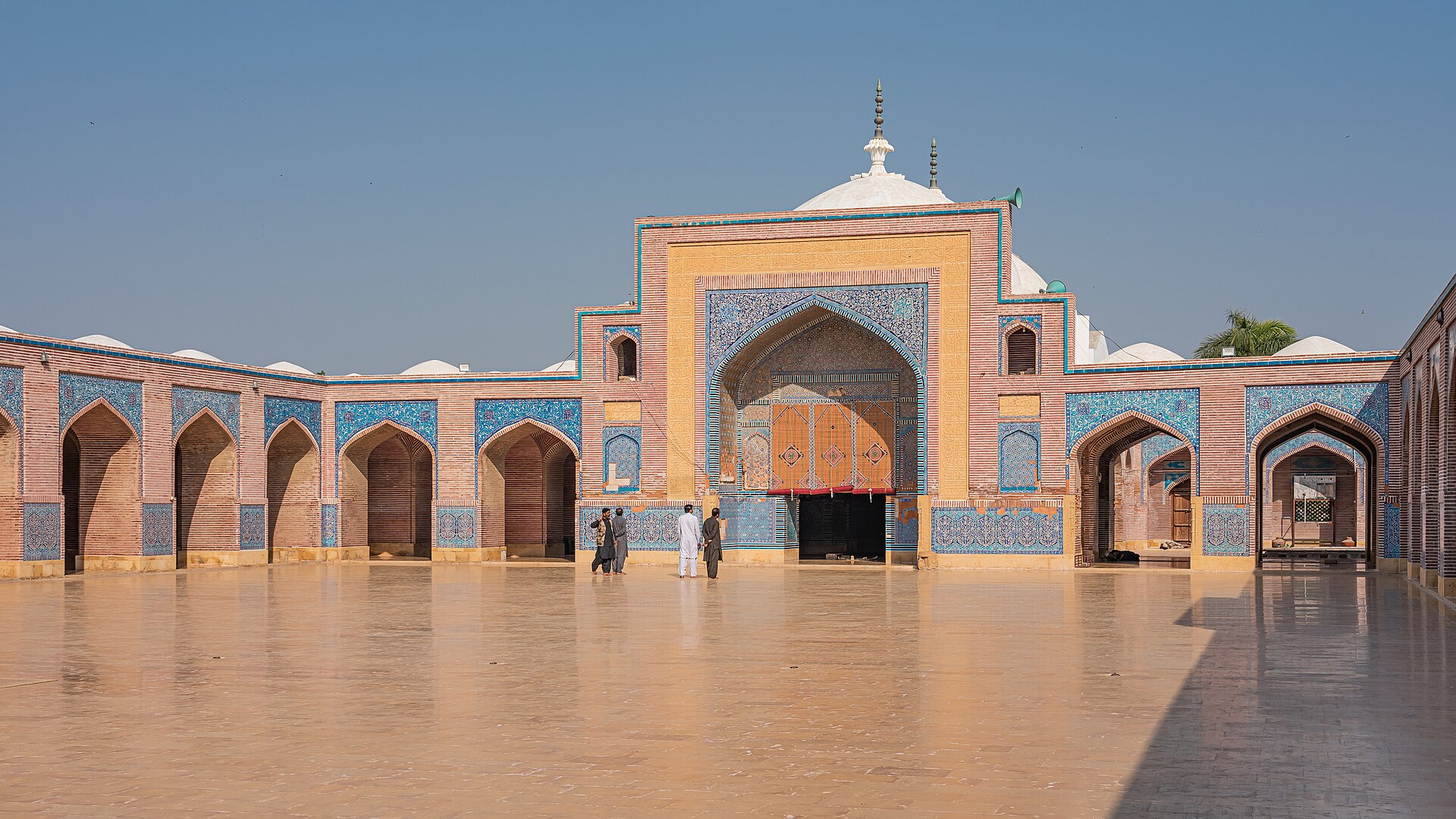
Shah Jahan Mosque in Thatta is one of those rare places where history isn’t just remembered—it’s felt. Built in the 17th century under the orders of the Mughal emperor Shah Jahan, it stands on the edge of the city, a quiet witness to a time when Thatta was a thriving hub on the trade routes between Delhi and Sindh. Unlike the more famous Mughal landmarks in India, this mosque remains relatively unknown outside Pakistan, which only adds to its authenticity. There are no crowds, no tourist traps, just the weight of centuries pressing gently against its walls.
The architecture of the mosque is a conversation between Mughal grandeur and the local traditions of Sindh. Constructed from red brick, the building takes on a warm, earthy hue, especially striking at sunset. The facades are adorned with delicate stone carvings and glazed tiles featuring floral patterns, a hallmark of Mughal art. Inside, a spacious courtyard is framed by arched walkways, while the main prayer hall is crowned with three domes, a signature of the era. What sets this mosque apart is the absence of minarets, giving it a more restrained, almost meditative presence.
Shah Jahan, best known for commissioning the Taj Mahal, chose Thatta for a reason. In the 17th century, the city was a prosperous center where trade, culture, and ideas intersected. The mosque wasn’t just a place of worship; it was a statement of imperial power, a symbol of unity across diverse regions. Standing within its walls today, it’s easy to imagine merchants, scholars, and pilgrims gathering here, their voices mingling with the calls to prayer and the murmur of political debates. Time moves differently in this place—even the noise of the modern city feels distant, muffled by the layers of history.
The interior of the mosque is simpler than its counterparts in India, but no less evocative. The floors are paved with stone slabs, and the walls bear Arabic calligraphy—verses from the Quran and the names of rulers. Light filters through high arched windows, casting shifting shadows across the carved columns. At the center of the courtyard, an old well still stands, once a vital source of water for worshippers. Though it’s rarely used now, its presence adds to the sense of continuity, as if the past isn’t just preserved here but still alive.
Thatta may not draw the same crowds as Lahore or Karachi, but it holds its own treasures. The Shah Jahan Mosque is one of them, offering a glimpse into the Mughal era that feels more intimate than the grander monuments elsewhere. The city was once the capital of Sindh, its streets echoing with the footsteps of local dynasties and later, Mughal rulers. Today, Thatta is a quiet place where life unfolds slowly, and the past isn’t hidden behind modern facades. From the mosque’s elevated position, the view stretches over the surrounding landscape—clay houses, palm groves, and the winding Indus River, which has sustained these lands for centuries.
Visiting the mosque isn’t just about seeing an architectural landmark; it’s a chance to reflect on how cities and empires rise and fall. Shah Jahan likely never imagined that his creation would outlast his empire, standing long after its glory faded. Now, the mosque serves as both a place of worship and an open-air museum, where every stone has a story to tell. Without the distraction of crowds, it’s possible to notice the small details—the way the light plays on the tiles, the texture of the brickwork—that might otherwise go unnoticed.
If you find yourself in Thatta, don’t rush away after seeing the mosque. Take time to wander through the old city, where narrow streets wind past traditional houses with intricately carved wooden balconies. In the local shops, you might stumble upon old coins, pottery, or textiles that hint at the city’s former prosperity. As the heat of the day subsides, head toward the river, where fishermen still cast their nets just as their ancestors did hundreds of years ago.
The Shah Jahan Mosque isn’t just a building; it’s a living piece of history that continues to evolve. It reminds us that even in the most unassuming corners of the world, there are places where time moves at its own pace. Here, the past isn’t something distant—it’s right beneath your feet, waiting to be discovered. And that, perhaps, is the most rewarding part of any journey.