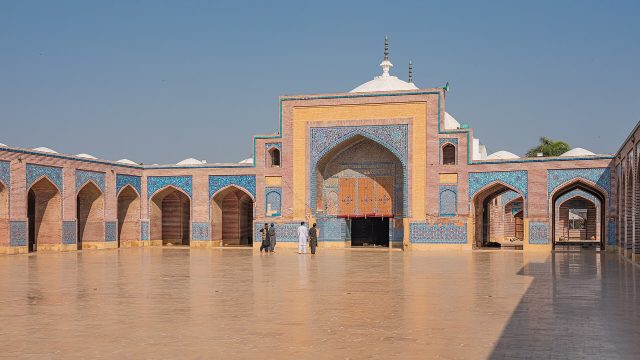
Perched on the quiet outskirts of Tatta, the mausoleum of Nawab Mirza Jani Beg stands as a quiet witness to a time when this city was one of Sindh’s most vital hubs. Built in the late 16th century, it belongs to a rare category of monuments that have preserved not just their architectural integrity but also the spirit of an era when Muslim rulers of the Delhi Sultanate and their provincial governors sought to immortalize themselves in stone. Jani Beg, the man for whom the mausoleum was built, was a prominent figure at the court of the Mughal emperor Akbar, and his resting place reflects a transitional period in the region’s history—when Persian traditions had not yet fully given way to Mughal influence.
The architecture of the mausoleum blends the austerity and elegance typical of Sindh’s building traditions of the time. Constructed from local brick, a material often used in place of stone in this region, the structure is adorned with glazed tiles featuring geometric and floral patterns. The colors—shades of blue and turquoise—are characteristic of Islamic art, though here they carry a softer, more subdued tone than their Persian counterparts. The dome, though not as grand as those of Mughal monuments, is proportionally harmonious, and the interior once boasted intricate stucco work and paintings, much of which has faded with time.
Surrounding the mausoleum is a small necropolis, where descendants of Jani Beg and other local nobles lie buried. The graves are simple, marked only by stone slabs inscribed with Arabic calligraphy, a stark contrast to the lavish gardens and fountains often found in Mughal mausoleums. There is no excess here—just a quiet beauty and the palpable sense of history that lingers in the air. Locals still visit to pay their respects, and on still days, the only sound is the whisper of wind through the dry grass covering the hillside.
In the 16th century, when the mausoleum was built, Tatta was at its peak. It served as the capital of Sindh under the Tarkhan dynasty and later became a key trading and cultural center on the route between Delhi and Central Asia. Caravans laden with silk, spices, and precious stones passed through, while local rulers patronized poets, scholars, and artisans. The mausoleum of Jani Beg is one of the few remaining traces of that era, when Tatta was not just a provincial town but a place where history was made.
Today, the mausoleum has an air of gentle neglect, but this only adds to its charm. There are no crowds, no vendors, no modern distractions—just silence and the feeling of stepping into another century. The entrance is usually open, though not always; sometimes a local caretaker keeps watch, and if you’re lucky, he might share a few stories about the place. Inside, it’s cool even on the hottest days, and the light filtering through narrow windows casts shifting shadows across the walls, highlighting the remaining carvings and patterns.
For those interested in the history of Islam in South Asia, the mausoleum of Jani Beg is a significant landmark. It illustrates how local traditions intertwined with external influences, how Sindhi craftsmen adapted Persian and Mughal motifs to create something uniquely their own. There’s none of the grandeur associated with the mausoleums of the Great Mughals, but that’s precisely its appeal. This is a place for those who appreciate subtlety, who are willing to look closely and listen to the quiet.
In recent decades, the mausoleum has drawn more attention from historians and architecture enthusiasts, though it remains largely unknown to the wider public. Perhaps because Tatta itself isn’t a major tourist destination, or perhaps because places like this require patience and curiosity to truly appreciate. But those who make the journey rarely leave disappointed. Here, you can spend an hour or two simply sitting on the steps, watching how the light changes on the walls, or examining the inscriptions on the gravestones, wondering about the lives they represent.
The mausoleum of Nawab Mirza Jani Beg is more than just an architectural relic—it’s a living page of history, one that endures even as many of its chapters have faded. It serves as a reminder that even in small, overlooked towns, far from the capitals and tourist trails, there are places that hold the memory of great eras. If you ever find yourself in Tatta, it’s worth a visit—not for the sake of photographs or ticking off a checklist, but to feel the breath of the past.