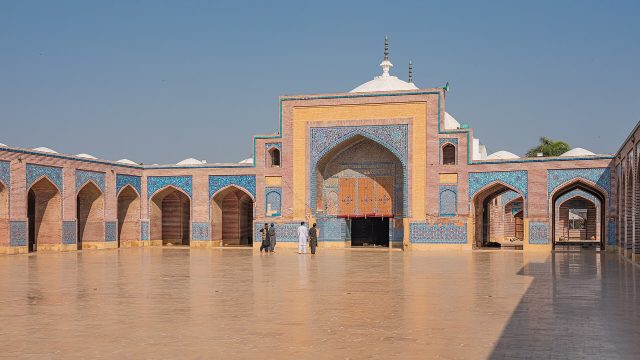
Isa Khan Tarkhan’s mausoleum stands on the edge of what was once a thriving city, a quiet witness to an era when Thatta was more than just a name on a map—it was the heart of a powerful state. Built in the sixteenth century, the structure has weathered centuries of wind and sand, its presence a subtle but enduring link between past and present. There are no crowds here, no hurried footsteps or chatter. Only the stillness of the desert, broken occasionally by the cry of a bird or the rustle of dry grass underfoot.
The architecture tells its own story, one shaped by the traditions of Sindh and the influences that would later define Mughal design. The dome, rising above the flat landscape, appears almost weightless despite its heavy brick construction. The facades are adorned with intricate carvings—geometric patterns intertwined with floral motifs—that shift with the light, casting delicate shadows as the sun moves across the sky. The effect is most striking at dusk, when the walls take on a warm, golden hue, softening the lines of the stone.
Isa Khan Tarkhan, the man for whom the mausoleum was built, was a figure of considerable influence during the reign of the Tarkhan dynasty, a time when Sindh’s sultanate was at its height. Thatta was not just a political center then but a cultural crossroads, and Isa Khan’s legacy is woven into the fabric of the city’s history. His mausoleum was meant to be more than a final resting place; it was a statement of power and prestige, a reminder of the man who helped shape the region’s destiny.
Inside, the air is cool and dim, pierced by thin shafts of light filtering through narrow windows. The walls bear inscriptions in Arabic and Persian—verses from the Quran and poetry dedicated to the departed. The floor, laid with tiles that have cracked with age, still hints at the craftsmanship of a bygone era. Unlike the lavish Mughal tombs of Delhi or Agra, this one is restrained, almost austere. Yet that simplicity gives it a quiet strength, as if the walls themselves hold not just the remains of Isa Khan but the echoes of an entire age.
Sixteenth-century Thatta was a city where cultures converged. Merchants from Persia, artisans from Central Asia, and scholars from the Arab world all passed through its streets, leaving their mark on its architecture, language, and traditions. The mausoleum is a relic of that time, a symbol of a city that once thrived as a hub of trade and learning. Today, little remains of Thatta’s former glory, but the mausoleum endures, a silent testament to the days when the city was a vital link between East and West.
Visiting the mausoleum feels less like a tour and more like stepping into history. There are no signs, no guided audio explanations—just the quiet and the wind sweeping through the empty chambers. Locals rarely come here, though shepherds sometimes graze their flocks on the nearby plains. For them, the mausoleum is just another part of the landscape, unremarkable in its familiarity. But for those who travel from afar, it offers something rare: a chance to touch history not as a story in a book, but as something tangible, shaped by stone and time.
The land around the mausoleum is vast and open, a desert where time seems to move more slowly. In summer, the heat is relentless, the sand burning underfoot, the air shimmering with the weight of the sun. Winter brings a different kind of stillness, with cool mornings and a thin mist that clings to the ground. On those days, the mausoleum feels almost otherworldly, as if it doesn’t quite belong to this place but has paused here, waiting for something just beyond reach. That sense of transience is part of its strange allure—a mix of awe and melancholy, as if you’re standing at the edge of something vast but just out of grasp.
This isn’t a place that dazzles at first sight. Its beauty isn’t in bold colors or ornate decorations but in the atmosphere that settles over you the moment you step inside. There’s nothing superfluous here, nothing that distracts from the mausoleum’s purpose: to preserve the memory of a man and his time. Perhaps that’s why it still stands, despite wars, invasions, and the slow march of neglect. It doesn’t demand attention or proclaim its grandeur. It simply exists, a quiet reminder that history isn’t just about dates and events—it’s about the people who lived, loved, and faded away, leaving behind only stone and the stories they carry.