Mahabat Khan Mosque stands in the heart of Peshawar, a quiet witness to the centuries that have shaped this city. Built in the mid-17th century, it is more than a place of worship—it is a living thread connecting the Mughal era to modern Pakistan. Commissioned by Emperor Shah Jahan, the same ruler who gave the world the Taj Mahal, the mosque bears his name in honor of Mahabat Khan, a governor of Kashmir and Lahore. Yet unlike the opulent marble of Agra, this structure is simpler, more restrained, and perhaps for that reason, more deeply woven into the fabric of everyday life in Peshawar.
The architecture reflects the classic Mughal style, though with local touches that set it apart. Three white domes rise above the old bazaar, their silhouettes shimmering in rainwater puddles after a storm. The minarets, once used as watchtowers, now stand as reminders of a time when Peshawar was a key outpost on the Silk Road. The entrance is framed by a carved portal where geometric patterns intertwine with floral motifs—a hallmark of Mughal design, though executed with the understated elegance typical of provincial mosques. Inside, a spacious courtyard with a fountain for ablutions is surrounded by shaded galleries, offering respite from the heat.
The main prayer hall is striking not for its grandeur, but for its sense of harmony. Wooden columns, adorned with simple carvings, support the high ceiling, while the walls are covered in tiles of blue and turquoise—colors that have been cherished here for generations. The mihrab, pointing toward Mecca, is lined with white marble, its clean lines and quiet beauty free of excess. There are no gold inlays or precious stones, just a space designed for reflection, where the noise of the bazaar outside fades into the background.
Peshawar has seen its share of upheaval, and Mahabat Khan Mosque has endured much. During Sikh rule in the 19th century, it was turned into a garrison, and later, under the British, it nearly became a barracks. Yet each time, the mosque reclaimed its original purpose, as if the very ground beneath it resisted any other fate. Today, it remains an active place of worship, its courtyard filling with the faithful during prayer times, the call to prayer echoing over the rooftops of the old city. Even in quieter moments, you might find elderly men reading the Quran under the shade of trees or children playing near the fountain.
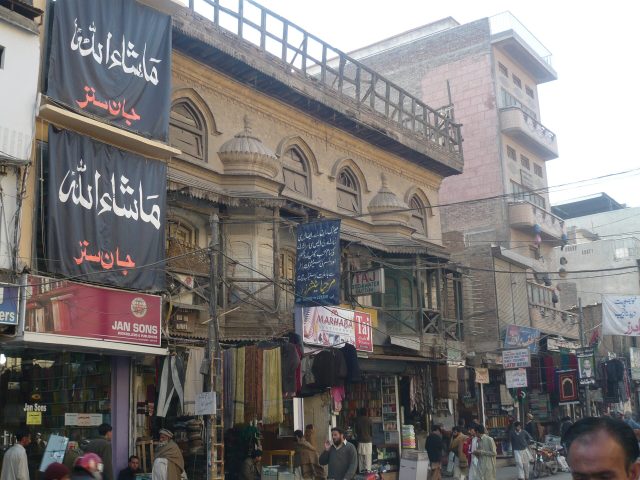
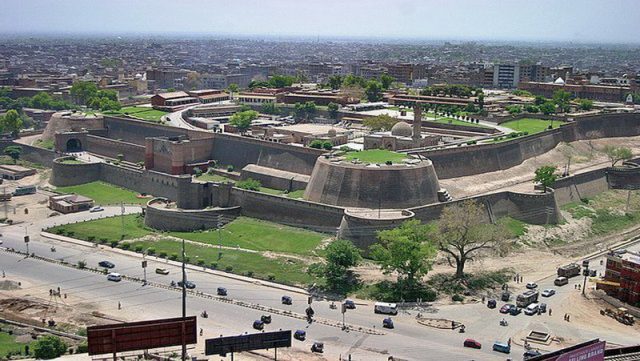
The area around the mosque is a world unto itself, best explored at a leisurely pace. Nearby lies Qissa Khwani Bazaar, one of Peshawar’s oldest markets, where vendors sell everything from spices and dried fruits to antique coins and handwoven carpets. Narrow streets, lined with two-story houses featuring intricately carved balconies, lead to other historic sites, like Bala Hisar Fort, once the residence of Afghan rulers, and the labyrinthine alleys of the old city. Together, they create an atmosphere where Mahabat Khan Mosque feels less like a relic and more like a living part of Peshawar’s pulse.
For visitors, the mosque often serves as an introduction to the region’s Pashtun culture and Mughal heritage. Unlike the crowded tourist spots of Lahore or Islamabad, this place offers a quieter experience. You can arrive in the early morning, when sunlight first touches the domes, or in the late afternoon, when shadows stretch long and the air is filled with the scent of freshly baked bread and cardamom tea. In those moments, it’s easy to imagine how the scene might have looked three hundred years ago—the same domes, the same pigeons circling the courtyard, the same sounds of the city beyond the walls.
Mahabat Khan Mosque is more than an architectural landmark; it is where history and the present intersect. It reminds us that Peshawar is not just a gateway to Afghanistan or a stop on ancient trade routes, but a city with its own identity. Amid the bustle of the bazaar and the energy of the streets, the mosque remains a place of calm, where people come not only to pray but to find a moment of peace. Perhaps that is its greatest value—not in the grandeur of its stones, but in the quiet it offers to anyone who steps through its gates.