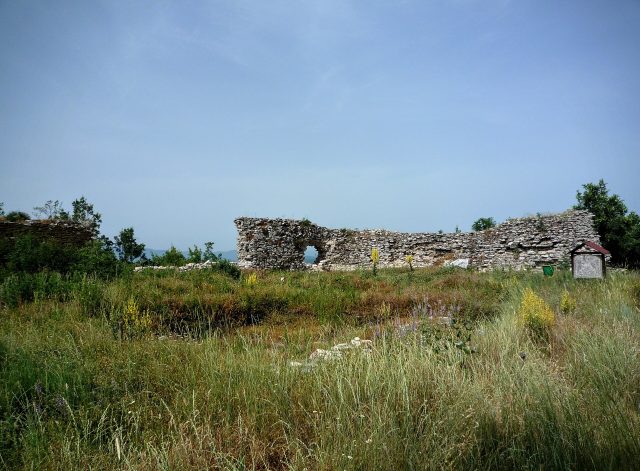
The mosque in Ivaylovgrad is one of those rare places that seem frozen in time, a quiet witness to the layers of history that have shaped this corner of Bulgaria. Built in the seventeenth century, when these lands were part of the Ottoman Empire, it stands as a remnant of an era when different cultures, religions, and ways of life intersected here. Though its walls now bear the marks of centuries, the structure retains a certain presence, as if inviting visitors to pause and consider the countless lives that once passed through its doors.
The architecture is unmistakably Ottoman, with its rectangular form and thick stone walls that were once crowned by a dome—long since lost to time. The entrance is framed by a portico with arches supported by columns, a design seen in many mosques of the period. Inside, fragments of the mihrab, the niche indicating the direction of Mecca, still remain, along with traces of the wall paintings that once adorned the interior. Decades of neglect have taken their toll, yet even in its current state, the mosque offers a glimpse of its former significance, a place where prayers were recited and communities gathered.
Ivaylovgrad itself lies in southern Bulgaria, not far from the Greek border, in a region where history has always been a tapestry of influences. During the Ottoman period, the town was home to Muslims and Christians, merchants and artisans, and the mosque was more than just a religious site—it was a focal point of daily life. After Bulgaria gained independence in the late nineteenth century, many mosques across the country were abandoned or repurposed, but this one endured, though not without changes. Its survival is something of an anomaly, a quiet defiance of the passage of time.
Today, the mosque stands apart from the usual tourist trails, which only adds to its appeal. The area around it is peaceful, the silence broken only by the occasional call of birds or the rustling of leaves in the wind. Locals regard it with a kind of quiet respect, though few venture inside; for them, it’s simply part of the landscape, a fixture that has always been there. For travelers, however, it offers a different kind of history—one that isn’t confined to museums or guidebooks, but exists as a living part of the town, where the past isn’t erased but lingers in the present.
It’s curious that the mosque was never completely destroyed, unlike so many others in Bulgaria. Perhaps its survival is due to Ivaylovgrad’s relative obscurity; unlike larger cities, it didn’t experience the same dramatic shifts in population or purpose. Or maybe it was simply luck—the sturdy stone walls proving more resilient than expected, weathering not just the elements but the social upheavals that followed the end of Ottoman rule. Whatever the reason, the mosque remains one of the few tangible reminders of a time when Islamic architecture was woven into the fabric of this region.
In recent years, there has been talk of restoring the mosque, though for now, these remain just discussions. Historians and local authorities debate the best approach: whether to return it to its original state or preserve it as it is, with all the marks of time intact. For some, it’s a question of honoring history; for others, it’s about potential tourism. But for the moment, the mosque continues to stand as it has for centuries, offering visitors the chance to see it not as a polished monument, but as a place shaped by time and circumstance.
Visiting the mosque doesn’t require any special preparation—just the willingness to step inside and look around. There are no crowds, no guides explaining the significance of every stone, no sense of being rushed along. It’s a place where you can simply stand, touch the cool surface of the old walls, and imagine what it must have been like when the building was whole. There’s no need for explanations here; the silence and the weight of history speak for themselves.
The mosque isn’t one of Bulgaria’s most famous landmarks, and that’s part of its charm. There’s no tourist infrastructure, no souvenir stalls, no selfie sticks. Just the quiet, the history, and the feeling of having stumbled upon a place that hasn’t yet been claimed by mass tourism. For those who seek out destinations with character—places that feel authentic rather than curated—it’s a small but meaningful discovery. It doesn’t demand attention; it simply exists, a quiet testament to the passage of time.