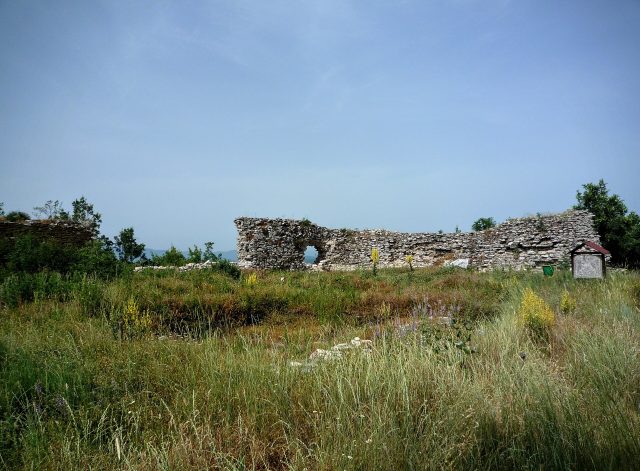
The Church of Saints Constantine and Helena in Ivaylovgrad is one of those quiet places where the past lingers in the air, untouched by the rush of modern life. Perched on a gentle hill in southern Bulgaria, not far from the Greek border, it overlooks a landscape of rolling vineyards and oak groves, where time moves at its own unhurried pace. The surrounding countryside feels suspended in another era—fields stretch into the distance, old stone houses stand weathered by decades, and the only sounds are the occasional church bell and the murmur of the wind through the trees.
Built in the mid-19th century, when this region was still under Ottoman rule, the church was more than just a place of worship. For the local Christian community, it was a symbol of resilience, a quiet assertion of faith in a time when such expressions were often restricted. The architecture is unassuming yet deliberate—thick stone walls, a low-slung roof of aged terracotta tiles, and a modest bell tower that blends seamlessly into the landscape. There’s nothing grand about its exterior, but that’s part of its charm. It was built to serve, not to impress, and the years have only deepened its sense of authenticity.
Step inside, and the simplicity continues. The iconostasis, carved by local craftsmen, is adorned with delicate woodwork, its patterns worn smooth by generations of hands. The icons themselves follow the traditions of Bulgarian religious art—faces of saints rendered with a warmth that feels almost familial, their expressions serene yet deeply human. Above the entrance, a fresco of Constantine and Helena watches over the congregation, their figures painted in the same understated style. These images weren’t just religious symbols; they were protectors, woven into the fabric of daily life, invoked in times of hardship and celebration alike.
For the people of Ivaylovgrad, this church has always been a constant. It witnessed baptisms, weddings, and funerals, standing firm through the upheavals of history. The region changed hands repeatedly—from Ottoman rule to Bulgarian, then briefly Greek, and back again—but the church remained a steady presence. Even when services were restricted, the community gathered here in secret, preserving their traditions and their sense of identity. Today, it still functions as an active place of worship, though the crowds of tourists that flock to Bulgaria’s more famous sites never make it this far. Those who do visit come seeking something different: not spectacle, but stillness.
The town of Ivaylovgrad itself is a place where history feels tangible. Once a crossroads of trade routes, it was home to Bulgarians, Greeks, and Turks, their cultures intertwined over centuries. The remnants of that past are still visible—crumbling Ottoman baths, old stone bridges, and public fountains that once served as gathering places. The architecture tells its own story: narrow streets lined with houses that bear the marks of different eras, their facades a patchwork of influences. Even the local dialect carries traces of this diversity, a quiet echo of the people who once lived here.
A visit to the Church of Saints Constantine and Helena is less about ticking off a landmark and more about stepping into a slower rhythm. There are no guided tours here, no souvenir stalls, no crowds jostling for the best photo. Instead, there’s the scent of incense lingering in the air, the soft rustle of leaves outside, and the sense that the walls themselves hold memories. It’s the kind of place where you might sit for a while on one of the wooden benches, watching the light filter through the narrow windows, and feel the weight of centuries pressing gently against your shoulders.
This corner of Bulgaria is often overlooked, and perhaps that’s for the best. The lack of tourist infrastructure means the experience remains unfiltered—raw, real, and deeply personal. The church isn’t just a relic; it’s a living part of the community, still used for services, still a place where locals come to mark the milestones of their lives. If you find yourself in Ivaylovgrad, it’s worth taking the time to wander its quiet streets, to pause in the churchyard, and to listen. History here isn’t something confined to textbooks; it’s in the stones, in the faces of the people, in the way the light falls across the old frescoes. And sometimes, that’s enough.