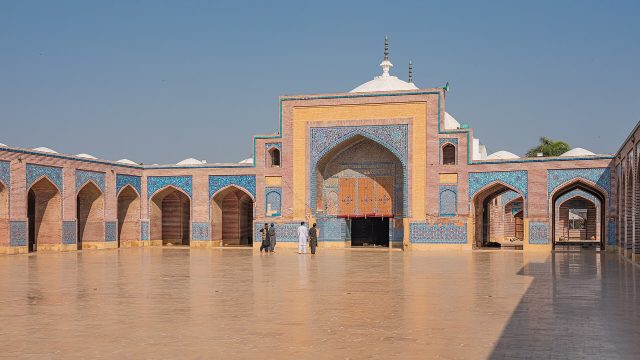
The tomb of Diwan Sharandi in Thatta is a place where time feels still. Built in the 17th century, it stands on the edge of the old town, where narrow lanes and low-slung houses open into space, sparse trees, and dry grass. There are no crowds here—just silence, broken by bird calls and the occasional voices of locals passing by.
The architecture of the tomb is brick and stone. The structure follows the Sindhi style of its time, with Mughal influences. The dome rises above the main building, its proportions matching the landscape. The facades carry geometric patterns and floral motifs carved into the brickwork. Inside, the walls once held frescoes, now worn to faint traces in the dim light.
Diwan Sharandi, the poet and statesman buried here, held influence at the Mughal court. In Sindh, he is remembered for his poetry on love, nature, and life, and for his political work that linked Sindh to the imperial center. The tomb marks where art and power once met.
Thatta was once the capital of Sindh. Its rulers controlled trade routes between India, Persia, and Central Asia. The city was known for its weavers, whose textiles were valued far beyond the region. Today, Thatta is a quiet town where the past lingers in old quarters and small workshops.
The tomb is where history appears in small things.
The heavy wooden door creaks as it opens. The inner courtyard, lit through lattice screens, offers cool shade even in heat. Inside, the air smells of old stone and dry earth. There are no plaques or guides—just silence and the chance to piece together the story yourself.
For those exploring Sindh’s history, the tomb is a starting point. Nearby stand other monuments from the same era, like the tomb of Jam Nizamuddin or Thatta’s ancient mosques. But it’s also enough to sit on the steps, watching sunlight move across the walls.
You realize why places like this matter. History isn’t just something you read—it’s in the stone, the wood, the air.
The tomb of Diwan Sharandi isn’t as famous as other landmarks in Pakistan. There’s no rush here, no need to follow the crowd. It’s a place for those who seek history that isn’t put on display but simply exists, woven into the landscape.
Locals visit the tomb during religious festivals or anniversaries. An elderly man might sit by the entrance, reciting the Quran. Children play in the courtyard. For them, the tomb isn’t a museum—it’s a place where past and present meet.
If you come to Thatta, don’t hurry past. Step inside. Listen to the quiet. Maybe here, more than anywhere, you’ll feel what travel is about—not checking off sights, but finding a place where history becomes real, and the past feels like part of your own experience.