Lido Beach in Sarandë is one of those quiet corners of the Albanian coast where the sea meets the mountains so gently it feels as if nature itself arranged every pebble with care. The beach isn’t large, and that’s part of its charm—there are no crowds, no blaring music, none of the hustle that defines more famous resorts. A narrow strip of smooth stones and fine sand stretches along a sheltered bay, where the water stays calm even when winds pick up elsewhere. Behind it, low hills rise, covered in the kind of Mediterranean greenery that thrives in the salty air. The water here is clear, with a faint turquoise tint, and even in the height of summer, the heat is softened by a steady breeze rolling in from the sea.
Sarandë itself is a place that feels different from the rest of Albania. Tucked into the country’s southern edge, just a stone’s throw from the Greek border, it carries a distinct blend of influences. You’ll hear both Albanian and Greek spoken in the streets, and the local rhythm of life reflects that duality. Unlike the busier port city of Durrës or the more tourist-driven Vlorë, Sarandë has kept its small-town pace. Lido Beach fits right into that unhurried atmosphere. It’s not the kind of place that tries to impress with flashy amenities or trendy beach clubs. Instead, it offers something simpler: a sense of stillness, a break from the noise.
The beach is framed by low cliffs that curve around it like a natural amphitheater, shielding it from strong winds. Along the shore, a handful of cafés and small restaurants serve coffee, grilled fish, and the kind of simple meals that taste better when eaten with your feet still in the sand. There’s no pretension here—just wooden tables under makeshift awnings, woven chairs, and the occasional scent of charred mussels and lemons drifting from the kitchen. As evening falls, strings of lights flicker to life, their reflections dancing on the water. Sometimes, someone plays a guitar, or a radio hums softly in the background, but the real soundtrack is the steady rhythm of the waves.
Lido Beach hasn’t always been the way it is today. Just a few decades ago, Albania was one of the most isolated countries in Europe, and even its own citizens couldn’t freely visit the coast. Beaches like this existed, but they were mostly used by local fishermen or the rare traveler who managed to get permission to come here. Everything changed in the early 1990s, after the fall of communism. Borders opened, and slowly, tourists began to trickle in. But for a long time, Sarandë and its surroundings remained overlooked, overshadowed by more popular destinations. Only in recent years have people started seeking it out—not for its nightlife or luxury, but for the quiet it offers.
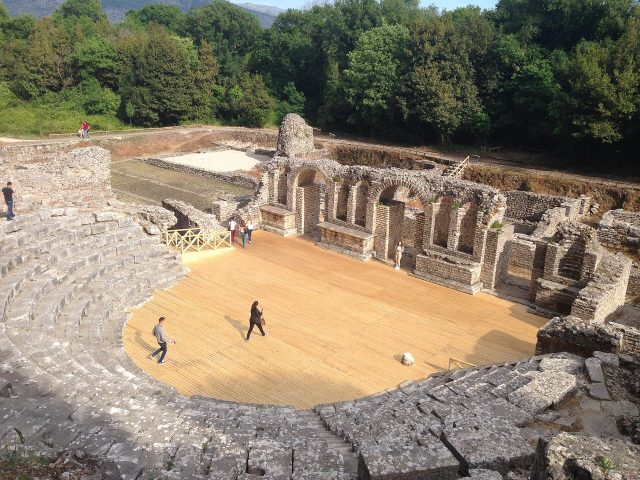
The area around the beach carries traces of a much older past. Not far from Lido, the ruins of Butrint, an ancient city that was once a major regional hub, stand as a reminder of how long this stretch of coast has been inhabited. Sarandë itself dates back to the 4th century BC, when it was founded by the Greeks as Onchesmos. Over the centuries, it passed through the hands of Byzantines, Venetians, and Ottomans, each leaving their mark. While Lido Beach itself doesn’t have any grand historical monuments, the land around it feels layered with stories—of trade, conquest, and the slow, steady pulse of life by the sea.
The water at Lido is perfect for those who prefer to wade rather than dive. You can walk in up to your waist and stand there for ages, watching tiny fish dart between the stones beneath your feet. The seabed is rocky but smooth, and the waves rarely get rough—the bay’s shape protects it from storms. On clear days, the Greek island of Corfu is visible just a few kilometers offshore, its outline shimmering on the horizon. Ferries occasionally pass between the two countries, adding a sense of connection to the view. It’s a reminder that this stretch of sea has always been a bridge, not a barrier.
Evenings at Lido Beach have a magic of their own. As the sun sinks behind the hills, the sky turns shades of pink and gold, and the water becomes a mirror. Locals and visitors gather on the shore, some sitting on the stones, others lingering at the cafés with a glass of wine. There are no loud parties here, no thumping music—just the murmur of conversation, the sound of waves lapping at the shore, and the occasional cry of a seagull. For those used to the energy of bigger resorts, it might feel too quiet at first. But that’s the point. This is a place where time slows down, where the simplest things—a sunset, the taste of salt on your lips, the cool water against your skin—become enough.
Lido Beach isn’t the kind of place you visit for entertainment or guided tours. There are no water parks, no jet skis, no high-end beach clubs. What it offers instead is something harder to find these days: a sense of authenticity. The beach isn’t manicured or polished, and that’s part of its appeal. The cafés aren’t fancy, the chairs aren’t cushioned, and the sand isn’t perfectly raked. But none of that matters when you’re lying on the stones, listening to the sea, and watching the light play on the water. It’s the kind of place that doesn’t demand anything from you—just your presence.
Perhaps that’s why people keep coming back. Not for the sights or the activities, but for the way it makes them feel. There’s a quiet contentment here, a sense of being exactly where you’re meant to be. In a world that often feels too loud and too fast, Lido Beach offers a rare kind of stillness. It’s not a place you’ll see on postcards or in travel brochures, but for those who find it, it becomes a kind of secret—a small, unassuming stretch of coast where the sea, the mountains, and the sky come together in perfect, effortless harmony.