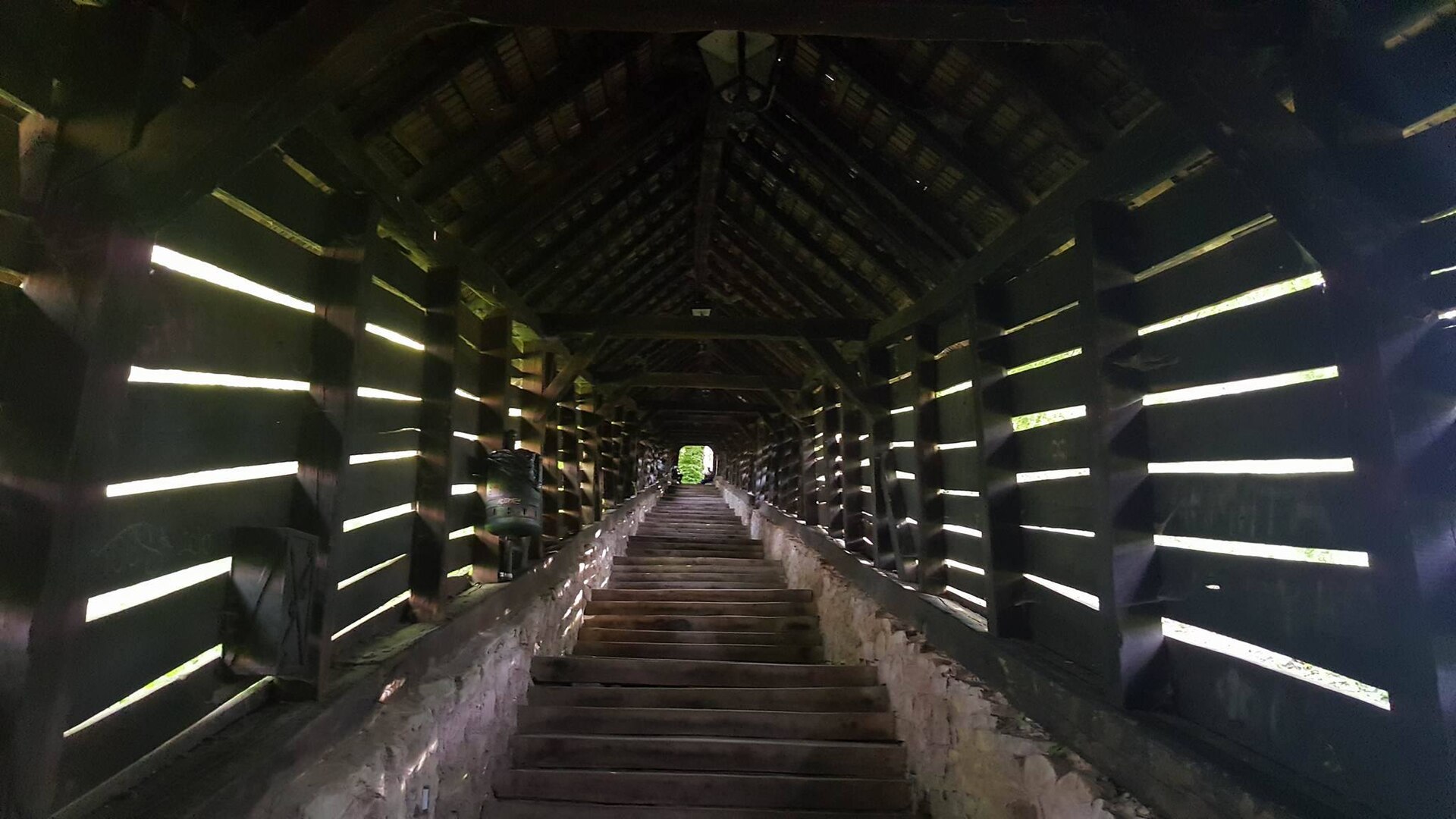
The Scholar’s Staircase in Sighișoara isn’t just a set of steps climbing a hillside—it’s one of those quiet corners of the city where history feels tangible beneath your feet. Built in the 17th century, it served a practical purpose: connecting the lower town to the church on Berg Hill, where the school for Saxon settlers’ children once stood. Winters here were harsh, with snow lingering for weeks, so the covered wooden staircase shielded students from the elements as they made their way to lessons. Today, it looks much as it did four hundred years ago—narrow, with worn wooden planks that creak underfoot, as if whispering stories of every step taken over the centuries.
The staircase is part of Sighișoara’s old town, a UNESCO World Heritage site founded by Transylvanian Saxons in the 12th century. The city still retains its medieval layout, with winding cobblestone streets, tiled roofs, and fortress walls encircling the historic center. The Scholar’s Staircase fits seamlessly into this landscape, as if it has always been here. It begins at the foot of the hill, near a small square where, in summer, vendors sell local honey and handmade crafts, and in winter, the scent of roasted chestnuts fills the air. From here, you can see the red-tiled roofs cascading down toward the Târnava Mare River and the rolling green hills beyond.
As you climb, the details of the staircase’s age become impossible to ignore. The wooden railings are smoothed by countless hands, and some steps have worn into gentle dips over time. The roof, supported by slender posts, creates a sense of shelter, as if time moves slower here. About halfway up, a small landing offers a place to pause and look around. Below, the city hums with everyday life—people hurrying about their business, others sipping coffee on benches, tourists snapping photos of the old facades. It’s moments like these that remind you Sighișoara isn’t a living museum; it’s a place where past and present coexist naturally.
At the top of the staircase stands the Church on the Hill, another of the city’s treasures. Built in the 14th century, it blends Gothic and Romanesque styles, its interior adorned with 15th-century frescoes and an intricately carved altar. Inside, it’s cool and quiet, even on the warmest days, with light filtering through narrow stained-glass windows, casting a soft glow. Beside the church lies a small cemetery, where generations of Saxon families rest, including those whose children once climbed these steps to school. The gravestones are modest, many covered in moss, each one holding its own silent story.
The Scholar’s Staircase is more than just an architectural landmark—it’s a symbol of the connection between generations. In the 17th century, it was an essential part of daily life; today, it’s one of the reasons visitors come to Sighișoara. Yet it hasn’t become a tourist spectacle. There are no crowds, no loud announcements, just people ascending the steps, pausing to catch their breath or take a photo before continuing—some to the church, others to the viewpoint overlooking the city. Its charm lies in its unassuming presence; it doesn’t demand attention but remains a vital part of the urban landscape.
Sighișoara is known for its atmosphere, where legends and reality intertwine. It’s the birthplace of Vlad the Impaler, the historical figure behind the Dracula myth, and the city often finds itself tied to vampire lore. But the Scholar’s Staircase tells a different story—one of everyday life in medieval Transylvania, of work, education, and simple joys. There’s no mystique here, just the quiet creak of wooden steps and the weathered wood, evoking a sense of peace, as if time has paused to let you glance backward.
Visiting the staircase isn’t just about history; it’s about the view from the top. From the hill, you can see the city sprawling along the river, with endless fields and forests stretching into the distance. In summer, the scene is especially beautiful—green slopes, blooming gardens, and bright rooftops creating a sense of warmth and tranquility. In winter, Sighișoara transforms into a fairy-tale town, snow blanketing the tiles and wooden balconies, the staircase becoming part of the wintry landscape. No matter the season, it remains a place where you can step away from the rush and feel the weight of the past.
Today, the Scholar’s Staircase is more than just a path to the church; it’s part of a route that helps you understand Sighișoara better. It reminds you that the city’s history wasn’t built on grand events alone but on small, ordinary moments. That might be why it draws people in—there’s nothing ostentatious or forced about it, just a quiet, unassuming beauty that reveals itself one step at a time.