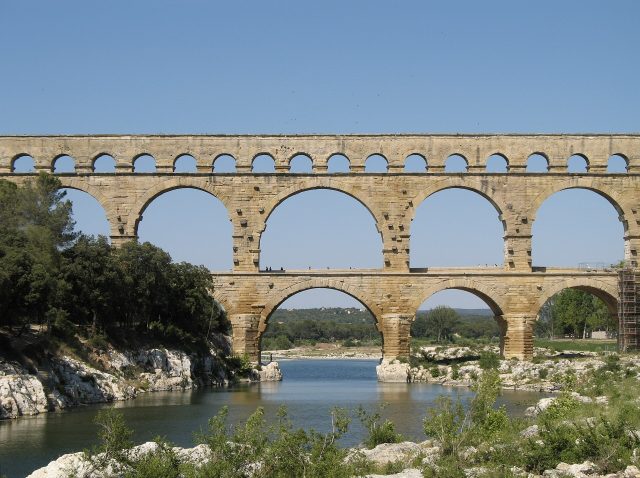
The steps known as Nicolas’ Staircase are more than just a way down to the Pont du Gard—they’re a quiet thread connecting ancient Rome to the everyday rhythms of modern France. Winding through the small town of Vers-Pont-du-Gard, they lead toward the Gardon River, where the aqueduct still stands after nearly two thousand years, its pale limestone arches cutting across the valley. The staircase itself is much younger than the bridge, yet it feels like it’s always been here, offering a way to get closer to one of the most remarkable feats of Roman engineering.
The Pont du Gard is impossible to ignore. Built as part of an aqueduct that once carried water to Nîmes, its three tiers of arches stretch nearly 300 meters across the river, their weathered stone defying time. The Romans built to last, and this structure is proof. Nicolas’ Staircase, though far more recent, fits seamlessly into the landscape, bridging past and present. From the bottom, you can look up at the arches from the water’s edge, or climb to the top for a sense of just how massive the construction really is.
The staircase takes its name from Nicolas Ledoux, an 18th-century architect who oversaw improvements around the Pont du Gard. By then, the aqueduct had long since stopped serving its original purpose, but fascination with it never faded. Ledoux designed the steps not just for access, but to complement the natural surroundings and the ancient structure itself. The stonework is precise, the turns gradual, as if the path had been shaped by time rather than human hands.
Today, the staircase is used by locals as much as by visitors. For some, it’s a route to the river for a swim on a hot day; for others, a place to walk the dog or go for a morning run. Pine and oak trees line the way, their scent mixing with the cool river air. In summer, the area hums with activity—families, cyclists, picnickers all finding their own reasons to be here. In winter, it’s quieter, a place to be alone with the landscape and the weight of history.
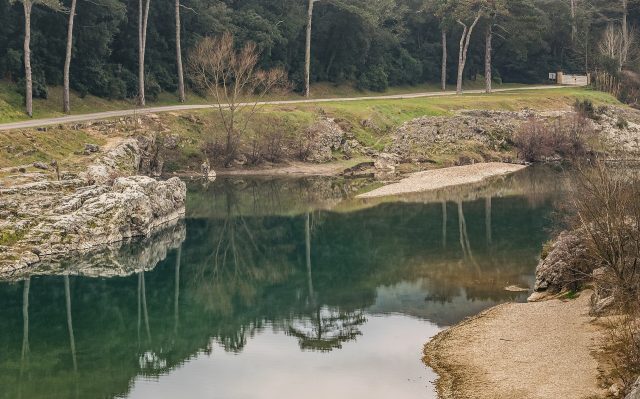
At the bottom, you can walk beneath the arches of the Pont du Gard, feeling the solidity of the ancient stones. The Gardon River runs clear and green, reflecting the bridge’s curves. Occasionally, you’ll spot fishermen casting their lines, hoping for trout or barbel. The water is shallow in places, forming small pools perfect for wading. If you cross to the other side, the view opens up to a valley dotted with vineyards and olive groves, where old stone farmhouses hide among the hills.
Nicolas’ Staircase isn’t a tourist attraction in the usual sense. There are no crowds, no tickets, no grand narratives—just a path that blends into the landscape. It’s a place for those who prefer things unhurried and unpolished. You could visit for a day from Nîmes or Avignon, or stay longer in one of the nearby guesthouses, exploring the surrounding countryside at a leisurely pace.
Vers-Pont-du-Gard isn’t just about the bridge and the staircase. The area is known for its vineyards, where Côtes du Rhône wines are produced, and for its small villages with stone houses draped in wisteria. Local restaurants serve Provençal dishes—ratatouille, tapenade, goat cheese, and, of course, wine. In summer, festivals and markets bring the region to life, offering a taste of its flavors and traditions.
What makes Nicolas’ Staircase special is the way it reminds you that history isn’t always behind glass. Sometimes, it’s just there, waiting for you to walk past and notice. There are no plaques with long explanations, but the stones themselves seem to hold stories—of the people who built the bridge, of those who walked these steps before you. You can sit by the river, listening to the water over the rocks, or climb to the top and look out over the valley, imagining the aqueduct in its prime, carrying water to a city far away. Either way, the place lingers in a way that feels less like visiting a monument and more like stepping into a living past.