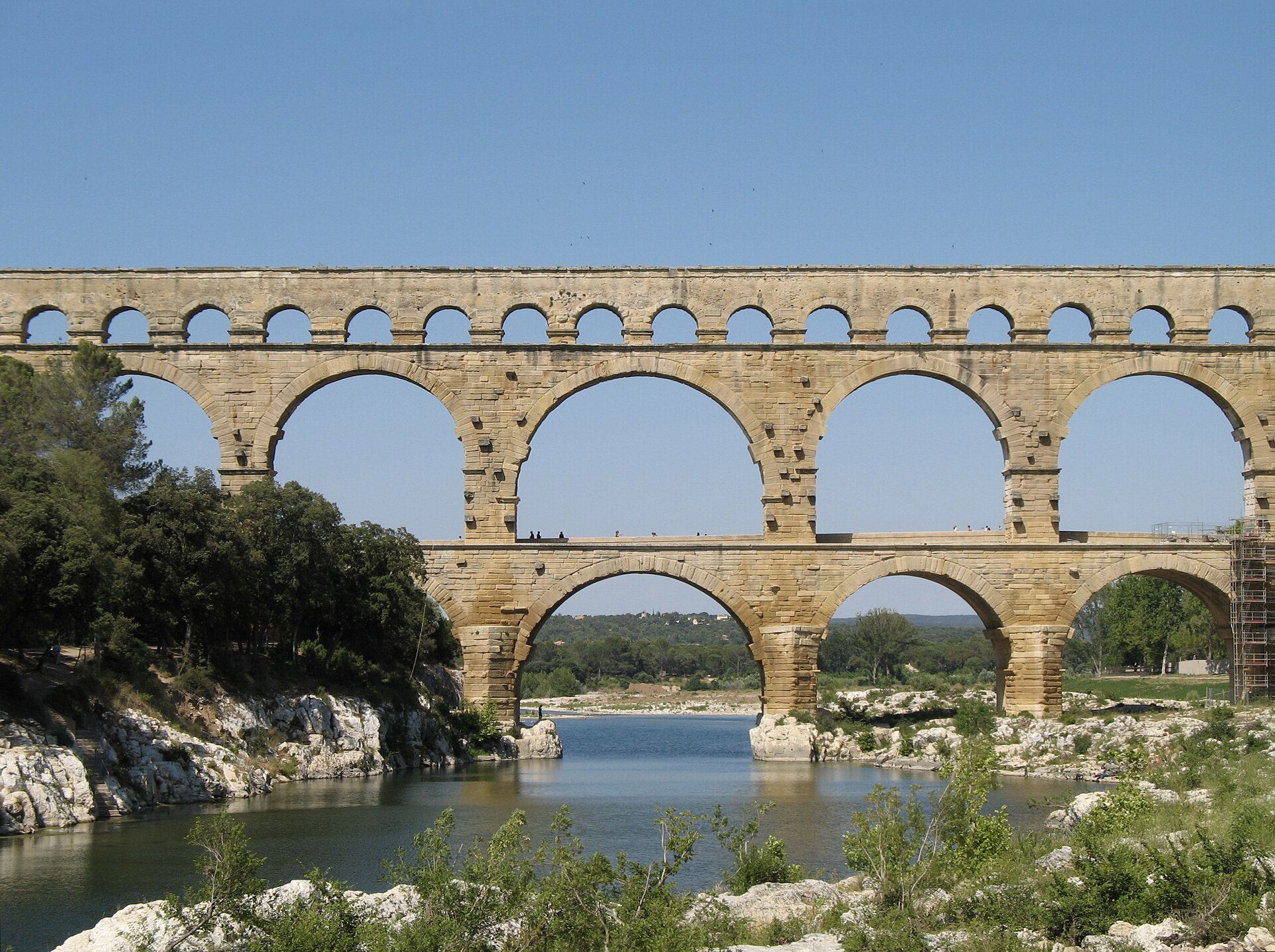
The Pont du Gard is one of those rare ancient structures that hasn’t just survived the centuries—it still feels alive, as if time moves differently here. Rising over the Gardon River valley, this Roman aqueduct, built in the first century, stands with the same quiet authority it must have had two thousand years ago. Its massive limestone arches, stacked without mortar, carry an unexpected lightness, as if the stone might lift off the water at any moment. Yet it has remained firmly rooted, a testament to both engineering brilliance and the enduring power of human craftsmanship.
The Romans didn’t build the Pont du Gard for beauty, but for function. It was part of a fifty-kilometer water system that carried fresh spring water from Uzès to Nemausus, now the city of Nîmes. The aqueduct’s slope was calculated with astonishing precision—a mere thirteen meters of elevation change over its entire length—so that water could flow by gravity alone. The fact that this was achieved without modern tools still seems almost impossible. The stones fit together so tightly that the structure has withstood not only time but earthquakes, floods, and even medieval attempts to dismantle it for building materials.
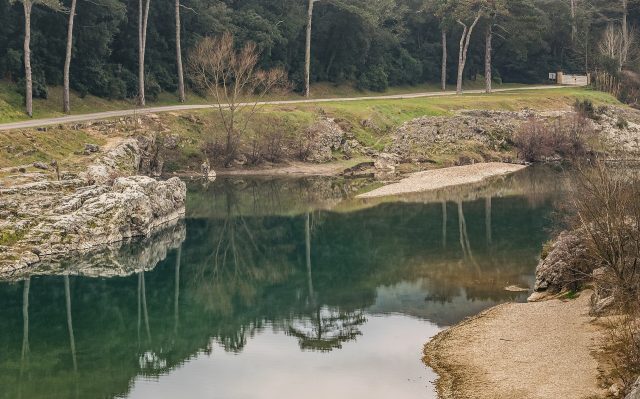
Today, the Pont du Gard is more than a monument; it’s a place where history and nature intersect. The Gardon River valley here is especially striking, with rocky banks covered in Mediterranean scrub, quiet pools where ducks drift, and the constant murmur of water over stones. In summer, people come to swim, though it’s not always officially permitted—the river can be unpredictable, especially after rain. Still, visitors find secluded spots to wade into the cool water at the bridge’s base, as if trying to touch the ancient life that once flowed overhead.
Trails wind around the Pont du Gard, offering hours of exploration. One path crosses to the opposite bank, where the best views unfold, particularly at sunset when the stone glows golden and the arches cast long shadows over the water. Another trail descends to the river, revealing remnants of ancient supports and giving a sense of the structure’s original scale. Locals say beavers once lived here, and though they’re rarely seen now, on quiet evenings, you might still hear something splashing in the shallows.
Unlike many historic sites, the Pont du Gard hasn’t become a museum in the traditional sense. There are no crowds following audio guides or guides reciting the same script all day. Instead, there’s a hush broken only by the hum of cicadas and the rush of the river. That said, it’s not entirely deserted—families picnic here in summer, cyclists pass through, and people come simply to sit by the water with a book or to take photographs that will later remind them of how easily time seems to slip away in this place.
It’s hard to imagine now, but the Pont du Gard wasn’t always so well-preserved. In the nineteenth century, there were plans to demolish it to make way for a road. Fortunately, that never happened, and in the twentieth century, it was recognized as an architectural monument and later designated a UNESCO World Heritage site. Restoration efforts here are careful, not aiming to return the bridge to some imagined perfection but to preserve what remains. The stones still bear the marks of time—cracks, moss, weathered surfaces—that make the structure feel even more alive.
The Pont du Gard is at its most atmospheric in early spring or late autumn, when the crowds thin and the landscape is either just waking up or settling into quiet. On those days, it can feel almost abandoned, though in reality, it’s simply waiting. You can climb to the upper tier, where water once flowed, and try to picture Roman engineers checking the slope, or walk beneath the arches, feeling their immense scale. If you listen closely, it’s easy to imagine the echoes of those who built this bridge, who relied on its water, or who passed by without realizing their work would outlast them by millennia.
But the Pont du Gard isn’t just about the past. It’s very much part of the present, too. Festivals, open-air concerts, and even weddings take place here. In summer, films are screened by the river, and in winter, Christmas markets bring warmth to the cool air. Locals treat the bridge like something familiar, almost alive, knowing all its secrets—the best photo spots, the shadiest places to escape the heat, the best bakeries in the nearby villages. Though it’s long been a symbol of Provence, it hasn’t become a tourist trap. It remains a place where you can simply be—standing by the water, watching the light change, and thinking about all that has happened here over two thousand years.