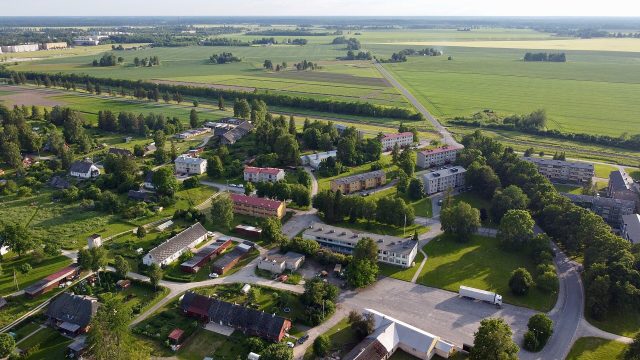
Laiuse Castle stands quietly on a low hill near Jõgeva, its ruins woven into the Estonian landscape like a half-remembered dream. There are no grand towers or polished stones here, just fragments of walls softened by moss and ivy, their edges blurred by time. The place doesn’t demand attention—it simply exists, offering silence instead of spectacle. On most days, the only sounds are the wind through the grass and the occasional voices of locals walking their dogs or pausing to let children explore the crumbling foundations. It’s the kind of site that rewards those who seek it out, not with fanfare, but with the quiet weight of history.
The first records of Laiuse date back to the early 13th century, when this corner of Estonia became a battleground between the Sword Brethren and the local tribes. The castle was built as a stronghold, a place to control trade routes and secure the order’s expanding territory. By the 14th century, it had passed into the hands of the Livonian Order, which reinforced its walls and turned it into one of the key fortresses in eastern Estonia. More than just a military post, Laiuse became a small center of power, home to a komtur’s residence and a settlement where craftsmen, merchants, and farmers lived under the order’s rule.
The architecture of the castle followed the standard design of medieval Teutonic strongholds. At its heart stood a massive stone keep, the last refuge during sieges, surrounded by defensive walls punctuated with arrow slits. Over time, additional towers and moats were added, but the castle’s life was cut short. During the Livonian War in the 16th century, Russian forces destroyed it, and when the region later fell under Swedish control, Laiuse lost its strategic importance. The stones were gradually carried away for other buildings, leaving only the foundations and lower walls to mark its former presence.
What remains today is modest but evocative. The ruins, though sparse, still hint at the castle’s original layout—a square keep, the outlines of inner buildings, the faint traces of a moat. The best time to visit is in spring or autumn, when the hill is carpeted in golden leaves or shrouded in morning mist, lending the place an almost mystical air. Locals sometimes call it the "ghost castle," though there are no actual legends of spirits—just the kind of stillness that makes the past feel closer. The absence of crowds or modern distractions only deepens the sense of stepping into another era.
Despite its state of decay, Laiuse is a protected historical site. Soviet-era archaeological excavations uncovered details about the castle’s structure and the daily lives of its inhabitants, but no large-scale restorations have taken place. Perhaps that’s for the best. Without reconstructed walls or museum displays, the ruins retain a raw authenticity, allowing visitors to imagine the past without the filter of interpretation. There are no signs explaining every stone, no audio guides narrating its history—just the quiet invitation to piece it together yourself.
For those visiting Jõgeva, Laiuse offers a reason to venture beyond the town. The journey there is part of the experience, whether on foot or by bicycle along country roads that wind through fields and small forests. There are no cafes or souvenir shops nearby, just open space and the feeling that time moves differently here. In summer, wildflowers bloom around the ruins; in winter, snow blankets the stones, turning them into a seamless part of the landscape. It’s not a place for those seeking entertainment, but for those who want to feel the past in its most unvarnished form.
Laiuse reminds us that history isn’t always found in grand monuments. This small, overlooked site holds the echoes of centuries—of battles fought and lives lived, of the slow rise and fall of orders and empires. It was never the stage for dramatic events, which is precisely why it feels so true to the everyday reality of medieval Estonia: a place of hardship and resilience, where the ordinary and the extraordinary were often one and the same. Today, the ruins are more than just stones. They are a bridge to a time that shaped the land, a silent witness to the people who once called this place home.