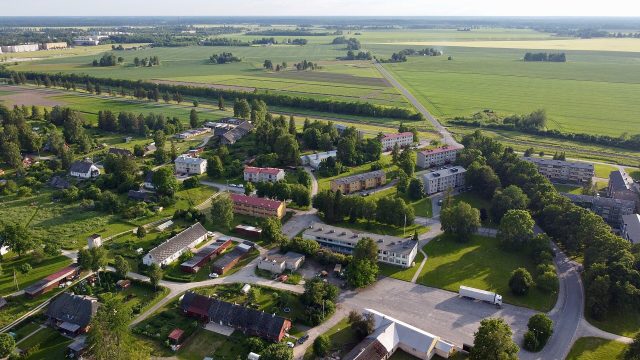
Jõgeva is a quiet town in eastern Estonia, known more for its agricultural roots and harsh winters than for grand landmarks. Yet tucked between low-rise apartment blocks and Soviet-era administrative buildings stands the Church of St. Peter, a modest but enduring symbol of the region’s layered history. Built in the late 19th century, it was one of the few structures in Jõgeva to survive the upheavals of the 20th century relatively unscathed, serving as a rare constant in a place that has seen borders shift, regimes change, and populations disperse.
The church’s architecture is unassuming, reflecting the practical spirit of its time. Constructed in a neo-Gothic style, it features a single tall spire that rises above the surrounding rooftops, its red-brick facade softened by time and weather. The pointed arches and narrow windows are typical of the period, though here they lack the ornate detailing found in larger urban churches. Inside, the space is intimate, with whitewashed walls and simple wooden pews arranged around a central aisle. The altar, though not elaborate, holds a quiet dignity, its restrained design in keeping with the Lutheran traditions that have shaped Estonia’s religious landscape.
St. Peter’s was completed in 1895, a time when Jõgeva was still a small rural settlement under the Russian Empire. The church was built to serve the growing Estonian community, which had begun to assert its cultural identity even as it remained under foreign rule. For decades, it was a gathering place not just for worship but for community life—baptisms, weddings, and funerals marked the rhythms of local existence. During the Soviet era, when religious institutions were suppressed, the church remained open, though its role was diminished. Some of its original furnishings were lost or altered, but the building itself endured, a silent witness to the resilience of faith in a secular state.
The church’s interior is notable for its stained-glass windows, which depict biblical scenes in muted tones. Unlike the vibrant, dramatic windows found in cathedrals, these are understated, their colors blending into the soft light that filters through on clear days. The effect is contemplative rather than awe-inspiring, inviting reflection rather than spectacle. The organ, though not original, is still used for occasional services and concerts, its sound filling the space with a warmth that contrasts with the cool exterior.
Outside, the churchyard is small but well-tended, with a few old gravestones leaning slightly under the weight of years. The plots are modest, many belonging to families who have lived in Jõgeva for generations. In summer, the grass is neatly trimmed, and the surrounding trees provide a sense of seclusion from the town’s more modern surroundings. It’s a place where the past feels tangible, where the names on the stones connect the present to a time when Jõgeva was little more than a cluster of farms and a railway stop.
Today, St. Peter’s is one of the few historical buildings in Jõgeva that hasn’t been repurposed or demolished. While the town has expanded with new housing and infrastructure, the church remains a quiet anchor, its presence a reminder of the continuity that persists beneath the surface of change. Services are still held here, though the congregation is small, reflecting the broader decline in religious observance across Estonia. Yet the building itself retains a sense of purpose, not as a relic but as a living part of the community.
For visitors, the church offers a glimpse into a side of Estonia that isn’t often highlighted in travel guides. It’s not a grand tourist attraction, nor does it claim to be. Instead, it stands as a testament to the everyday history of a place that has seen empires rise and fall, where life has unfolded in small, unrecorded moments. The architecture, the quiet interior, and the surrounding churchyard all speak to a different pace of time—one measured in generations rather than headlines.
If you find yourself in Jõgeva, the church is worth a visit not for its size or splendor, but for what it represents. It’s a place where the past isn’t just remembered; it’s still present, woven into the fabric of a town that has learned to endure. Whether you come for the history, the architecture, or simply a moment of quiet, St. Peter’s offers something rare: a sense of stillness in a world that moves too quickly.