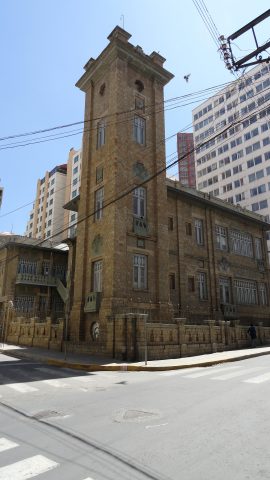
The San Francisco Cultural Center and Museum in La Paz is one of those rare places where history isn’t just preserved behind glass—it lingers in the stone, the faded frescoes, and the quiet courtyards that have witnessed centuries of change. Tucked into the heart of the city, this complex began as part of a Franciscan monastery founded in the 16th century, when Spanish settlers were still carving out a foothold in the high Andes. Today, it houses museum galleries, a library, and exhibition spaces, but what makes it special is the way it carries the weight of the past without feeling like a relic. The building itself tells a story, one of adaptation and endurance in a land far from the European traditions that shaped it.
The architecture is a quiet testament to that story. Thick adobe walls, vaulted ceilings, and heavy wooden beams speak of the Franciscans’ efforts to recreate a piece of their world in the thin air of the Andes. The central courtyard, with its fountain and arched walkways, was once a place of prayer and reflection; now, it offers visitors a moment of respite from the city’s relentless energy. On clear days, the monastery’s rooftop provides a sweeping view of La Paz sprawling across the valley below—a reminder of how the city has grown around this ancient core. The climb up the narrow stairs is worth it, if only to see the contrast between the old and the new, the sacred and the everyday.
Inside, the museum’s collections go beyond religious art to paint a picture of life in La Paz through the ages. Colonial-era paintings, ornate church silverware, and everyday objects from different periods reveal how people adapted to life in this high-altitude city. One of the most striking displays is the collection of religious sculptures, where European influences blend with indigenous craftsmanship. Some of the figures seem almost alive, their expressions so vivid they follow you as you move through the galleries. It’s easy to imagine them in processions centuries ago, carried through the streets of a city that was still finding its identity.
Yet the museum isn’t stuck in the past. In recent years, it has become a space for contemporary Bolivian artists, hosting exhibitions that tackle modern themes—social issues, urban life, the stark beauty of the Andes. Occasionally, the old halls echo with live music or poetry readings, the sound of the present mingling with the silence of history. These events create an unexpected dialogue between eras, a reminder that the monastery has always been more than just a place of worship. It was, and still is, a gathering point for the city’s cultural life.
The library is one of the center’s hidden treasures, home to rare books and manuscripts dating back to the 16th century. Among them are religious texts, historical chronicles, and early maps of La Paz, offering a glimpse into how the city was perceived and documented over time. While access to the collection is limited, the library occasionally puts on exhibitions showcasing its most valuable works. For researchers or anyone curious about the region’s history, these books are a window into a world that no longer exists, yet still shapes the city today.
The Franciscan monastery was more than a religious institution—it was a bridge between cultures. In colonial times, it served as a school for the local population, one of the first in La Paz. That tradition continues in a way, with lectures and seminars on Bolivian history and art held within its walls. For many locals, the cultural center is a familiar place, somewhere to learn, to meet, or simply to spend time surrounded by beauty. It’s a reminder that history isn’t just something to observe; it’s something that lives on in the way people interact with these spaces.
Visiting the San Francisco Cultural Center is also a chance to see La Paz differently. The city is known for its chaos—its steep streets, its bustling markets, its dizzying altitude—but here, it feels still. The monastery’s courtyards are sheltered from the noise, the clamor of the streets muted by thick walls. It’s a place to pause, to catch your breath, and to reflect on how many layers of history are packed into this city. Every stone, every archway, seems to hold a story, waiting to be noticed by those who take the time to look.
If you find yourself in La Paz, the museum is worth a visit, if only to step away from the usual tourist paths. There are no crowds here, no rush—just the quiet rhythm of a place that has seen centuries pass. You might spend an hour wandering the galleries, lingering over details that reveal themselves slowly, or simply sitting in the courtyard, watching the light shift across the old walls. In a city that moves at a relentless pace, the San Francisco Cultural Center offers something rare: a moment of stillness, and a connection to the past that feels strangely alive.