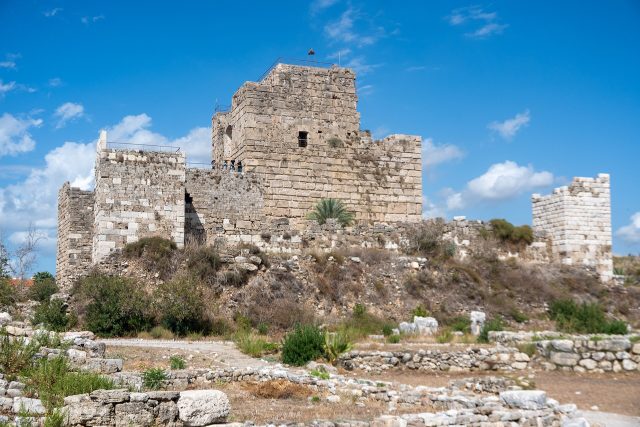
Byblos Castle stands on a rocky promontory overlooking the ancient Phoenician city, still called Jbeil by locals. This is one of those rare places where history isn’t just preserved in stone—it seeps through every crack and corner, layer upon layer. The fortress itself is a medieval creation, built in the 12th century when the Crusaders ruled these lands. They constructed it over the remains of even older structures, so what you see today is a patchwork of eras: Roman columns jutting from the ground, Byzantine foundations, and the sturdy towers of the Crusader stronghold.
The architecture is classic for its time—thick sandstone walls, narrow arrow slits, and heavy gates designed to withstand sieges. Yet there’s nothing grim about it. The fortress was built for more than just defense; it was a place where people lived. Inside, you’ll find remnants of living quarters, water cisterns, and even a small chapel. The spaces are empty now, but it’s easy to imagine the clatter of armor, the murmur of voices, and the daily routines of knights and soldiers who once called this place home.
From the castle walls, the view stretches across the Mediterranean, the same sea that was the lifeblood of the Phoenicians. They founded Byblos in the third millennium BCE, turning it into one of the ancient world’s most important trading hubs. Their ships carried cedar wood, purple dye, and glass across the Mediterranean, reaching as far as North Africa and Spain. The fortress sits at the edge of the old port, where the remains of ancient docks still dip into the water, a quiet testament to the city’s maritime past.
There are no exhibits or explanatory plaques inside the castle. It’s not a museum in the traditional sense but more like an open book where every worn stone and crumbling arch tells its own story. You can wander freely, climb the walls, or explore the underground chambers. Just below the fortress lies a small but well-preserved Roman amphitheater, where concerts and performances still take place occasionally. The acoustics are surprisingly good, and sitting on the ancient steps, it’s not hard to imagine the voices of actors or orators filling the air centuries ago.
Byblos is more than just the castle—it’s a living city with a rhythm all its own. Beyond the fortress walls, the old town unfolds in a maze of narrow streets lined with spice shops, bakeries, and tiny cafés. The scent of fresh bread and cardamom coffee mingles with the salty breeze from the sea. In the evenings, when the heat subsides, locals gather along the waterfront to sip coffee or share a hookah. The castle is lit up after dark, its silhouette shimmering in the water below.
The history of Byblos is woven with myth and legend. It’s said that the Phoenicians invented the alphabet here, the foundation of many modern writing systems. The city is also mentioned in the Bible as the source of cedar wood for King Solomon’s temple. These stories add a layer of intrigue, making the place feel like a crossroads of civilizations where every stone hums with the past.
This isn’t a site you can rush through in an hour. To really understand Byblos, you need to linger—wander the old souks, watch the fishermen mend their nets by the harbor, or sit in a café and listen to the mix of Arabic, French, and English drifting through the air. The city has a way of making time feel fluid, as if the Crusader knights, Roman merchants, and Phoenician sailors are all still here, just out of sight.
The best time to visit is early morning, when the light is soft and the stones are cool, or in the late afternoon, when the shadows stretch long and the air is filled with the sounds of the city waking up or winding down. Either way, Byblos Castle leaves you with the sense that you’ve touched something enduring, something that connects the past to the present in a way few places can.