Shakhrisabz is one of those places that often slips through the cracks of Uzbekistan’s well-trodden tourist routes, overshadowed by the grandeur of Samarkand or the romance of Bukhara. Yet its history is just as layered, its streets just as steeped in the past. Tucked away among low clay houses and quiet, tree-lined lanes, the Hazrati Imam Complex feels like a pause in time—a place where the weight of centuries lingers in the air, unhurried and undisturbed.
The complex is named after Abu Abdallah al-Kaffal ash-Shashi, a 10th-century scholar and poet whose influence stretched far beyond the borders of his homeland. His tomb became the heart of this site, and over the centuries, it grew into a cluster of mosques, madrasas, and mausoleums, each layer adding to its quiet significance. Today, it remains a place of pilgrimage, but also something rarer: a corner of the world where the past isn’t just preserved but still alive, breathing alongside the present.
The architecture here doesn’t compete with the monumental scale of Samarkand’s Registan or Bukhara’s Poi Kalon. Instead, it has a different kind of charm—subtle, understated, but no less striking. The main mausoleum of Hazrati Imam, built in the 16th century, is a study in restraint. Its portal is adorned with the familiar blue and turquoise mosaics of Central Asia, though the colors have softened with time. Inside, the light filters through lattice windows, casting delicate patterns on the walls. It’s easy to imagine scholars debating theology in this dim, cool space or worshippers gathering for prayer, their voices echoing under the vaulted ceiling.
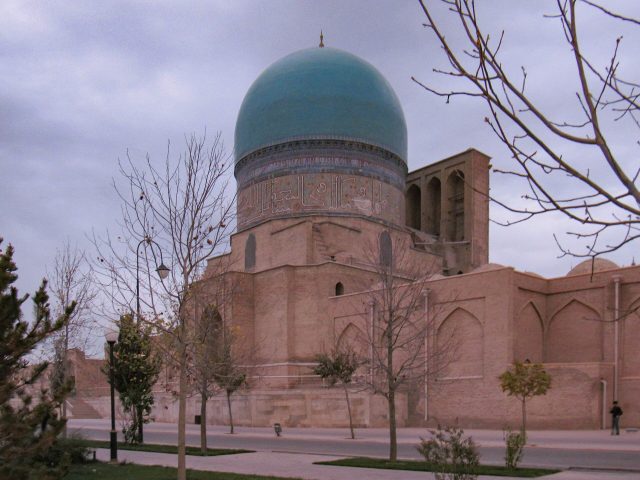
Next to the mausoleum stands the Kok-Gumbaz Mosque, its name meaning "Blue Dome." Commissioned by Ulugh Beg, the grandson of Tamerlane, in the 15th century, it remains one of Shakhrisabz’s most recognizable landmarks. The dome, once a vibrant blue, has faded slightly, but it still stands out against the earthy tones of the surrounding buildings. Inside, fragments of intricate woodwork and faded murals hint at the craftsmanship of the era. The mosque is cool in summer, quiet in winter, and the only sounds that break the stillness are the occasional footsteps of visitors or the murmur of a prayer.
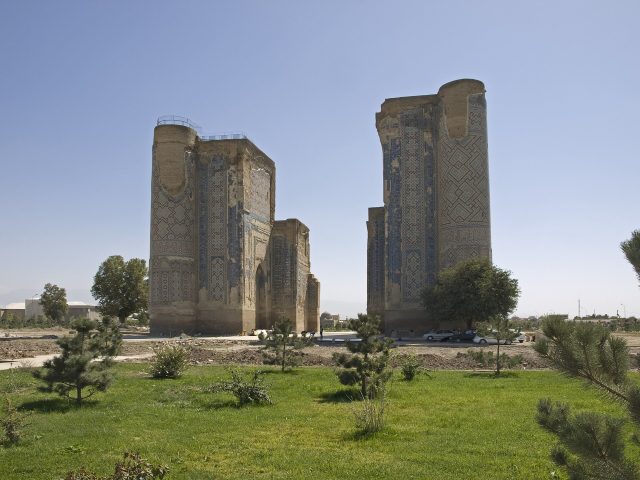
Shakhrisabz is best known as the birthplace of Tamerlane, the conqueror whose empire once stretched across much of Central Asia. While his grand palaces and fortresses have long since crumbled, the Hazrati Imam Complex offers a glimpse into the city’s golden age. In the Middle Ages, Shakhrisabz was more than just a political center—it was a hub of learning and culture, drawing poets, scientists, and artists from across the region. The complex became a symbol of that flourishing, a place where spiritual life and everyday existence intertwined.
Today, the complex moves to its own unhurried rhythm. Locals come here in the mornings to pray or simply sit in the shade of the courtyard’s trees. There are no crowds, no souvenir stalls, no guides rushing visitors along. This quiet allows for small discoveries—the weathered gravestones in the adjacent cemetery, each with its own story, or the carved wooden doors of the mosque, their details still sharp despite centuries of use. It’s the kind of place where you can linger, tracing the patterns on the walls or listening to the rustle of leaves, imagining what the city must have looked like in its prime.
For many travelers, Shakhrisabz is little more than a stopover on the way to more famous destinations. But the Hazrati Imam Complex is worth slowing down for. There’s no pressure here, no sense of being herded through another tourist attraction. Instead, there’s space—space to wander, to reflect, to feel the weight of history without the noise of the modern world intruding. The complex isn’t a museum; it’s a living place, where people still gather for prayer, where religious holidays are observed, and where the past isn’t just remembered but actively woven into daily life.
In an age where so many historical sites feel like stage sets, Shakhrisabz offers something different. The Hazrati Imam Complex isn’t about spectacle; it’s about authenticity. It’s a place where the line between past and present blurs, where the echoes of centuries-old conversations still seem to hang in the air. For those willing to step off the beaten path, it’s a reminder that history isn’t just something to be observed—it’s something to be felt.