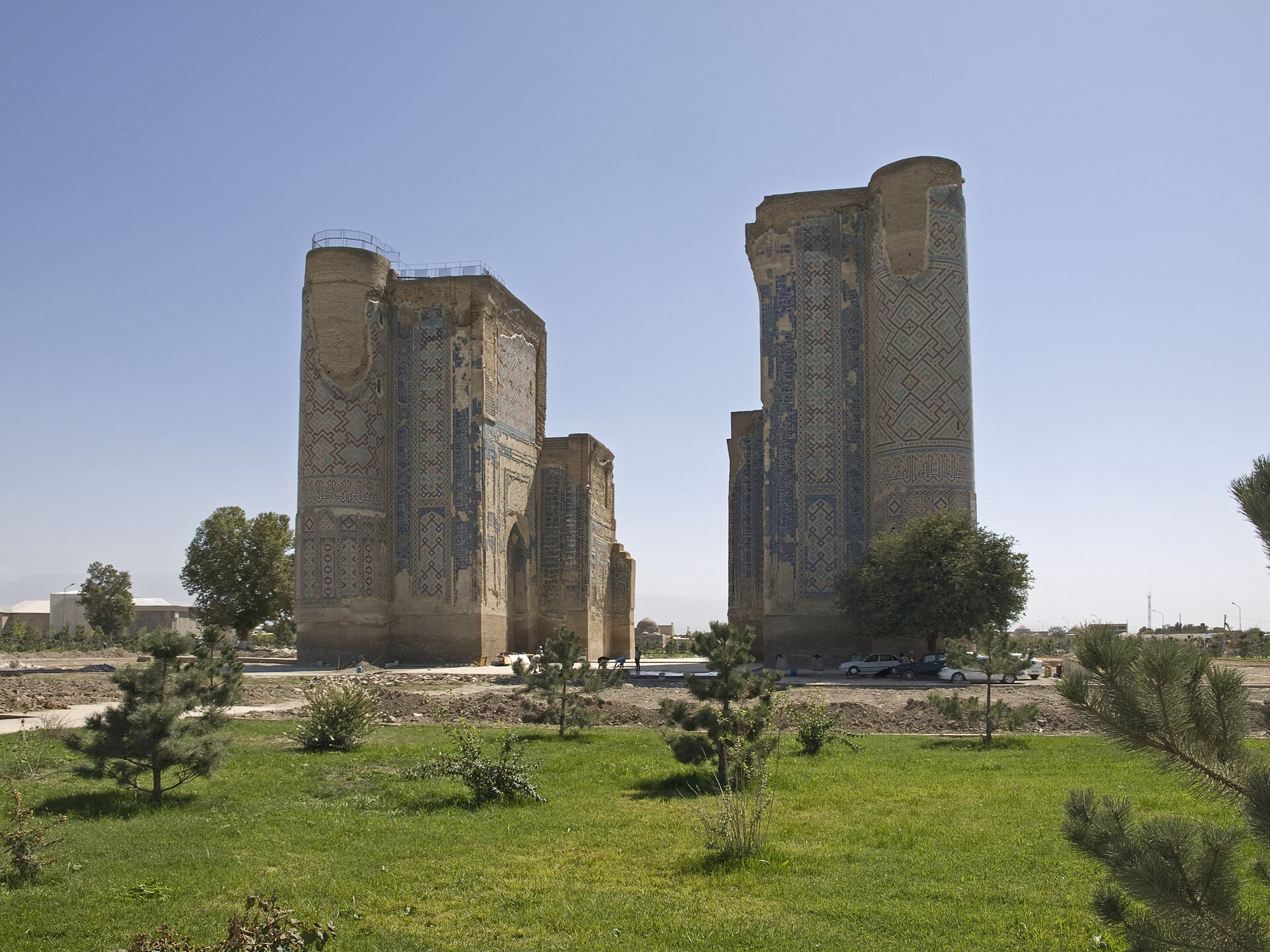
Ak-Saray Palace in Shakhrisabz isn’t just a ruin—it’s a place where history lingers in the very air, where the past feels almost tangible between the crumbling walls. Built in the 14th century under Timur’s command, it was meant to be the grandest structure of its time, a declaration of power and ambition for a ruler who dreamed of shifting his empire’s capital to his hometown. Today, only two towering portals remain, their forty-meter heights still commanding attention. The surviving mosaic patterns and glazed tiles hint at the skill of medieval craftsmen, offering a glimpse of what once was a breathtaking vision of imperial splendor.
Shakhrisabz held a special place in Timur’s heart. Born here, he envisioned it as the new center of his empire, a city that would outshine even Samarkand. Ak-Saray was to be the heart of this transformation—not just a palace, but a sprawling complex with reception halls, gardens, libraries, and even an observatory. Construction began in 1380 and stretched over two decades, yet the project was never finished. Timur died before its completion, and his successors moved the capital back to Samarkand. The palace stood unfinished, but even in its incomplete state, it became one of the most ambitious architectural endeavors of its era.
What remains of Ak-Saray is striking, even in decay. The grand portals, adorned with intricate geometric designs and Arabic calligraphy, once formed the entrance to an immense ceremonial space. The inscriptions—*Greatness belongs to God alone* and *Glory to my sovereign*—were more than decoration; they reflected an era where power and faith were inseparable. The tiles that once covered the walls shimmered in shades of blue, turquoise, and gold, playing with light and shadow. Some of these decorations now reside in museums, but the fragments left behind still evoke the palace’s former magnificence.
Timur didn’t just want a palace—he wanted a statement. Ak-Saray was meant to surpass everything that came before it, including the grand structures he had encountered during his campaigns in Persia and India. To achieve this, he brought in the finest artisans from across his empire, while materials were sourced from distant regions. Marble for the columns was said to have been transported from Badakhshan, a testament to the scale of the undertaking. The project demanded vast resources, and not everyone approved of such extravagance. But for Timur, the goal was to leave something enduring, and in that sense, the palace succeeded.
Today, Ak-Saray is more than an architectural monument—it’s a place where the spirit of medieval Shakhrisabz still lingers. The ruins stand amid the quiet streets of the old city, where life moves at an unhurried pace. In the summer heat, the shade of the portals offers a brief respite from the sun. Locals sometimes gather here, sitting on benches in the small park that surrounds the site, or showing visitors the city’s most famous landmark. There’s a sense of timelessness here, as if the echoes of courtiers and foreign envoys might still be heard in the breeze.
Shakhrisabz may not be as famous as Samarkand or Bukhara, but it’s here that Timur’s legacy feels most immediate. Ak-Saray isn’t just a ruin—it’s a testament to the ambitions and craftsmanship of an entire civilization. It reminds us that even the grandest plans can remain unfinished, yet still retain their power. The palace never became the capital Timur envisioned, but it became part of a history that endures in stone and story.
Visiting Ak-Saray is less about seeing a tourist attraction and more about experiencing history firsthand. The wind sweeps between the portals, sunlight catches the remaining tiles, and for a moment, it’s easy to imagine the past still alive in these walls. Unlike more crowded sites, this one offers space to reflect, to stand alone with the weight of centuries. Shakhrisabz moves at its own pace, and Ak-Saray fits perfectly into that rhythm—unhurried, majestic, and quietly enigmatic.
Time has worn the palace down, but it hasn’t erased its presence. What remains continues to inspire, a reminder that greatness isn’t always measured in size, but in the ability to preserve the essence of an era, even in ruins. For anyone drawn to Central Asia’s history, this is a place that shouldn’t be missed. It doesn’t reveal everything at once, but it leaves you with something deeper than just memories of stone and mosaic—a sense of having touched something far greater.