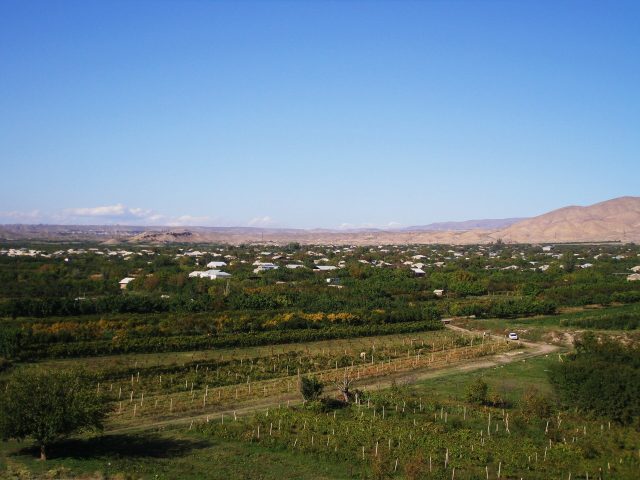
Dvin is one of those Armenian places that lingers more in history books than on modern maps. Today, it’s a quiet village perched on a hill, just over ten miles south of Yerevan, but once it was the beating heart of ancient Armenia. From the fourth to the thirteenth centuries, Dvin served as the country’s capital, its political and cultural nucleus, and the seat of the Armenian Catholicos—the head of the Armenian Apostolic Church. Little remains of its former grandeur, yet even the ruins whisper stories of a city that once thrived at the center of a nation.
Among the most significant remnants of Dvin’s past is the Catholicos Palace, a site deeply entwined with Armenia’s history. When Christianity became the state religion in 301, Dvin transformed into the country’s religious hub. The palace was built on the foundations of earlier structures, becoming the residence of the Catholicos, the spiritual leader of the Armenian people. For centuries, it wasn’t just a home for the church’s head but also a vital administrative center where the fate of the nation was often decided.
The architecture of the palace reflects a transitional period in Armenian design, where the influences of antiquity gradually gave way to Christian traditions. What survives today—fragments of walls and foundations—offers a glimpse into its original form. The palace consisted of several halls connected by galleries, its walls adorned with carved ornaments and frescoes. The central hall, likely the site of church councils and important state gatherings, stands out even in ruin. Time and earthquakes have taken their toll, leaving only scattered remnants, but these still convey the scale and dignity of the original structure.
More than just a residence, the palace symbolized the unity of church and state. During Dvin’s golden age, it hosted foreign envoys, witnessed the signing of treaties, and served as a place of judgment. The Armenian Catholicos played a pivotal role in the country’s political life, and their influence often extended beyond Armenia’s borders. The palace was a repository of sacred relics and manuscripts, many of which later became cornerstones of Armenian written culture.
Dvin’s decline began in the thirteenth century when Mongol invaders razed the city, and the palace fell into disrepair. Earthquakes, particularly a devastating one in 893, inflicted irreparable damage. Over time, the ruins were swallowed by grass, and it wasn’t until the nineteenth century that archaeologists began uncovering its secrets—a process that continues today. Visitors can now see the remains of walls, columns, and mosaic floors that once graced the halls. Despite the destruction, the site retains a quiet power, as if time itself has paused to preserve the memory of its former glory.
A visit to the Catholicos Palace is more than a walk among ruins; it’s a chance to connect with Armenia’s past. Though Dvin has faded from prominence, it remains a potent symbol of national identity. Standing among the hills and fields, it’s easy to imagine the bustling city that once was—the voices of clergy and rulers, the weight of decisions that shaped a nation. The ruins serve as a reminder that Armenia is one of the world’s oldest Christian countries, its history inseparable from its faith.
Today, Dvin is a peaceful place, drawing those who seek to understand the roots of Armenian culture. There are no crowds, no noisy cafes, no souvenir stalls—just the wind rustling through the grass and the occasional visitor paying homage to history. The Catholicos Palace, though in ruins, lives on in legends and stories of a time when Dvin was the center of the Armenian world. Perhaps it’s this very stillness that makes it so compelling—a place where the past feels closer than ever.