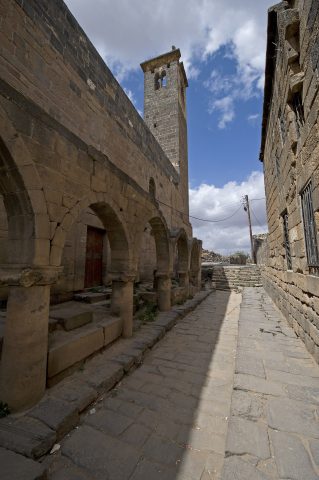
Kamid al-Lawz is one of Lebanon’s quieter archaeological sites, tucked away in the Beqaa Valley near the town of Kab Elias. Unlike the country’s more famous ruins, it doesn’t draw crowds or feature prominently in guidebooks, yet its history stretches back millennia, offering a glimpse into the layers of civilization that once thrived in this corner of the Levant.
The site was inhabited as early as the Bronze Age, but it flourished most notably during the Phoenician era and later under Roman rule. Excavations have revealed the remains of a city that served as a key administrative and commercial hub, linking the Mediterranean coast with the inland regions. Among the scattered ruins are fragments of temples, residential quarters, public buildings, and even an early Christian basilica—testament to the settlement’s long and varied past. The city’s strategic location made it a crossroads for trade and culture, though today, little remains above ground beyond the outlines of walls, broken columns, and patches of mosaic flooring.
What makes Kamid al-Lawz unusual is its lack of modern intervention. There are no fences, no reconstructed facades, and few signs to explain what you’re seeing. Visitors are free to wander among the stones, but without context, the ruins can feel like little more than a jumble of weathered rock. Yet this very absence of polish is part of the appeal. The site feels untouched, a place where history isn’t curated for tourists but left to speak for itself. The silence is broken only by the wind and the occasional rustle of dry grass, making it easy to imagine the city as it once was.
One of the most intriguing discoveries here is the so-called "palace," uncovered in the mid-20th century. This complex of buildings, with its courtyards, colonnades, and faded frescoes, likely served as the residence of a local ruler or high-ranking official. Its architecture blends Phoenician, Greek, and Roman influences, reflecting the cultural exchanges that shaped the region. Much of the decorative detail has been lost to time, but the remaining fragments hint at the grandeur that once defined the space. The palace stands as a reminder of how even a provincial city could be a microcosm of the wider ancient world.
The Beqaa Valley, where Kamid al-Lawz is located, has long been a meeting point of empires. Over the centuries, it fell under the sway of Egyptians, Hittites, Assyrians, Persians, Greeks, and Romans, each leaving their mark on the landscape. The city’s fortunes rose and fell with the shifting tides of power, yet it never entirely faded from significance. Its position along the route from Damascus to the Phoenician coastal cities of Tyre and Sidon ensured its role as a waystation for merchants, soldiers, and travelers. Today, the ruins offer a quiet testament to that enduring legacy.
Lebanon is dotted with such sites, places where history lies just beneath the surface. Kamid al-Lawz is one of the lesser-known among them, and that’s precisely what makes it special. There are no tourist traps here, no reconstructed temples or souvenir stalls—just the raw, unfiltered remnants of the past. The absence of crowds allows for a more intimate experience, one where the weight of centuries feels almost tangible. The distant mountains, the dry earth underfoot, and the occasional birdcall all contribute to a sense of timelessness.
Visiting Kamid al-Lawz requires some effort. There’s no visitor center, no clearly marked paths, and little in the way of amenities nearby. Those who make the journey should come prepared with water, a map, and a willingness to navigate without much guidance. The roads leading to the site can be rough, and signage is minimal, but the reward is a rare opportunity to explore history on its own terms. This isn’t a place for those in a hurry; it’s for travelers who want to step off the beaten path and engage with the past in a more personal way.
In a country known for its dramatic ruins like Baalbek or the vibrant streets of Beirut, Kamid al-Lawz offers something different: a sense of discovery. It doesn’t demand attention with towering columns or elaborate carvings, but rather invites quiet reflection. There’s a humility to the site, a reminder that history isn’t always about grand monuments. Sometimes, it’s found in the quiet persistence of stones that have witnessed the rise and fall of empires, yet remain, patient and unassuming, waiting to be noticed.