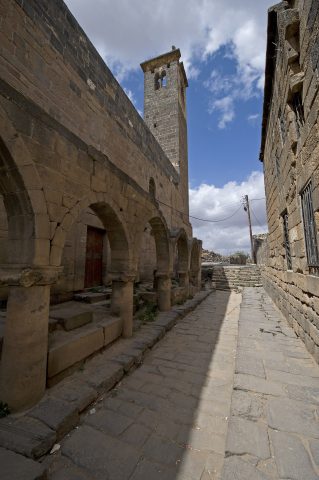
Perched on a hillside overlooking the Bekaa Valley, the Church of Saint George in Kab Elias stays with you after you leave. It doesn’t stand out with grand facades or crowds, but sits quietly among vineyards and villages, as if waiting to be found. There are no guided tours or souvenir stalls. That’s what makes it real. Here, the church isn’t a relic—it’s part of the landscape, part of the lives of the people who live in this valley.
The history of the church is like Lebanon’s: layered, with civilizations overlapping for thousands of years. Kab Elias, halfway between Beirut and Baalbek, has always been a crossroads. Christianity took root here long ago. The exact origins of the Church of Saint George are unclear, but its architecture suggests it was built during the Ottoman era. Many Christian sites in the region were constructed on older sacred grounds. The building’s design—white stone walls, a low dome, narrow stained-glass windows—shows a mix of Byzantine influences and local traditions, common in 18th- and 19th-century Lebanese churches.
Inside, the space feels small, protective. Light through the colored glass softens the worn icons and wooden pews. The iconostasis, painted by local artisans, bears the marks of time; some colors have faded, but the saints’ faces remain clear. Saint George appears more than once, a quiet reminder of the faith that built this place. There’s no opulence, just devotion that has lasted through generations.
For the people of Kab Elias, the church is part of who they are. In a country where religious communities often live side by side but separately, such places become symbols of unity. Services, baptisms, and weddings happen here. On feast days, the church fills with hymns sung for years. The biggest celebration is on Saint George’s Day, when the faithful gather for prayers and meals outdoors, a tradition that mixes faith with local hospitality.
A small garden lies beyond the church walls. Olive trees and lavender grow in the shade, and benches let visitors sit and look out. Below, the Bekaa Valley stretches out, fields and vineyards framed by the Lebanon Mountains. The scene feels unchanged. It’s a place where conversations move slowly, where the elderly gather to talk or just sit, where history is present but not overwhelming.
The Church of Saint George isn’t like Lebanon’s grand cathedrals or ancient monasteries. It doesn’t try to be. There are no gilded altars or towering spires—just quiet resilience. That’s why it stands out. It’s untouched by mass tourism, where Lebanon’s spirit feels unfiltered: patient, layered. Those who find it often return, not for photos or stories, but for the stillness it offers.
If you’re traveling through the Bekaa Valley, take the detour up the hill. Whether you’re religious or not, the place slows you down. It doesn’t ask for much—just a moment of attention, respect for the stories it holds, and openness to the quiet over the valley. Some discoveries happen when you least expect them.