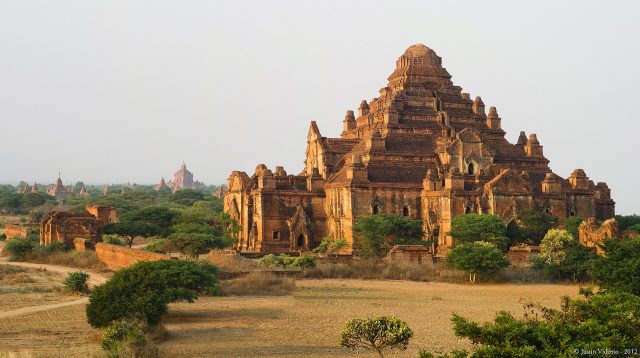
Bagan is a place where time feels suspended, and Gawdawpalin stands as one of its most evocative temples. Built in the late 12th century, it rises from the plain among hundreds of other pagodas, its slender form remarkably well-preserved. Unlike many of Bagan’s structures, which bear the scars of earthquakes, Gawdawpalin retains much of its original silhouette, offering a glimpse of how it looked eight centuries ago. It belongs to the later period of Bagan’s architectural evolution, when builders had mastered the art of brick vaulting and achieved a balance between grandeur and elegance.
The temple is a two-story structure with a square base, crowned by a tapering spire. Four entrances lead into a central hall, where a colossal Buddha statue once stood. Today, only the pedestal remains, its sheer size hinting at the statue’s former scale. The interior walls are adorned with faded murals, their details softened by time. Some scenes from the Buddha’s life are still visible, rendered in the characteristic Bagan style—gentle lines and muted colors that blend into the dim light filtering through narrow windows.
Gawdawpalin was never meant to stand alone. It was part of a vast monastic complex, where monks lived, studied, and meditated. The foundations of these surrounding buildings are still visible, scattered across the site like echoes of a once-thriving community. Archaeologists believe the temple served not only as a place of worship but also as a center of learning, where Buddhist texts and philosophy were taught. The scale of the complex suggests it played a significant role in the religious and intellectual life of Bagan during its golden age.
Visiting Gawdawpalin is as much about the atmosphere as it is about the architecture. The best time to explore is early morning or late afternoon, when the sun casts long shadows across the reddish earth and the heat is less intense. At these hours, the temple is quiet, with only the occasional rustle of dry grass or the distant footsteps of locals heading to other pagodas. The stillness makes it easier to imagine the temple as it once was—a hub of activity, filled with the murmur of prayers and the rustle of palm-leaf manuscripts.
The history of Gawdawpalin is intertwined with that of Bagan itself. It was built during the reign of King Narapatisithu, one of the last great rulers of the Bagan dynasty. This era marked the height of the kingdom’s architectural ambition and the consolidation of Theravada Buddhism, which gradually replaced earlier religious traditions. Gawdawpalin reflects this shift in its design—gone is the heaviness of earlier pagodas, replaced by a sense of lightness and harmony. The temple’s proportions feel almost modern in their precision, a testament to the skill of its builders.
Yet for all its strength, Gawdawpalin is not immune to the passage of time. Earthquakes, erosion, and human neglect have left their marks. The 2016 quake damaged many of Bagan’s temples, and Gawdawpalin was no exception—cracks now snake across its walls, and fragments of its decoration have crumbled. Restoration work is ongoing, but the process is slow and delicate. The goal is not just to repair but to preserve the temple’s authenticity, ensuring that future visitors can still sense the layers of history embedded in its bricks.
What makes Gawdawpalin special is its intimacy. Unlike the towering temples that dominate Bagan’s skyline, it feels approachable, almost human in scale. There’s no overwhelming grandeur here, just a quiet dignity that invites reflection. The temple seems to hold the memories of those who built it and those who once gathered within its walls, their presence lingering in the cool shade of its corridors.
If you visit Bagan, don’t rush straight to the most famous pagodas. Take a moment to wander through Gawdawpalin. Sit on its steps, look out over the plain dotted with ancient spires, and try to picture the scene as it was centuries ago. In these quiet moments, you might begin to understand why Bagan is often called one of the world’s most mysterious places. It’s not just the architecture that captivates—it’s the sense of time standing still, of stories half-told, and of a past that still breathes in the present.