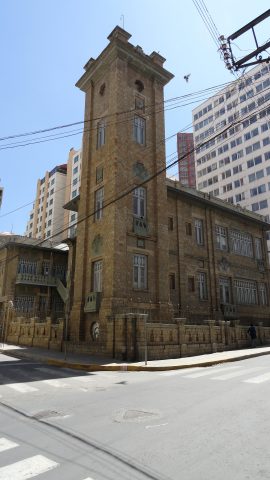
San Calixto College in La Paz is the kind of place that doesn’t demand attention but quietly lingers in the memory of those who take the time to notice it. Tucked away in the heart of Bolivia’s administrative capital, it sits at the intersection of history, education, and the everyday rhythm of the city. Unlike the more obvious landmarks that draw crowds, this building doesn’t announce itself with flashy signs or tourist brochures. Its understated presence is what makes it special—a quiet chapter in the noisy, vibrant story of La Paz.
Founded in the late 19th century, San Calixto was part of a network of Jesuit schools that sought to blend rigorous academics with spiritual and moral instruction. The Jesuits left a lasting mark on Latin American education, and their influence is still visible here, not just in the curriculum but in the architecture itself. The college’s neoclassical design reflects the era’s ideals of progress and European intellectual traditions. High ceilings, sturdy columns, and wide corridors give the space a sense of permanence, as if the very walls were built to shape both mind and character.
Today, the college remains an active school, though its significance extends beyond the classroom. Students come from across Bolivia, some from distant regions, making it a second home for many. The daily routines feel timeless: the sound of a bell marking the start of lessons, the creak of old wooden floors, and the scent of aged books in the library. Yet modernity has found its place here too, with computer labs and science facilities where students conduct experiments and research. The blend of old and new is seamless, a reflection of how the institution has adapted over time.
One of the most intriguing parts of San Calixto’s history is its observatory. Established in the early 20th century, it was among the first in Bolivia and became a hub for astronomical research in the region. Scientists here studied the southern skies, contributing findings to international journals. Though the observatory is no longer as active as it once was, its instruments and archives remain, a testament to a time when La Paz was a notable point on the global scientific map.
The college’s inner courtyard offers a glimpse into how different eras coexist within its walls. Faded murals share space with modern graffiti, while a bust of the founder stands as a reminder of the past. The atmosphere is always one of quiet industry—students hurrying to class, teachers in conversation, staff tending to the grounds. There’s no sense of idleness here, just the steady hum of daily life, which somehow feels more authentic than any staged spectacle.
For those interested in the history of education in Latin America, San Calixto is a fascinating case study. It’s not a museum where artifacts are preserved behind glass; it’s a living space where past and present overlap naturally. Walking through its halls, you can imagine the generations of Bolivians who studied here, the evolving methods of teaching, and how the building itself has changed to meet new needs. In this way, the college is more than a school—it’s a microcosm of the shifts that have shaped the country over more than a century.
San Calixto isn’t on the typical tourist trail. There are no guided tours, souvenir shops, or cafes for visitors. But that’s precisely why it’s worth seeking out if you want to see La Paz beyond the postcard images. To find it, you only need to ask a local—many in the city know the place and will point you in the right direction. The key is not to expect something grand or theatrical. What makes it special isn’t spectacle, but the chance to witness history that’s still unfolding.
In recent years, the college has begun to open its doors to the public more often, though still sparingly. Occasionally, it hosts lectures, student exhibitions, or academic events, offering rare opportunities to peek into its daily life. For those in La Paz during such moments, it’s a unique chance to see how one of Bolivia’s oldest educational institutions functions and what role it plays in the city today.
San Calixto doesn’t shout its story, but it speaks volumes. About how education shapes society, how architecture reflects the values of its time, and how traditions endure even as the world changes. There are no bright colors or dramatic flourishes here, just something far more meaningful: authenticity. That’s what makes the college more than just another building in La Paz—it’s a living piece of the city’s history, one that continues to be written every day.