Perched on the slopes above Kotor, the Church of Our Lady of Remedy has watched over the city for centuries, its quiet presence a constant through wars, earthquakes, and the slow march of time. Built in the 17th century when Kotor was still under Venetian rule, the church feels almost forgotten today, overshadowed by the more famous cathedrals in the Old Town. Yet those who take the time to visit discover something far more intimate—a place where history lingers in the air, untouched by the crowds below.
The church’s architecture is simple, almost austere, as if designed to blend into the mountainside rather than stand out. Its light stone facade has weathered into a soft golden hue, and the entrance is marked by an unadorned portal, free of the grand flourishes found in larger churches. Inside, the space feels even smaller, the low ceiling and narrow walls creating an atmosphere of quiet seclusion. Faded frescoes line the walls, their Orthodox motifs softened by time, while the main altar remains dedicated to the Virgin Mary, candles flickering before it as they have for generations.
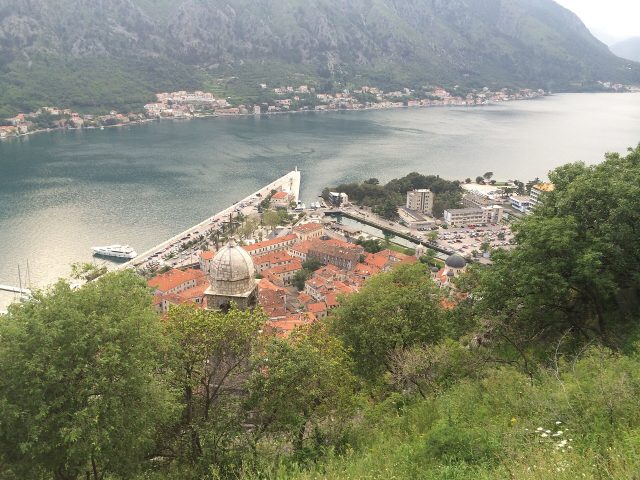
Most visitors pass by without a second glance, their eyes fixed on the path leading to St. John’s Fortress. But those who pause find a different kind of reward. The church sits among olive trees, their silvery leaves rustling in the breeze, and from the small terrace out front, the view stretches across the Bay of Kotor. On clear days, the water shimmers under the sun, and the distant villages on the opposite shore appear like tiny brushstrokes against the mountains. In summer, the shade of the trees offers relief from the heat, while the scent of pine and saltwater drifts up from the bay.
The church’s history is tied to moments of hardship, particularly the plague that swept through Kotor in the 17th century. According to local tradition, the people turned to the Virgin Mary for protection, and the church became a symbol of hope during those dark times. Later, the 1979 earthquake left its mark—cracks in the walls, faded frescoes—but the building was restored by the community, its scars now part of its story. Even today, the signs of those struggles remain, a quiet testament to resilience.
Inside, a few ancient icons have survived the centuries, the most striking being a Byzantine-style depiction of the Virgin and Child. The deep colors and solemn lines are characteristic of the tradition, and the small wooden iconostasis beside it bears the handiwork of local craftsmen. The church doesn’t feel like a museum, though. It’s still a living place, where services are held occasionally, and where locals come to light a candle or sit in silence. Sometimes, pilgrims stop here; other times, it’s just weary travelers seeking a moment of peace.
For the people of Kotor, the church is more than just a historical site. It’s a place to escape the noise of the city, to reflect, or simply to breathe. Even in the height of tourist season, it remains quiet, a rare pocket of solitude in a region that draws crowds. The path leading to it is narrow, winding through trees before revealing the small stone building almost hidden among the greenery. It’s easy to miss, but those who find it often linger longer than they planned.
Early mornings here are especially magical. As the sun rises over the bay, the first light spills across the water, dissolving the mist that clings to the surface. The city below is still asleep, and the church feels suspended in time, as if holding onto the secrets of the past. By evening, when the mountains blush with the colors of sunset, the silence deepens. The only sounds are the wind in the leaves and the distant chime of church bells echoing across the bay.
The Church of Our Lady of Remedy isn’t grand or opulent. It doesn’t demand attention like the larger landmarks in Kotor, nor does it offer the dramatic views of the fortress above. Instead, it offers something quieter—a sense of stillness, a connection to the people who have prayed here, suffered here, and found solace here over the centuries. For some, it’s just a detour on the way to somewhere else. For others, it’s a place to pause, to listen, and to remember that some things endure.