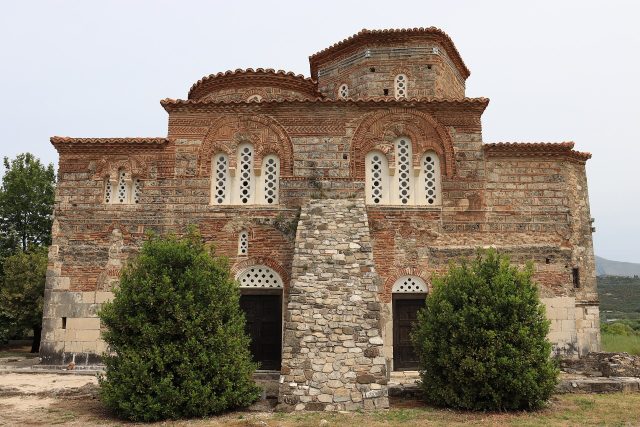
Himarë’s Church of Saint Mary feels like a place where time has paused, leaving behind a quiet corner of the past amid the modern world. Perched on a hillside overlooking the Ionian Sea, it stands above the rugged coastline, its simple stone walls blending into the landscape of cliffs and olive groves. Built in the 18th century, this small Byzantine church doesn’t demand attention like grand cathedrals do, yet its unassuming presence holds a quiet strength. From here, the view stretches across the water, where the sea meets the sky in a haze of blue, and the wind carries the scent of salt and pine.
The church is deeply tied to Himarë’s history, a town that has long been a crossroads of cultures and conflicts. For centuries, this stretch of Albania’s coast was a strategic point, fought over by empires and local clans alike. The Church of Saint Mary witnessed it all—Byzantine rule, Venetian influence, and the slow encroachment of the Ottoman Empire. During times of invasion, its thick walls offered shelter, and its doors remained open when others closed. It wasn’t just a place of worship but a symbol of resilience, a small but steadfast reminder of faith and identity in a changing world.
Architecturally, the church is modest but striking in its simplicity. Built in the late Byzantine style, it features low vaulted ceilings, sturdy stone walls, and narrow windows that filter sunlight into soft, golden pools. Inside, faded frescoes still cling to the walls, their colors muted by time but their stories intact—scenes from the Bible, saints with solemn expressions, and the ever-watchful eyes of the Virgin Mary. The icon of the Mother of God is particularly revered, believed by locals to hold miraculous power. The altar is adorned with carved wood, worn smooth by generations of hands, and the floor is laid with the same stone as the walls, cool underfoot even in summer.
Himarë has always been a place where different worlds met. Greeks, Albanians, Orthodox Christians, and Catholics lived side by side, and the Church of Saint Mary became a bridge between them. When it was built in the 18th century, the region was caught between the fading influence of Venice and the rising power of the Ottomans. For the people of Himarë, the church was more than a religious site—it was a keeper of traditions, a place where language, customs, and faith were preserved despite outside pressures. Even today, it remains a living part of the community, not just a relic of the past.
Visiting the church is a quiet experience. There are no crowds, no guided tours rushing through, just the sound of the wind and the distant murmur of the sea. The path leading up to it winds through narrow streets lined with old stone houses, their gardens overflowing with bougainvillea and citrus trees. In summer, the air is thick with the scent of herbs and warm earth, and the view from the hill is breathtaking—endless blue water, jagged cliffs, and the occasional fishing boat bobbing on the waves. Inside the church, the atmosphere is one of stillness, the kind that makes you slow down without realizing it.
Locals speak of the church with pride, sharing stories passed down through generations. Some tell of miracles attributed to the icon of the Virgin Mary, others of the church’s role in protecting the town during turbulent times. There’s a belief that if you make a wish before the icon, it will come true, though no one seems in a hurry to test it. The church isn’t just a tourist attraction; it’s a place where people still come to light candles, to pray, or simply to sit in silence for a while.
What makes the Church of Saint Mary special is how it embodies the spirit of Himarë itself. It’s not grand or imposing, but it carries the weight of history in every stone. The town has seen empires rise and fall, yet here, on this quiet hillside, life has continued in much the same way for centuries. The church stands as a reminder that some things endure—not through force, but through quiet persistence. It’s a place where you can sit on the steps outside, listen to the waves below, and feel the layers of time settling around you.
Himarë is a town where the past and present coexist effortlessly. There are no skyscrapers, no traffic jams, just the rhythm of the sea and the slow pace of life. The Church of Saint Mary fits perfectly into this landscape, not as a monument to be admired from afar, but as a living part of the community. It doesn’t need to shout to be heard; its presence is enough. In a world where so much is built to impress, this small church offers something rarer—a sense of belonging, of continuity, of history that isn’t just remembered but still alive.