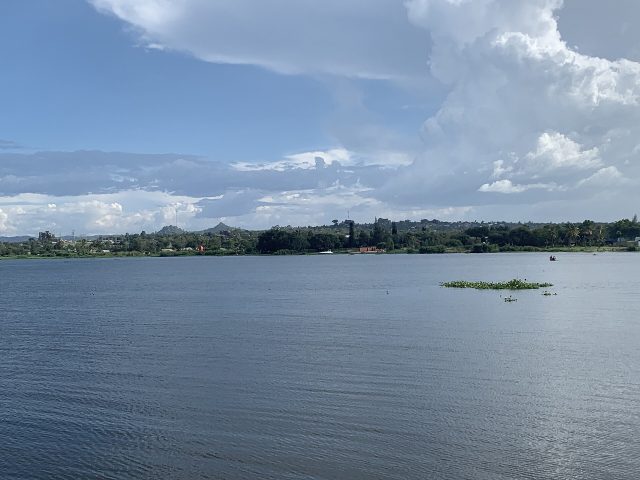
St. Paul’s Church sits on a low hill, overlooking Lake Victoria. It doesn’t demand attention, but those who notice it often linger, as if the place slows time. Musoma isn’t a place tourists flock to, and the church wouldn’t appear in most guidebooks if not for the way it has settled into the landscape over the years. Its presence feels natural, as if it has always been part of the town’s rhythm.
Built in the early 1900s, when this region was under German colonial rule, the church reflects the architecture of the time. There’s no ornamentation, just clean lines and modest proportions—a whitewashed exterior, a red-tiled roof, and narrow arched windows. The building is small, designed to blend rather than dominate. It doesn’t tower over the surroundings; it exists among them.
Inside, the church maintains that same restraint. Wooden pews, a plain altar, a few icons, and stained-glass windows allow the space to breathe. Light filters through the windows, casting patterns on the stone floor. Even on Sundays, it’s rarely crowded. Those who come do so for the stillness, for the rituals that have unfolded here for generations.
Musoma is a town shaped by the lake—its people fish, trade, and live by the water’s moods. St. Paul’s has long been more than a place of worship; it’s part of daily life. When the church was first established, it was part of a mission where European priests and nuns worked alongside local communities, running schools and clinics. Some of that legacy remains, though the mission itself is gone.
Over the decades, the church has accumulated stories. Some say it survived World War I because British troops used it as a field hospital. Others claim its basement once held mission records, though now it’s filled with old hymnals and ledgers. A few locals insist that at dawn, when mist rises from the lake, you can still hear the echo of a bell, though the original was removed long ago. These tales add to the church’s quiet presence.
Today, services are infrequent, and the building shows signs of age—peeling paint, a sagging roof beam. But it hasn’t been abandoned. The people of Musoma still tend to it, patching up the walls, sweeping the floors. In a town where life moves to the rhythm of the lake, the church offers a place to pause.
The view from the church grounds is worth the visit. Lake Victoria stretches out, its surface shimmering under the sun. Fishermen set out in wooden boats at dawn, their silhouettes small against the water. On clear days, distant islands appear on the horizon. In the evenings, the air cools, carrying the scent of fish and damp earth. There are no tourist trails here—just the lake, the sky, and the quiet hum of life.
St. Paul’s isn’t a monument to grandeur. It doesn’t impress with size, but in its own way, it tells a story of how different worlds coexist. For some, it’s just an old building on the edge of a town. For others, it’s a piece of history that refuses to be forgotten, a place where the past lingers.