St. Patrick’s Church in Rathoat sits quietly on a low hill, its weathered stones holding centuries of Irish history within their silent walls. Built in the thirteenth century, it overlooks the gentle slopes and patchwork fields of County Meath, a landscape that has changed little since the days when the church was new. The surrounding graveyard is a place of soft moss and older memories, where headstones tilt with age and some bear dates reaching back to the seventeenth century. There are no crowds here, only the occasional murmur of visitors and the steady whisper of wind through the grass.
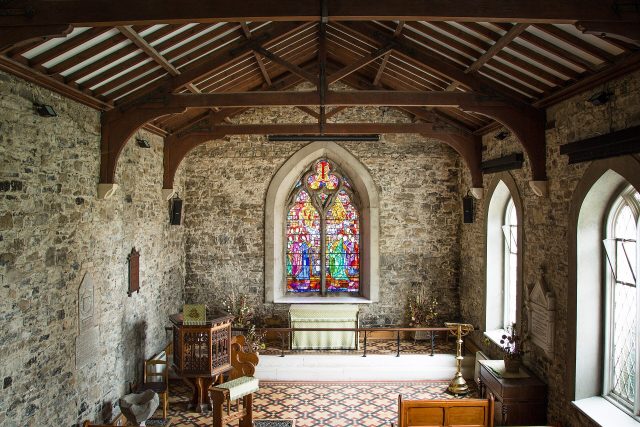
The architecture carries the marks of time and adaptation. Originally a modest stone structure with narrow windows and thick walls, the church was later expanded with side chapels and buttresses, blending early Gothic elements with later modifications. Inside, fragments of medieval frescoes still cling to the walls, their faded colors hinting at the craftsmanship of long-ago artisans. The altar area is particularly striking, where traces of ancient paint remain, barely visible beneath layers of dust and time. Carved stone details, worn smooth by centuries, speak of the hands that shaped them.
This church has witnessed much of Ireland’s past. In the Middle Ages, it was more than a place of worship—it was a center of community life, where people gathered for services, settled disputes, and sought refuge in troubled times. When the English Reformation took hold, the building passed into Protestant hands, yet local Catholics continued to meet here in secret, defying the restrictions of the era. That duality lingers in the architecture, where Catholic and Protestant influences coexist in the same space, a quiet testament to the complexities of history.
Today, St. Patrick’s is open to visitors, though services are infrequent. The interior feels lived-in rather than preserved, with worn wooden pews, a simple pulpit, and a few memorial plaques dedicated to those buried nearby. A carved stone cross stands near the entrance, its age measured in centuries, its edges softened by time. Outside, the graveyard holds graves marked in both Gaelic and English, some so worn that their inscriptions have faded beyond reading. The oldest stones lean at odd angles, as if slowly sinking back into the earth.
Visiting St. Patrick’s is less about ticking off a landmark and more about stepping into a slower rhythm. Unlike the bustling tourist spots of Dublin or Killarney, this place has no crowds, no guided tours, no souvenir stalls. It’s just the church, the graveyard, and the land stretching out in every direction. You can wander among the headstones, deciphering the names and dates, or simply sit on the grass and watch the light shift over the hills. On clear days, the view extends for miles, and the sense of timelessness is almost tangible.
The surrounding countryside is quintessentially Irish—rolling fields that turn vibrant green in summer, quiet and windswept in winter. Locals still come here, some to tend family graves, others to find a moment of peace away from the noise of modern life. For visitors, it’s a chance to see Ireland as it once was, before highways and hotels reshaped the landscape. There’s no grand spectacle here, just the quiet persistence of history in the stones and the soil.
St. Patrick’s may not be one of Ireland’s most famous sites, but that’s part of its appeal. It lacks the grandeur of Gothic cathedrals or the fame of ancient monasteries, yet it possesses something rarer—a sense of authenticity. This is a place where history isn’t confined to plaques or glass cases; it’s in the rough texture of the walls, the cool shade of the nave, the way the wind moves through the graveyard. It’s the kind of spot that lingers in the memory long after you’ve left, not for what it shows you, but for how it makes you feel.