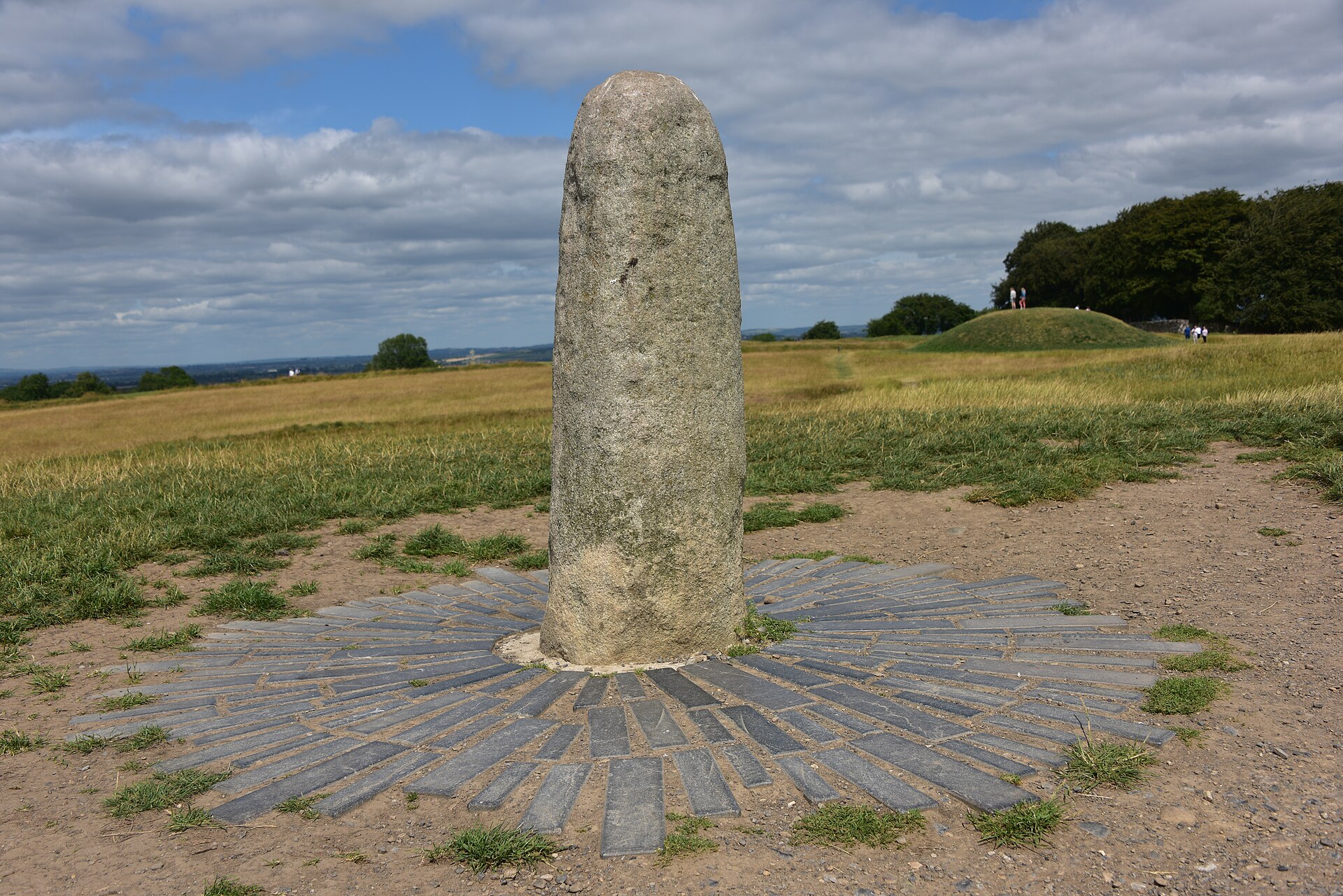
The Hill of Tara is where Ireland’s past feels almost tangible—a quiet rise of land that once pulsed with the life of a nation. At its summit stands the Lia Fáil, the Stone of Destiny, a modest pillar of weathered granite that has outlasted empires and myths. It doesn’t dominate the landscape like a castle or a cathedral, but its presence carries centuries of history. Legends say the stone would roar beneath the feet of a true king, a sound that once echoed across the plains of Meath. Today, it stands silent, its story lingering in the wind.
Tara is a sprawling archaeological site where layers of history overlap. Earthen banks, burial mounds, and faint outlines of circular enclosures mark a place that was once the political and spiritual heart of Ireland. For over a thousand years, chieftains gathered here, laws were debated, and the island’s fate was decided. The Lia Fáil sits at the highest point, where the land stretches in all directions. Standing there, you can almost hear the voices of crowds that once filled this space—arguments, celebrations, rituals binding people to the land.
No one knows where the stone came from. Some tales claim the Tuatha Dé Danann brought it to Ireland. Others say it arrived from the north, carried by invaders or traders. Archaeologists have no clear answers—no inscriptions, no artifacts, no proof of its age. It’s just a rough slab of granite, possibly from Ulster or Scotland, its edges worn smooth by time. Was it always a coronation stone? The truth is buried beneath myth.
The Lia Fáil isn’t compelling because of its size. It’s a quiet marker where history and folklore meet. Medieval texts describe it as a symbol of legitimacy, a test for kings. The idea of a stone judging a man’s worth feels primal, a relic of a time when the divine and earthly were one. Even as Ireland changed, the stone remained. Today, it’s fenced off, but visitors still touch it, as if some trace of its magic lingers.
The Hill of Tara is quiet now. On a clear day, the view from the top stretches toward the horizon—fields, farmhouses, stands of trees. This spot was chosen as a gathering place because it feels removed, yet connected to everything. The stone itself is unassuming, almost hidden among grass and wildflowers. But its location is deliberate. It stands where the land dips and rises, where the wind carries distant voices.
For visitors, the Lia Fáil is a link to a time when Ireland’s identity was being forged. Tara was where tribes came together, alliances were made, and the idea of a unified Ireland took shape. The stone witnessed it all. Did it ever truly cry out? The answers are lost, but the stone endures.
We cling to such places because they ground us. The Lia Fáil doesn’t offer grand revelations. It’s just a stone on a hill. But that simplicity is its strength. It doesn’t demand reverence—it simply exists, a fragment of the past that refuses to fade. Some come to connect with myth. Others sit and watch the clouds drift over the fields. Either way, the past isn’t just something we read about. We can stand on it, touch it, carry it with us.
Ireland has moved on, but the Lia Fáil remains. It doesn’t belong to any one era. It’s a bridge between myth and history. Whether you come for the legends, the archaeology, or the quiet, Tara offers a space to pause. The stone won’t speak, but the land will—if you listen.