Prague’s Astronomical Clock is one of those rare things that manages to be both a marvel of medieval engineering and a living piece of the city’s daily rhythm. Mounted on the southern wall of the Old Town Hall since the early 1400s, it holds the distinction of being the oldest functioning astronomical clock in the world. Over the centuries, it has endured fires, wars, and reconstructions—most notably after the 1945 battles, when the town hall was rebuilt and the clock reassembled from salvaged parts. Yet despite its age, it still keeps time, not just as a clock, but as a working model of the cosmos as understood six hundred years ago.
The clock’s face is a layered puzzle of symbols and systems. The upper dial, the astronomical one, doesn’t just tell the hour—it tracks multiple timekeeping traditions at once. There’s Old Czech time, Babylonian time, Central European time, and the position of the sun and moon within the zodiac. A small sphere even shows the current phase of the moon. Below it, the calendar dial, added later, features medallions for each month, painted by Josef Mánes in the 19th century. Together, they turn the clock into a kind of medieval infographic, a snapshot of how people once saw their place in the universe.
Every hour from nine in the morning until eleven at night, the clock puts on a brief but mesmerizing show. Two small windows open, and the twelve apostles appear one by one, their wooden figures moving in procession. Around them, other figures come to life: Death, a skeleton, rings a bell and flips an hourglass; a miser shakes his purse; a Turk shakes his head. The whole performance lasts less than a minute, but it’s enough to draw a crowd. Visitors start gathering well before the hour, craning their necks to catch the moment when the figures emerge. It’s easy to see why the spectacle has endured—there’s something almost magical in the way these centuries-old mechanisms still move with such precision.
Local legend claims that the clock’s creator, a master named Hanuš, was blinded afterward to prevent him from ever replicating his work elsewhere. Historians have debunked the story—records show the clock was actually built by a clockmaker named Mikuláš of Kadaň, based on designs by the astronomer Jan Šindel—but the tale persists. Perhaps because it adds a layer of mystery to an already fascinating piece of history. Or maybe because it speaks to the awe the clock has inspired for generations.
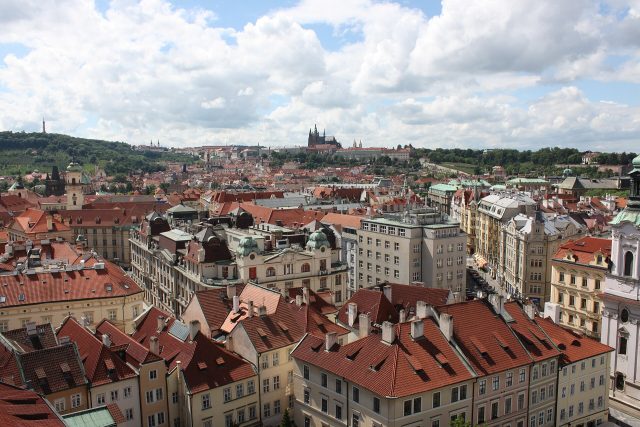
If you’re willing to climb the tower (or take the elevator), the view from above is worth the effort. From the top, Old Town Square unfolds beneath you, its red-tiled roofs and church spires stretching out in every direction. The Týn Church, with its twin Gothic towers, stands out against the skyline, while the cobblestones below trace the paths of countless visitors who have stood in this same spot over the centuries. Watching the apostles’ procession from up here offers a different perspective—less crowded, more immersive. Down below, the best views aren’t always right up against the clock. The figures can be hard to see from directly underneath, and the area fills up quickly. Instead, try watching from the edge of the square or from the balcony of a nearby café, where you can take in the scene without the jostling of the crowd.
The square itself is a kind of open-air museum, a cross-section of Prague’s architectural and historical layers. The Týn Church, with its imposing Gothic façade, has stood here since the 14th century, while the Church of St. Nicholas, just across the way, is a later Baroque addition. Between them, the statue of Jan Hus, the 15th-century religious reformer, serves as a reminder of the city’s turbulent past. Even the cobblestones beneath your feet have stories to tell—one of them marks the meridian that was once used to determine noon in Prague. It’s a place where history isn’t just preserved in museums but woven into the fabric of everyday life.
Standing in front of the Astronomical Clock, it’s hard not to feel a connection to the generations of Praguers and visitors who have gathered here before you. The clock has seen empires rise and fall, wars come and go, and the city itself transform from a medieval hub to a modern capital. Yet through it all, it has kept ticking, a quiet witness to the passage of time. Whether you’re drawn by its mechanical ingenuity, its historical significance, or simply the charm of its hourly show, the clock offers more than just a way to tell time—it offers a glimpse into the past, and a reminder of how much has changed, and how much has stayed the same.