Chan Chan feels like a place where time has settled into the earth itself. Just outside the Peruvian city of Trujillo, these ruins were once the heart of the Chimú kingdom, one of the most powerful civilizations in pre-Columbian America. Unlike the towering stone pyramids of Cusco or Machu Picchu, Chan Chan is vast and unassuming—a sprawling maze of adobe walls, palaces, and temples covering nearly twenty square kilometers. Its quiet grandeur lies in its scale and simplicity, a testament to a people who built not with stone, but with the materials at hand.
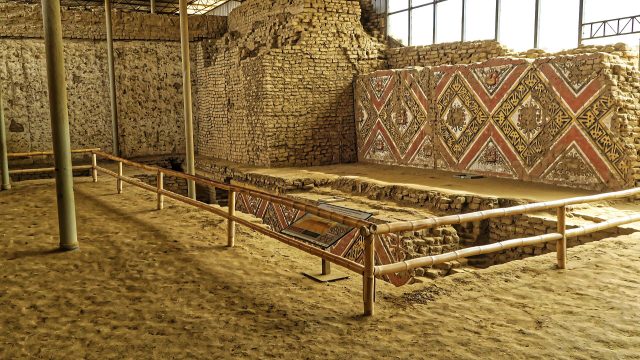
The city rose around the ninth century and thrived until the late fifteenth, when the Inca conquest brought its dominance to an end. At its peak, Chan Chan was the largest adobe city in the world, home to an estimated thirty thousand people. The Chimú constructed their homes, temples, and administrative buildings from *adobe*—a mixture of clay, sand, and plant fibers—then adorned them with intricate reliefs depicting fish, birds, ocean waves, and mythical creatures. These designs were more than decoration; they carried stories, preserved knowledge, and may have served ritual purposes. The ocean’s influence is everywhere, a reflection of the Chimú’s deep connection to the sea, their skill as fishermen, and their mastery of coastal navigation.
What makes Chan Chan remarkable is its thoughtful urban design. The city was divided into nine distinct citadels, each belonging to a different ruler. High walls enclosed these complexes, shielding them from both invaders and the relentless winds blowing in from the Pacific. Inside, the citadels held residential quarters, storage rooms, workshops, and shrines. The Chimú were also skilled engineers, constructing canals and reservoirs to capture rainwater and irrigate their fields. Some of these systems still exist today, a quiet reminder of how advanced their society was.
The most famous section of Chan Chan is the Nik An citadel, named after one of the Chimú rulers. Its walls bear some of the most elaborate and well-preserved reliefs in the city. Here, images of fish, crabs, and seabirds dominate, a nod to the Chimú’s maritime culture. At the center of the citadel stands the Temple of the Sun, where important religious ceremonies likely took place. Nearby, a platform for ritual games hints at the way sport and spirituality intertwined in Chimú life. Walking through these spaces, it’s easy to imagine the sounds of daily life—the murmur of voices, the clatter of tools, the distant crash of waves.
Today, Chan Chan is a place where history feels tangible. The ruins are slowly being reclaimed by the desert, the sun bleaching the adobe walls and the wind shifting the sand. There’s a sense of stillness here, as if the city is holding its breath. Yet the threat of erosion is constant. Rain, wind, and salt from the ocean air eat away at the structures, and while archaeologists and conservators work to preserve them, the process is painstakingly slow. Visiting Chan Chan isn’t just about seeing the past; it’s about witnessing the fragile balance between preservation and decay.
Unlike the crowded ruins of Machu Picchu, Chan Chan offers a quieter experience. There are no tour buses or long lines, just the vastness of the site and the stories it holds. Local guides often share legends of the Chimú—how they worshipped the moon rather than the sun, how their civilization fell to the Inca, and how their descendants still carry traces of that heritage. These tales breathe life into the ruins, turning them from silent relics into something more immediate.
If you find yourself in Trujillo, take the time to visit Chan Chan before heading to the beaches or the mountains. A few hours here is enough to appreciate its scale and significance. The best time to come is in the morning, when the sun is gentler and the shadows make the reliefs stand out. Bring water and a hat—shade is scarce, and the heat can be intense. But most of all, come with a sense of curiosity. This isn’t just another tourist site; it’s a place where every wall, every carving, holds the memory of a people who shaped the desert into a city.
Chan Chan reminds us that greatness isn’t always measured in towering monuments. Sometimes it’s found in the way a civilization adapts to its environment, in the skill of its artisans, and in the stories etched into its walls. The city hasn’t been forgotten, nor has it become a tourist trap. It exists somewhere between past and present, offering those who visit a chance to step beyond the surface and connect with something deeper. The adobe may crumble, but the legacy of the Chimú endures.