Bishapur is one of those rare places where the past feels almost tangible, as if the weight of history has settled into the very stones beneath your feet. Tucked away in a valley between the Zagros Mountains, not far from the modern city of Kazerun, it was founded in the third century by Shapur I, a ruler of the Sasanian Empire. This was a time when Persia was reasserting itself as a dominant force in the ancient world, and Bishapur was meant to be more than just another city—it was a statement. Built at the crossroads of trade routes linking the Persian Gulf to the Iranian interior, it was designed to rival the grandeur of Roman urban planning while embodying the power of a new dynasty that had risen from the ashes of the Parthian Empire.
The layout of Bishapur reflects a deliberate vision. Unlike many ancient cities that grew organically over centuries, this one was planned with precision. Wide, straight streets intersected at right angles, forming a grid that would have guided merchants, soldiers, and officials through its bustling heart. At the center stood a grand square, surrounded by public buildings that once housed the machinery of empire. What makes Bishapur remarkable is not just its ruins but the fragments of its former glory that still stand. The palace of Shapur I, for instance, preserves intricate mosaics depicting scenes of courtly life—rare surviving examples of Sasanian art. These mosaics blend Roman techniques with distinctly Persian motifs: dancers in flowing robes, musicians lost in melody, and hunters poised in mid-chase, all framed by geometric patterns that feel both elegant and purposeful.
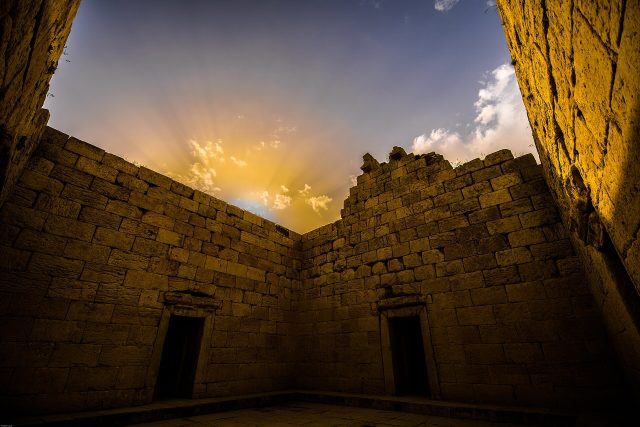
One of the most striking structures in Bishapur is the Temple of Anahita, dedicated to the Zoroastrian goddess of water and fertility. The temple itself is a simple square building, its corners marked by four sturdy columns, but its true significance lies in what it represents. At its center was a pool fed by mountain springs, a sacred space where water was not just revered but carefully managed. The Sasanians were masters of hydraulic engineering, and the remnants of aqueducts and canals around the temple hint at a sophisticated system that sustained the city even in arid conditions. Water here was more than a resource; it was a lifeline, a divine gift that shaped both the spiritual and practical life of Bishapur.
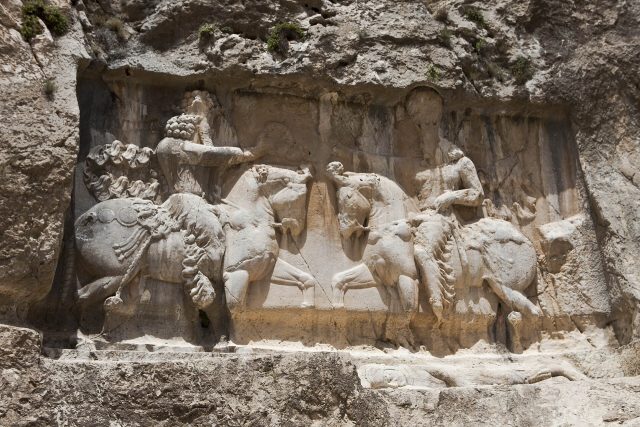
Just outside the city, carved into the rocky cliffs, are the famous reliefs that immortalize Shapur I’s victories. The most dramatic of these depicts the Sasanian king triumphing over the Roman emperor Valerian, a moment frozen in stone that captures the empire’s military prowess. These reliefs were not mere art—they were propaganda, a way to etch history into the landscape for future generations. The figures are rigid yet expressive, their poses laden with symbolism. Nearby, older Elamite inscriptions serve as a reminder that this land has been inhabited for millennia, long before the Sasanians claimed it as their own.
Bishapur thrived for centuries, but like many ancient cities, its decline remains something of a mystery. Perhaps it was overshadowed by larger centers like Ctesiphon, or maybe shifting trade routes left it isolated. By the 10th century, it was abandoned, its streets reclaimed by the desert. For hundreds of years, it existed only in local memory, until European explorers rediscovered it in the 19th century. Today, it stands as one of Iran’s most important archaeological sites, though it lacks the fame of Persepolis or Pasargadae. That obscurity, however, is part of its charm. There are no crowds here, just the quiet rustle of wind through the grass and the occasional cry of a bird echoing across the ruins.
Walking through Bishapur is like stepping into a different era. The stones beneath your feet once bore the weight of empires, and the silence that now envelops the site feels heavy with stories untold. You can almost hear the clamor of a marketplace, the murmur of prayers in the temple, the distant hoofbeats of soldiers preparing for battle. The city sprawls across a vast area, and as you wander its paths, it’s easy to imagine the daily rhythms of life here—merchants haggling over goods, priests performing rituals, children playing in the shade of the palace walls. The view from the hill where the citadel once stood is particularly striking. From this vantage point, the valley stretches out before you, a patchwork of green fields and distant mountains, as if time itself has paused to let you take it all in.
For those fascinated by history, Bishapur offers a unique glimpse into the Sasanian Empire’s blend of innovation and tradition. Unlike the opulent palaces of the Achaemenids or the mystical fire temples of Zoroastrianism, Bishapur’s beauty is more austere, shaped by practicality and ambition. It was built not for luxury but for power, and that purpose is still palpable in its ruins. The city’s design reflects a society that valued order and control, where every structure had a role to play in the grand scheme of empire. Even in decay, Bishapur commands attention, a silent testament to the rise and fall of civilizations.
What lingers most about Bishapur is its sense of resilience. The city was conceived as a symbol of strength, and in many ways, it still is. The mountains that surround it have witnessed countless changes, yet they stand as they always have, framing the ruins like guardians of the past. The wind that sweeps through the valley carries with it the whispers of a time when this place was alive with purpose. To visit Bishapur is to confront the fleeting nature of power and the enduring legacy of those who wielded it. It’s a place where history feels not like a distant memory but like something just beneath the surface, waiting to be rediscovered.