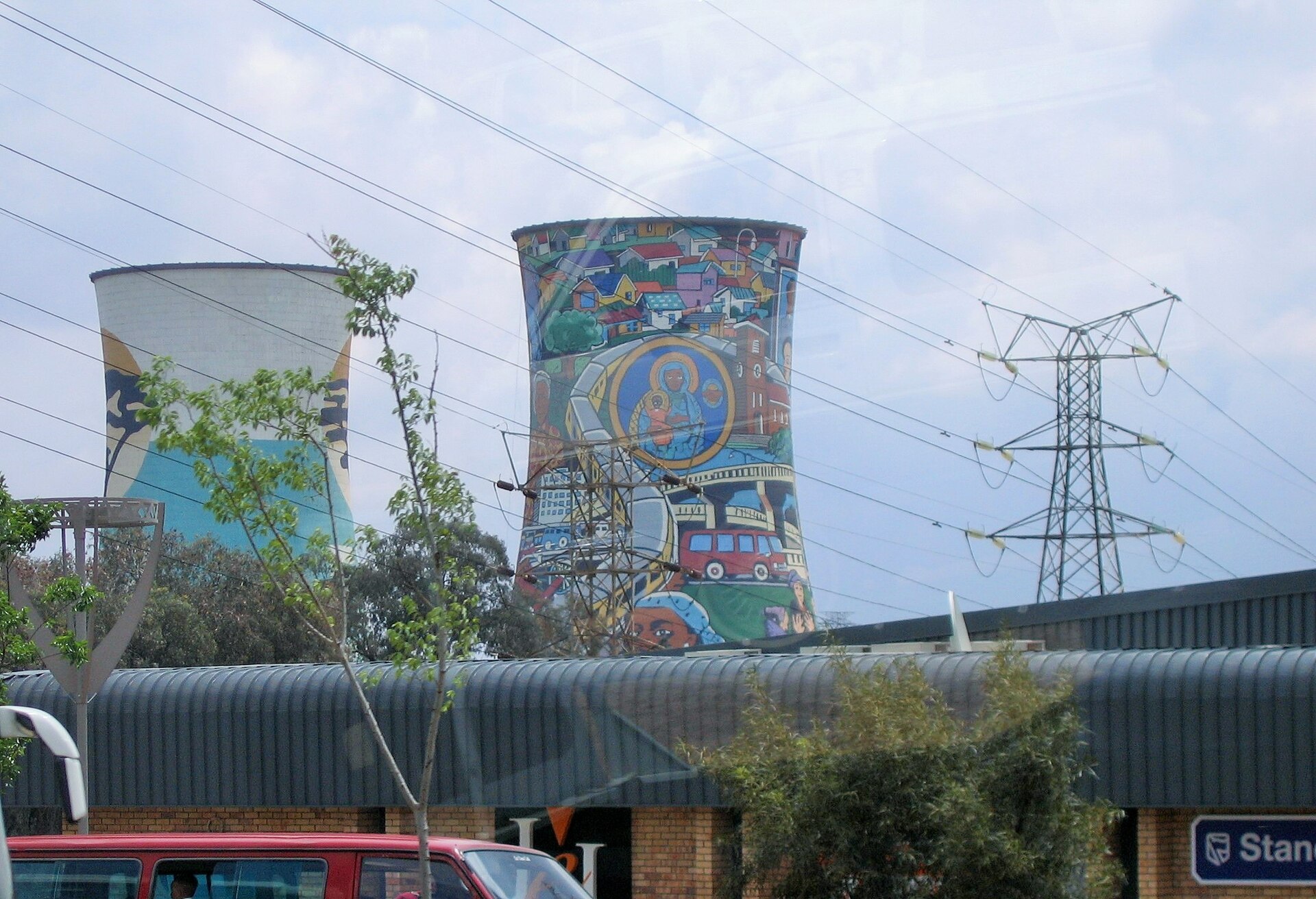
Perched on a gentle rise in Soweto, the Orlando Towers stand as a quiet but unmistakable landmark in the township’s skyline. From a distance, their imposing silhouette cuts against the African sky, a relic of mid-20th-century industry repurposed into something far more enduring. Built in the 1950s as part of a coal-fired power station that once powered Johannesburg’s expansion, the towers were a symbol of progress—though not always an equitable one. Back then, Soweto was still taking shape as a segregated urban settlement, and industrial projects like this were meant to modernize the city, even as they reinforced its divisions. Today, the power station is long gone, but the towers remain, transformed into a monument, a viewpoint, and an unlikely hub for adventure.
The design of the Orlando Towers is straightforward yet striking. The two concrete structures, square in profile, rise high above the surrounding streets, their tops capped with a lattice of metal that gives them a skeletal, almost futuristic look. There’s something distinctly utilitarian about them—no ornate details, no grand flourishes, just raw functionality. Yet against the backdrop of Soweto’s low-slung houses, bustling markets, and patches of greenery pushing through the pavement, they take on a different character. They feel both out of place and perfectly at home, a reminder of the industrial past that once defined this corner of Johannesburg. Inside, where turbines once roared, there’s now only silence, broken occasionally by the wind or the footsteps of visitors.
Soweto’s history is written into its streets, and the Orlando Towers have become part of that narrative, even if they weren’t at the center of the township’s most pivotal moments. During the 1976 Soweto Uprising, when students took to the streets to protest apartheid’s oppressive education policies, the towers stood in the background, silent witnesses to the unrest. They weren’t a stage for the protests, but they became part of the scenery, a fixed point in a landscape of change. Over time, they’ve come to represent more than just industry—they’re a marker of resilience, a structure that outlasted the system it was built to serve. Now, they stand as a bridge between past and present, a place where history isn’t just remembered but actively engaged with.
In the early 2000s, the towers took on a new role as an adventure destination. Thrill-seekers can now bungee jump from the platform between the two structures or rappel down their sides, the wind rushing past as Soweto sprawls below. From that height, the township reveals itself in layers: the colorful roofs of houses, the snaking streets, the distant haze of Johannesburg’s skyline. It’s a perspective that goes beyond the usual tourist gaze—less about observing and more about experiencing the place in a visceral way. For some, it’s just an adrenaline rush; for others, it’s a chance to connect with the energy of a community that thrives outside the usual travel itineraries.
But the Orlando Towers aren’t just for daredevils. They’ve become a gathering spot for locals and visitors alike, a place to wander, take photos, or simply sit in the small park that surrounds them. On weekends, the area buzzes with life—families picnicking, teenagers hanging out, vendors selling snacks, and music drifting through the air. The towers themselves seem to draw people in, offering a sense of scale and permanence in a neighborhood that’s always evolving. There’s something grounding about them, a reminder that even in a place shaped by struggle and change, there’s room for ordinary moments of joy.
What makes the Orlando Towers fascinating is how they’ve been reimagined over time. They began as a symbol of industrial might, then became a backdrop to political upheaval, and now serve as a space for recreation and reflection. This kind of transformation isn’t unique to Soweto—many places here carry layers of meaning, where the past isn’t erased but reinterpreted. There are no museum plaques or guided tours to explain it all; the towers simply exist, and their story unfolds in the way people interact with them. For some, they’re a memorial to the fight against apartheid. For others, they’re a place to test their limits. And for many, they’re just a striking feature of the landscape, a landmark that makes Soweto feel like home.
Soweto is often reduced to its political history, but it’s so much more than that. It’s a vibrant, living community with its own rhythm—cafés serving strong coffee, galleries showcasing local art, jazz clubs humming with music, and even small vineyards producing wine. The Orlando Towers are part of this tapestry, one thread in a larger story. They don’t demand attention, but if you take the time to look, they reveal something about the township’s character: its strength, its contradictions, its ability to adapt. They’re not trying to be anything other than what they are—a piece of history, a place of adventure, a quiet spot to watch the sunset.
There’s a certain charm in the fact that the Orlando Towers aren’t one of South Africa’s most famous landmarks. They don’t have the global recognition of Table Mountain or the Kruger National Park, but that’s part of their appeal. They’re unpretentious, a fixture in the daily lives of Sowetans rather than a must-see attraction. If you visit, you don’t have to jump off them to appreciate their presence. You can just walk up the hill, stand in their shadow, and take in the view. The air carries the scent of dry grass and city dust, the sounds of distant traffic and laughter. Time moves differently here—not in a rush, but not standing still either. The towers have seen decades of change, and they’ll see decades more, standing as a silent testament to Soweto’s past, present, and future.