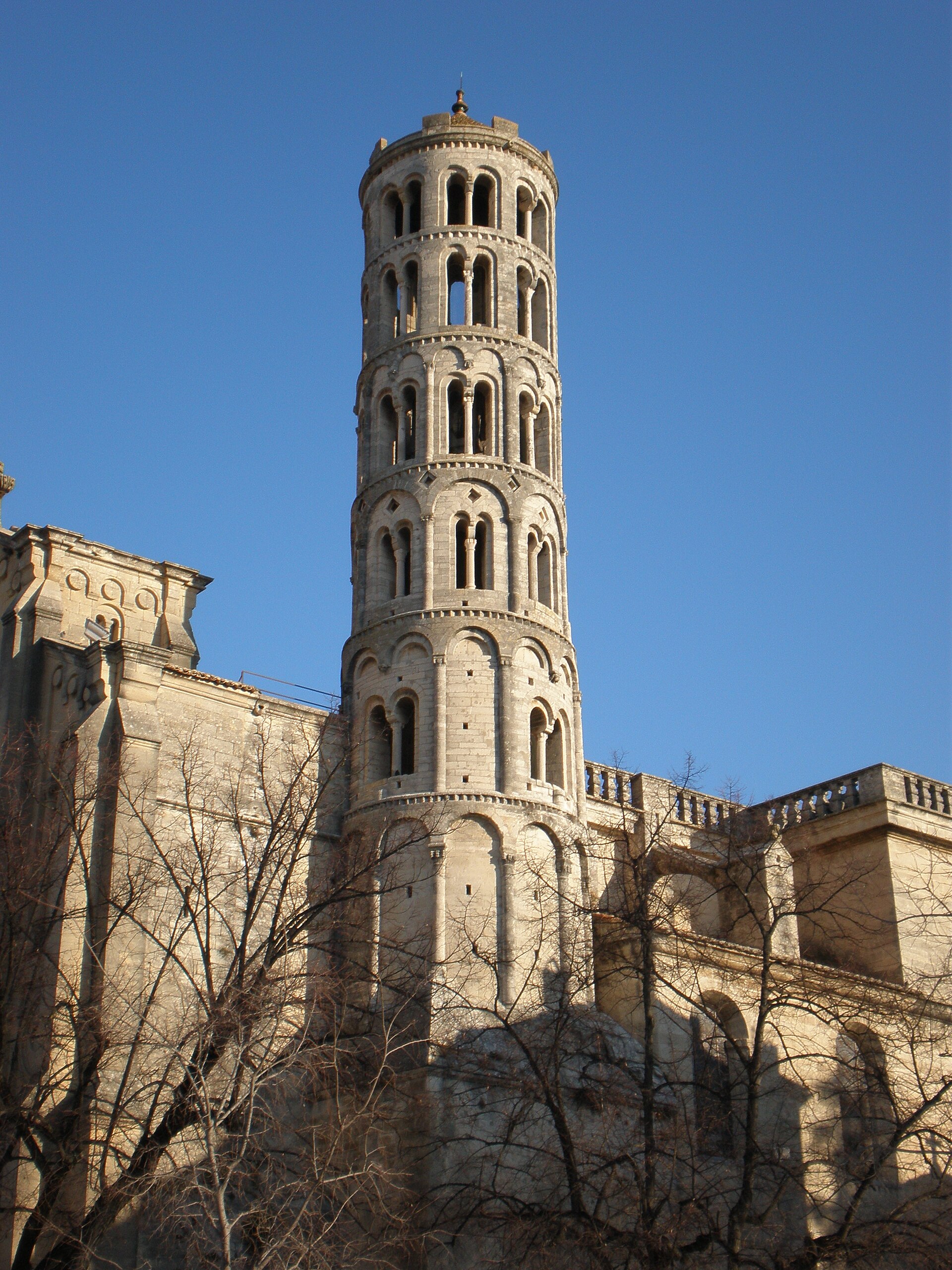
The Fenasse Tower stands as a quiet sentinel over Gord, a small town in the heart of Provence where time seems to move at its own unhurried pace. Built in the 12th century, it was once a critical lookout post, watching over the roads between Avignon and the Mediterranean. The tower’s thick limestone walls, worn smooth by centuries of wind and sun, still bear the marks of its military past—narrow arrow slits, sturdy battlements, and a steep spiral staircase that winds upward like a path through history. Unlike many fortifications of the era, Fenasse was never part of the town’s defensive walls. It stood alone, a solitary stronghold, which may be why it remains so well-preserved today. There are no grand halls or ornate chambers inside, just the raw, unadorned presence of stone and space, a reminder of a time when survival depended on vigilance.
From the top of the tower, the view unfolds like a living postcard of Provence. The rooftops of Gord stretch out below, a patchwork of terracotta tiles and winding alleys that twist between honey-colored houses. Beyond the town, the landscape softens into rolling vineyards and olive groves, their greens and golds shifting with the seasons. In the distance, the Luberon mountains rise like a hazy blue wall, their slopes dotted with villages that have changed little over the centuries. The light here is different—softer, warmer—especially in the late afternoon when the sun dips low and turns the stones to amber. It’s easy to imagine why this place has always felt like a crossroads, not just of trade routes, but of cultures and stories.
Gord itself is a town that wears its history lightly. There are no grand monuments or tourist traps, just a quiet, unassuming charm that seeps into the streets. The Fenasse Tower is part of that rhythm, a familiar landmark that locals pass by without fanfare. It’s not a place that demands attention, but one that rewards those who take the time to notice it. The tower has never been restored in a way that erases its age; the stones are still rough in places, the steps uneven, the air inside cool and slightly damp. Climbing to the top isn’t about ticking off a sight—it’s about stepping into a different era, where the world moved at the pace of a horse’s trot and the horizon was the only limit.
There’s something almost meditative about standing on the tower’s upper platform. The wind carries the scent of lavender and dry earth, and the sounds of the town below—church bells, the occasional clatter of a bicycle, the murmur of voices—fade into the background. This was once a place of watchfulness, where sentries scanned the countryside for signs of danger. Now, it’s a place of stillness, where the only movement is the slow drift of clouds across the sky. The tower doesn’t offer grand narratives or dramatic revelations; it simply exists, a silent witness to the centuries that have passed since its construction.
Like many old places, Fenasse has its share of legends. Some say the tower’s underground chambers once hid Templar treasures, though no evidence has ever surfaced. Others whisper about a ghostly knight who still patrols the battlements at night, a remnant of the tower’s martial past. These stories are likely just that—stories—but they add a layer of intrigue to the tower’s already rich atmosphere. There’s a certain magic in the way old stones hold onto tales, whether they’re true or not. It’s part of what makes places like this feel alive, as if the past isn’t just something to be studied, but something that lingers in the air.
What makes Fenasse special is its ordinariness. It’s not a grand cathedral or a royal palace, but a modest tower that has outlasted wars, plagues, and the slow march of progress. It has never been a symbol of power or wealth, just a practical structure built for a specific purpose. That simplicity is its strength. There are no crowds here, no guided tours rushing from one highlight to the next. Visitors can take their time, leaning against the warm stone of the parapet, watching the shadows lengthen across the valley. The tower doesn’t ask for admiration; it simply offers a moment of connection to a world that existed long before ours.
Gord is the kind of town where history isn’t confined to museums or plaques. It’s in the worn steps of the tower, the crooked lines of the old houses, the way the light falls across the square in the early morning. The Fenasse Tower is just one piece of that larger story, but it’s a piece that feels particularly vivid. Climbing its stairs is like turning the pages of a book where the ink hasn’t yet faded. The view from the top isn’t just a panorama—it’s a reminder of how small we are in the face of time, and how much beauty can be found in the quiet corners of the world.
If you visit, don’t expect a grand spectacle. There are no audio guides or interactive displays, no gift shops or cafes at the base. Just the tower, the town, and the landscape stretching out in every direction. It’s the kind of place that stays with you long after you’ve left, not because it’s extraordinary, but because it feels real. The Fenasse Tower doesn’t need to be anything more than what it is—a silent guardian of a town that has learned to live at its own pace, where the past and present coexist without fuss. And sometimes, that’s enough.