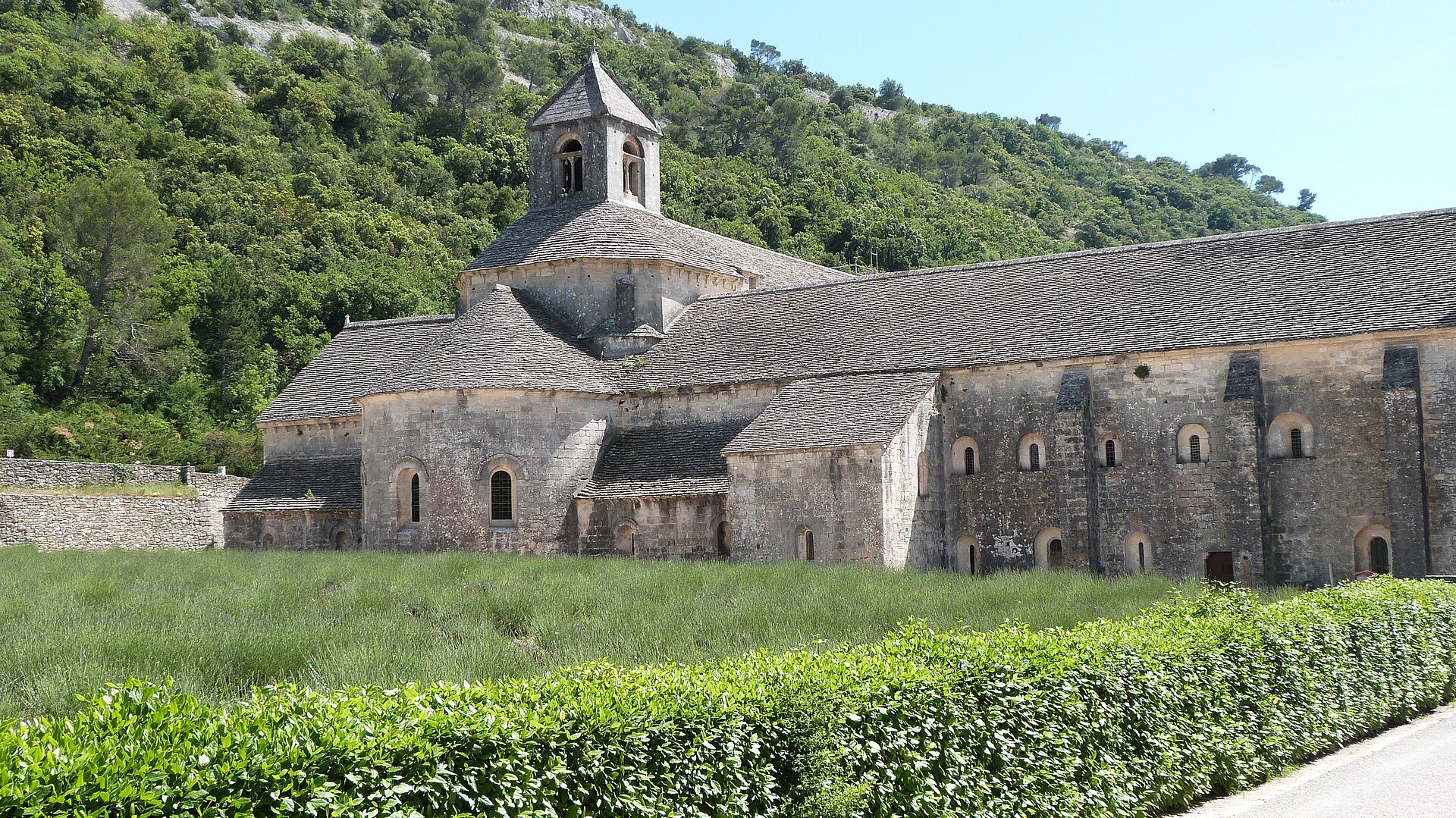
Senanque Abbey feels like a place where time has learned to breathe more slowly. Tucked into the heart of Provence, it rises from the landscape as if it grew there naturally, shaped by the same winds and sunlight that bend the cypress trees and paint the lavender fields in shades of violet. The twelfth-century monastery carries the quiet weight of the Middle Ages, though not in the way one might expect—there are no crowds, no tour guides with microphones, no signs pointing the way. Just the rustle of leaves, the distant chime of a bell, and the kind of silence that settles into your bones.
The story of Senanque begins with a group of Cistercian monks who sought out this remote valley to build a life apart from the noise of the world. The Cistercians were known for their austerity, their rejection of ornamentation, and their belief that beauty lay in simplicity. Over centuries, the monastery took shape stone by stone, each one laid with purpose. The church, the cloister, the refectory—every part of the abbey was designed to serve a function, not to impress. Even the light that filters through the narrow windows feels deliberate, as if measured out by generations of hands.
The architecture of Senanque is a perfect example of the Cistercian ideal: no unnecessary flourishes, no grand statements, just a quiet harmony between form and necessity. The church, built in the shape of a Latin cross, is striking in its restraint. High vaults and thick columns create a sense of space without overwhelming the senses, while the near absence of decoration leaves room for contemplation. The cloister, with its arched walkways surrounding a central garden, was the heart of monastic life. Here, monks would pray, read, or simply sit in silence. The fountain at its center still holds water as clear and cold as it was centuries ago.
Life at Senanque followed a rhythm set by the sun and the seasons. The monks rose before dawn, prayed, worked in the gardens and vineyards, and gathered again for evening services. They grew their own food, made their own wine, and copied manuscripts by hand in the scriptorium. Today, the fields and walls remain, though the daily routines have faded. In the summer months, the abbey is still a place of quiet, where the only sounds are the occasional footsteps of visitors who come not for entertainment, but for something less tangible.
Senanque was not always so secluded. In the Middle Ages, it was a vital spiritual and economic hub, a stop for pilgrims on their way to Santiago de Compostela and a refuge for locals seeking guidance. But as the centuries passed, the influence of monasteries waned, and Senanque fell into disrepair. By the eighteenth century, the last monks had left, and the buildings began to crumble. It wasn’t until the twentieth century that restoration efforts began, bringing the abbey back to life, though not entirely as it once was.
The landscape around Senanque is as much a part of its story as the stones themselves. Rolling hills stretch toward the horizon, covered in vineyards and olive groves, with the distant peaks of the Luberon mountains framing the view. In spring, wildflowers carpet the fields, while summer fills the air with the scent of lavender and thyme. Autumn turns the hills gold and russet, and in winter, a rare snowfall can transform the abbey into something out of a fairy tale. Many visitors come as much for the scenery as for the history, drawn by a sense of place that feels both ancient and alive.
Today, Senanque is still a living monastery. A small community of monks remains, following the traditions of their order in near silence. They are rarely seen, but their presence is felt in the careful upkeep of the gardens, the orderliness of the spaces, and the stillness that lingers in the air. For those who wish to stay longer, the abbey offers simple guest accommodations—not a luxury hotel, but a place to step away from the noise of modern life. A night here is less about comfort and more about connection, a chance to slow down and listen.
A visit to Senanque is not like visiting a museum or a tourist attraction. There are no flashy exhibits or guided tours with dramatic storytelling. Instead, it’s a place for those who appreciate the quiet, the unadorned, and the enduring. You can spend hours wandering the cloister, sitting on a bench in the garden, or simply gazing at the hills while birdsong drifts on the breeze. Time moves differently here, and when you leave, you carry something with you—something intangible, like the echo of a prayer or the memory of light on stone.