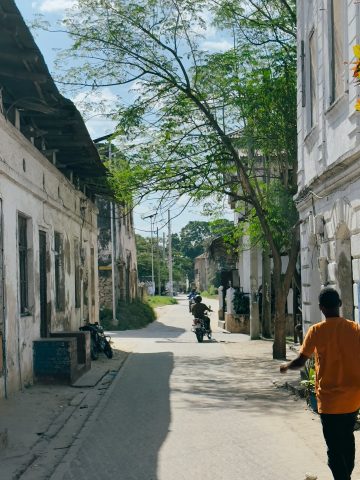
Bagamoyo is a place where time seems to have paused, leaving behind layers of history that still breathe in its quiet streets. Just an hour’s drive from Dar es Salaam, this coastal town was once one of East Africa’s most vital ports, a gateway between the continent and the wider world. Today, it feels far removed from the hustle of modern cities. The streets, paved with coral stone, wind past low-slung houses with intricately carved wooden doors and shaded verandas where merchants and travelers once lingered. There’s a sense that every corner holds echoes of those who passed through here centuries ago, their stories lingering in the salt-tinged air.
The name Bagamoyo carries a weight of meaning. In Swahili, it comes from *bwaga moyo*—to lay down one’s heart. Some say it refers to the enslaved people who were brought through this port, for whom Bagamoyo was the last piece of African soil they would ever touch. Others believe it speaks to the exhaustion of traders and explorers who, after months of trekking through the interior, finally reached the coast and could rest. Whatever its origins, the name feels fitting. This was a place where lives intersected—where empires, cultures, and fates collided and diverged.
Bagamoyo began as a small settlement along the trade routes that connected the African interior with the coast. By the 8th century, Arab traders had established themselves here, dealing in ivory, gold, and human lives. By the 19th century, the town had become a major hub in the slave trade, with thousands of people forcibly marched through its streets before being shipped across the Indian Ocean. Yet it was also a center of learning and faith. Mosques and madrasas rose alongside merchant houses, their architecture blending Arab, Indian, and African influences into something distinctly Swahili.
One of the most striking remnants of that era is the Old Fort, built in the mid-1800s. Constructed from coral stone and clay, it served as both a defensive stronghold and a warehouse for goods, later becoming a prison for enslaved people. Today, the fort houses exhibits on the town’s history, but even without them, its walls carry a heavy presence. Nearby stands the Catholic mission, founded in the late 19th century by German missionaries who arrived with the goal of ending the slave trade and converting the local population. Their efforts met resistance from Arab traders and some communities, but the mission remains a testament to the complex forces that shaped Bagamoyo.
The town’s architecture is a living record of its past. Walking through the old quarter, you’ll see houses with elaborately carved doors—geometric patterns and Arabic script hinting at the wealth of the merchants who once lived there. Many of these buildings follow the *zidaka* style, common along the Swahili coast, with inner courtyards that open into cool, high-ceilinged rooms designed to escape the heat. A short distance from the center lies the Kaole ruins, home to one of the oldest mosques on the East African coast, built in the 13th century. Nearby, the remnants of an ancient settlement—crumbling walls and tombs—offer a glimpse into a time when this place thrived as a bustling trading post.
Bagamoyo wasn’t always a relic of the past. In the late 1800s, it became the capital of German East Africa, and the colonial administration left its mark with new buildings—schools, hospitals, and government offices. The Germans envisioned turning the town into a major commercial and administrative center, but their rule was short-lived. After World War I, Tanganyika came under British control, and Bagamoyo’s importance as a port faded. Trade shifted to Dar es Salaam, and the town slipped into relative obscurity. Ironically, this neglect may have saved it. Without modern development, its historic character remained largely intact.
Life in Bagamoyo moves at its own unhurried pace. There are no crowds of tourists, just the easy rhythm of a town that exists for itself. Fishermen set out in traditional *dhows* at dawn, their wooden hulls cutting through the waves, while the market bustles with vendors selling fresh fruit, spices, and brightly patterned fabrics. In the evenings, musicians gather by the waterfront, playing *taarab*—a genre that blends Swahili melodies with Arabic and Indian influences. The music feels timeless, much like the town itself. It’s easy to imagine what life here was like a century ago, when Bagamoyo was a crossroads of cultures and stories.
Yet Bagamoyo isn’t frozen in time. It has its own quiet vitality—children playing in the sandy streets, elders chatting outside their homes, cafes serving fresh coconut water and grilled fish seasoned with local spices. The town doesn’t try to impress visitors, and that’s part of its charm. It doesn’t perform for outsiders; it simply exists, unapologetically itself. Those who come here often end up staying longer than planned, drawn in by the way Bagamoyo reveals itself slowly, like a story unfolding at its own pace.
For many travelers, Bagamoyo becomes more than just a stop on the way to Tanzania’s more famous attractions. There are no grand safaris or Zanzibar’s pristine beaches here, but there’s something deeper—a sense of connection to a history that isn’t neatly packaged in guidebooks. The town serves as a reminder of how fragile human lives can be, how cultures intertwine, and how important it is to remember the past, even when it’s painful. Bagamoyo doesn’t shout its significance. Instead, it speaks softly, offering its stories to those willing to listen.