Kaole is one of those rare places where time feels suspended, as if the world beyond its quiet ruins has moved on without it. Just a short distance from Bagamoyo, this small patch of land holds the remnants of a once-thriving settlement that played a crucial role in the trade and spiritual life of East Africa’s coast. Today, the only sounds are the rustle of tall grass in the wind and the occasional call of a bird. The stone walls, worn smooth by centuries and softened by moss, stand as silent witnesses to a past that was far from quiet. Unlike the crowded tourist sites that dot the region, Kaole offers solitude—a chance to walk among history without distraction, to touch the past with your own hands.
The ruins are all that remain of a city founded in the 13th century, which flourished until the 19th. At its height, Kaole was a vital hub in the network of trade routes connecting the African interior with the Indian Ocean. Long before Bagamoyo existed in its current form, this was where merchants from Persia, Arabia, India, and even China converged to exchange ivory, gold, spices, and enslaved people. The city was part of the Swahili Coast, a string of settlements stretching along the eastern edge of the continent, and its architecture reflected the blend of cultures that defined the region. The buildings here were not just structures but symbols of a world where borders were fluid and influence traveled with the monsoon winds.
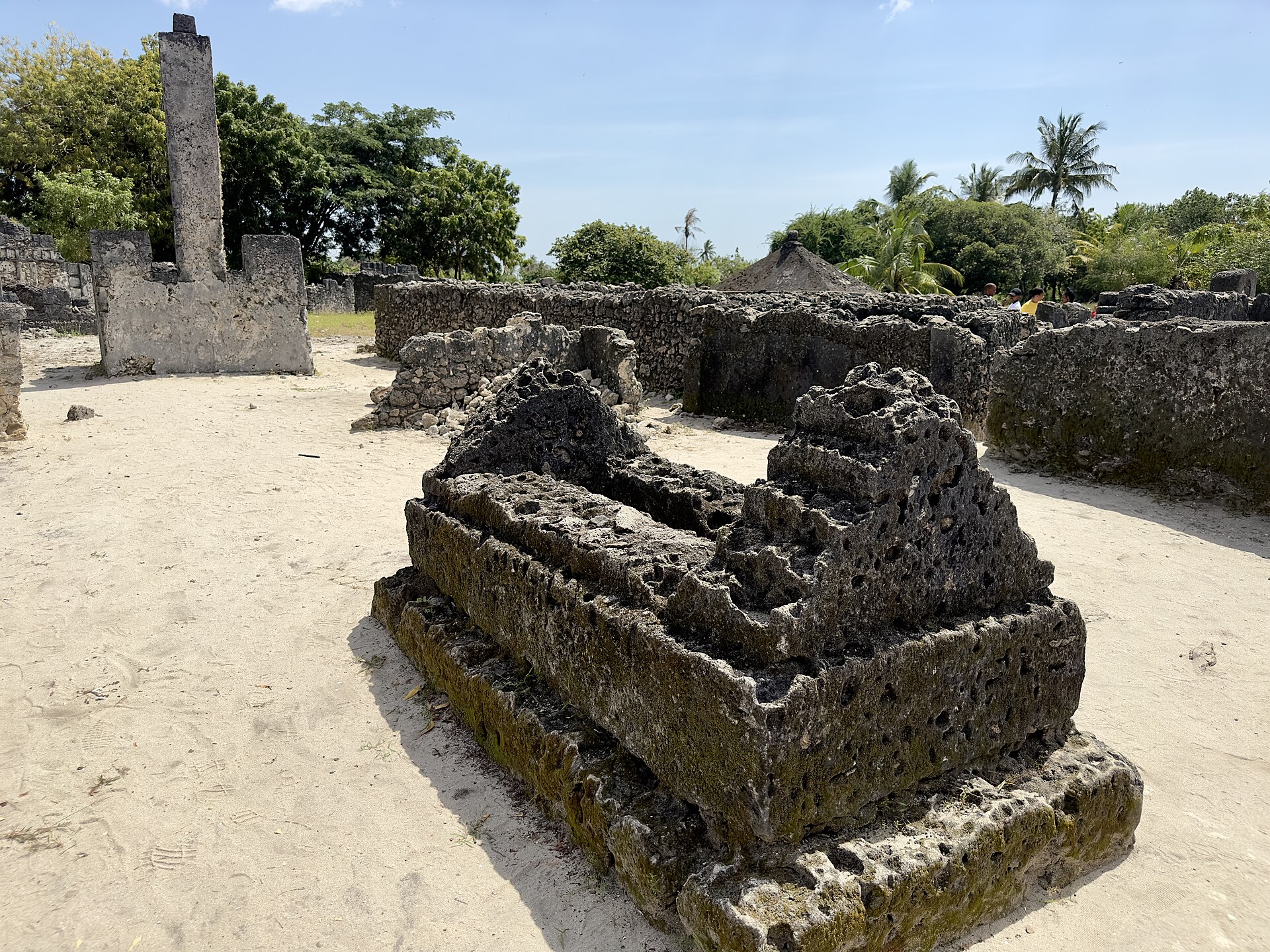
The most striking features of Kaole are its two mosques and several mausoleums, all built from coral stone. The larger mosque, dating back to the 13th century, is among the oldest in Tanzania. Though its walls are crumbling, traces of its former grandeur remain—arched doorways, prayer niches, and fragments of intricate carvings that hint at the craftsmanship of its builders. The smaller mosque, from a later period, is less ornate but no less significant. Both were constructed in the distinctive Swahili style, where local building traditions merged with Arab influences. The coral stone, quarried from the nearby shore, was shaped by hand, each block fitted together with care. The result is a style that feels both sturdy and delicate, as if the buildings were meant to endure but also to inspire.
The mausoleums tell their own stories. These are the resting places of local rulers and noble families, their tombs marked by domes and arched entrances. The most notable belongs to Sheikh Suleiman ibn Hasan, a 15th-century figure whose mausoleum is adorned with Arabic inscriptions that can still be deciphered with a little patience. Inside, the air is cool and still, though any treasures once kept here have long since disappeared. Yet even in their emptiness, the mausoleums carry a weight of history. They were built not just as memorials but as statements of power and faith, their designs meant to impress and endure.
Beyond the mosques and mausoleums, the ruins of Kaole include the foundations of homes and public buildings. These structures are less intact, their outlines blurred by time and vegetation, but they offer glimpses into daily life in the city. Some walls still stand waist-high, their coral blocks weathered but unmistakable. Archaeologists have speculated about the existence of an advanced water system, though no definitive evidence has been found. What remains are fragments—wells, drainage channels, the occasional carved detail—that suggest a society far more organized than the ruins might first imply. Piecing together the past here requires imagination, but the effort is part of what makes Kaole so compelling.
The city’s decline is tied to the darker chapters of East African history. By the 19th century, as Kaole faded, Bagamoyo became a major center for the slave trade. Enslaved people captured in the interior were marched through Kaole on their way to the coast, where they were loaded onto ships bound for markets in Arabia and the Persian Gulf. Today, there are no visible reminders of this suffering—no plaques, no memorials—just the quiet of the ruins and the distant sound of the ocean. Yet the weight of that history lingers, as if the stones themselves remember. It’s impossible to walk here without feeling the contrast between the beauty of the place and the brutality that once passed through it.
Nature has begun to reclaim Kaole, softening the edges of the ruins with grass, vines, and trees. Birds nest in the crumbling walls, and monkeys sometimes wander through, their chatter breaking the silence. The ocean, just a short walk away, provides a constant backdrop of sound, its waves a reminder of the trade routes that once defined this coast. The interplay between the man-made and the natural gives the site a sense of timelessness, as if the ruins are not just relics but part of an ongoing cycle of growth and decay.
Visiting Kaole is less about ticking off a tourist attraction and more about stepping into another era. There are no crowds, no guided tours with rehearsed scripts, no souvenir stalls. Just the ruins, the wind, and the occasional rustle of leaves. You can spend hours here, sitting on a low wall and trying to picture the city as it once was—full of voices, movement, and life. Or you can wander aimlessly, letting the stones guide you, each one a piece of a puzzle that may never be fully solved. Either way, Kaole leaves an impression that lingers long after you’ve left. It’s not just a place to see; it’s a place to feel, to reflect on the layers of history that shape the world we live in today.