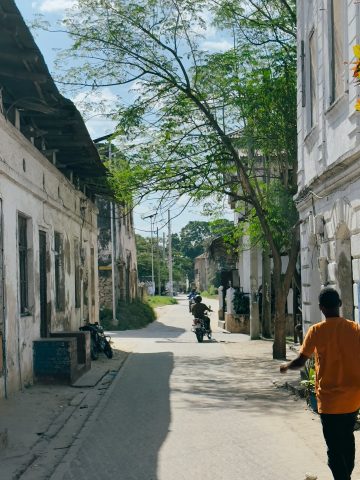
Bagamoyo is one of those places where the past lingers in the air, not as a distant memory but as something almost tangible. Karimjee House stands at the heart of this quiet coastal town, a building that has witnessed the ebb and flow of trade, culture, and history over more than a century. Built in the late 1800s, it was once the home of the Karimjee family, Indian merchants who played a significant role in shaping the economic landscape of East Africa. At the time, Bagamoyo was a bustling port, a crucial link between the interior of the continent and the Indian Ocean, where goods like ivory, spices, and cloth changed hands between African, Arab, and European traders. The house was more than just a residence—it was a hub of commerce, diplomacy, and daily life, a place where deals were struck and relationships forged across cultures.
The architecture of Karimjee House reflects the layered history of the region. The façade is distinctly Indian, with intricately carved wooden balconies and arched windows that hint at the family’s roots. Yet there’s also a European influence in the layout of the rooms and the use of local materials like coral stone and mangrove wood. The high ceilings, thick walls, and inner courtyards were practical adaptations to the tropical climate, designed to keep the interior cool while allowing breezes to circulate. The house wasn’t just built for living; it was built for business, with large reception halls where merchants would gather to negotiate and socialize. Walking through its rooms today, you can almost hear the murmur of voices and the rustle of papers from another era.
Today, Karimjee House functions as a museum, offering one of the few opportunities in Bagamoyo to step beyond the surface of the town’s history. The exhibits inside tell the story of the Karimjee family—their rise as traders, their interactions with local communities, and their place in the broader narrative of East African commerce. Old photographs, handwritten ledgers, and samples of the goods they traded—ivory tusks, spices, and bolts of cloth—paint a vivid picture of life in the 19th century. One of the most striking displays is a collection of antique maps, their faded lines tracing the routes of caravans that once connected Bagamoyo to the Great Lakes region and beyond. These maps reveal just how vast and interconnected the trade networks were, stretching across thousands of miles and linking distant cultures.
Bagamoyo itself is a town steeped in history, and Karimjee House occupies a unique place within it. In the 19th century, the town was a major hub for the slave trade, a dark chapter that casts a long shadow over its past. While the Karimjee family wasn’t directly involved in that trade, their house stands as a reminder of the complex forces at play during that time. After the abolition of slavery, Bagamoyo’s importance waned, but its history didn’t disappear. Instead, it settled into the fabric of the town, visible in the crumbling colonial buildings, the old mission churches, and the quiet streets where time seems to move at its own pace. Karimjee House bridges these different eras, offering a glimpse into a time when Bagamoyo was a thriving port and a crossroads of cultures.
Visiting Karimjee House is more than just a museum tour; it’s a chance to immerse yourself in the rhythm of old Bagamoyo. The house is centrally located, making it easy to explore the surrounding area on foot. Nearby, you’ll find the ruins of the German colonial fort, a reminder of the town’s brief but significant role in the colonial era. Just a short walk away is the Catholic mission, where early missionaries once worked to establish schools and churches. The streets around Karimjee House are narrow and shaded, lined with low-slung buildings topped with rusted corrugated iron roofs. The pace of life here is slow, almost languid, and even the occasional sound of a passing motorbike or the distant call of a market vendor doesn’t disrupt the sense of stepping back in time.
What makes Karimjee House particularly fascinating is how it embodies the cultural exchange that defined East Africa in the 19th century. The Karimjee family was part of a larger Indian diaspora that left an indelible mark on the region, contributing to its commerce, architecture, and social fabric. Their house is a physical manifestation of that exchange, blending Indian, Arab, and European influences into a single structure. In one room, you might see traditional Indian textiles displayed alongside intricately carved African wooden sculptures. In another, European-style furniture sits beside brass lanterns and woven mats. These juxtapositions aren’t just decorative; they tell a story of how people from different backgrounds lived, worked, and adapted to life in a rapidly changing world.
Bagamoyo today is a far cry from the bustling port it once was. It’s a quiet town, overshadowed by more famous destinations in Tanzania, which makes a visit to Karimjee House feel all the more special. There are no crowds here, no rush—just the opportunity to wander through the exhibits at your own pace, to sit in the inner courtyard and listen to the sounds of the town drifting in from outside. The museum is small, but it’s carefully curated, with each display thoughtfully arranged to evoke a sense of the past. If you’re lucky, a local guide might share stories about the house and its former inhabitants, their voices warm with the kind of personal connection that brings history to life.
Karimjee House isn’t just a relic of the past; it’s a living piece of history that continues to evolve. In recent years, efforts have been made to restore and preserve the building, ensuring that it remains a place where visitors can connect with the stories it holds. This preservation isn’t just for tourists—it’s for the people of Bagamoyo, for whom the house is a tangible link to their own heritage. History isn’t just something you read about in books; it’s something you can see, touch, and feel. And in Karimjee House, that history is waiting for anyone willing to step inside and listen.