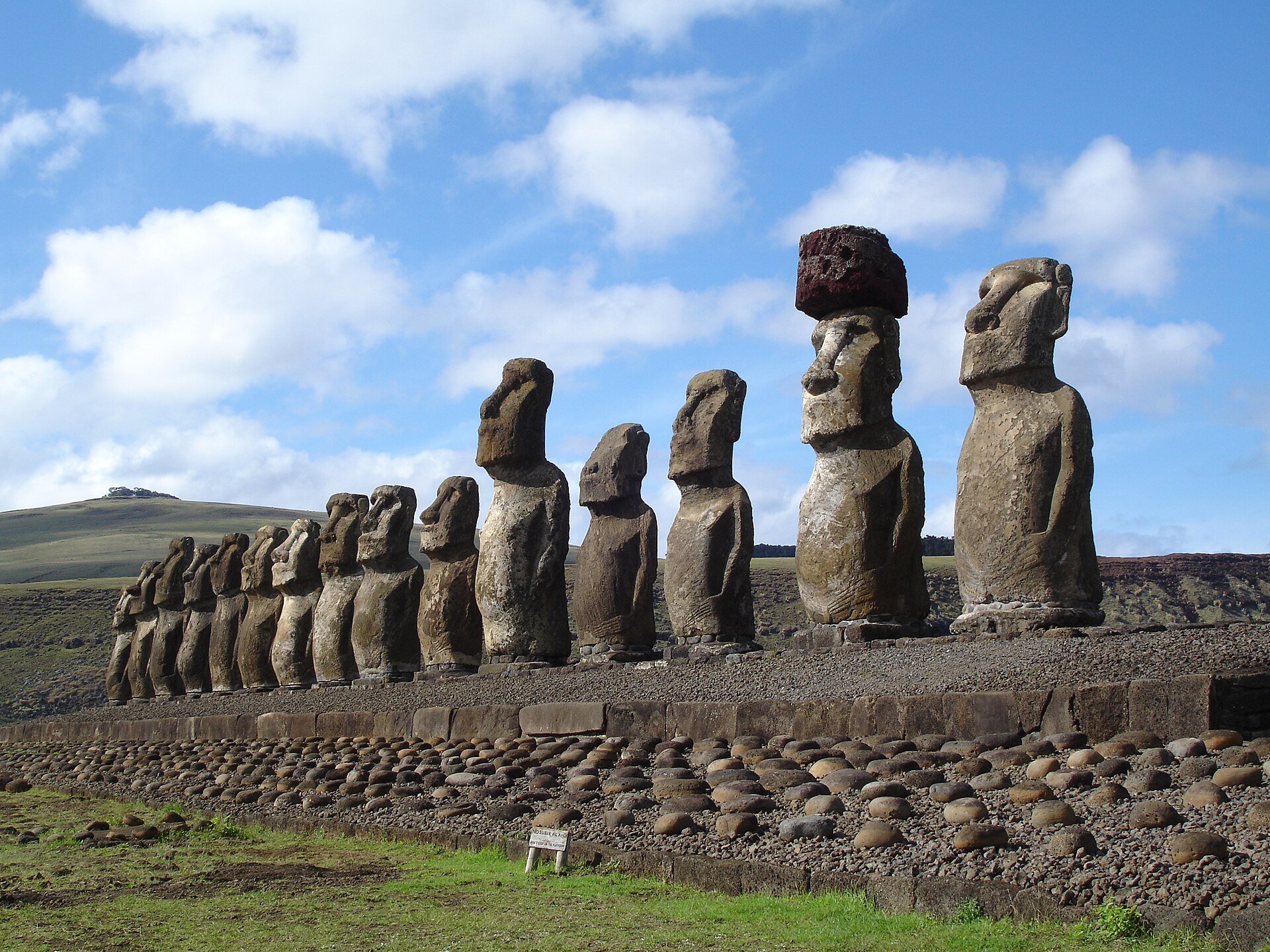
Ahu Tongariki stands as one of the most striking sights on Easter Island, a place where time seems to pause and the weight of history presses against the present. Fifteen towering moai, carved from volcanic stone, line up along a massive ceremonial platform, their backs to the ocean as if guarding the island from unseen forces. The sheer scale of the statues is impressive, but what lingers is how naturally they blend into the landscape—weathered by centuries, their rough surfaces mirroring the ancient earth beneath them. There’s no grand entrance, no modern distractions, just the quiet presence of these silent sentinels, their gaze fixed on the horizon.
The story of Ahu Tongariki is woven into the broader history of Rapa Nui, a tale of creation, conflict, and resilience. The moai were erected between the 12th and 17th centuries, during the height of the island’s culture, each one representing an ancestor or chief. Their placement was part of elaborate rituals meant to bridge the living and the dead, a physical manifestation of reverence and power. But by the 18th century, intertribal wars had left many of the island’s ceremonial platforms in ruins, the statues toppled and abandoned. Ahu Tongariki shared this fate, its moai lying scattered for generations, buried under soil and forgotten until the land itself seemed to reclaim them.
Restoration came slowly, a painstaking effort that required decades of work. In 1960, a tsunami triggered by a Chilean earthquake swept across the island, scattering the statues even further and damaging the platform. It wasn’t until the 1990s that a team of Chilean archaeologists and Japanese engineers began the process of bringing Ahu Tongariki back to life. Each moai had to be carefully lifted into place, the platform reconstructed stone by stone. The result is a site that appears untouched by time, though the truth is far more complex—every block, every statue, bears the marks of human determination to preserve what was nearly lost.
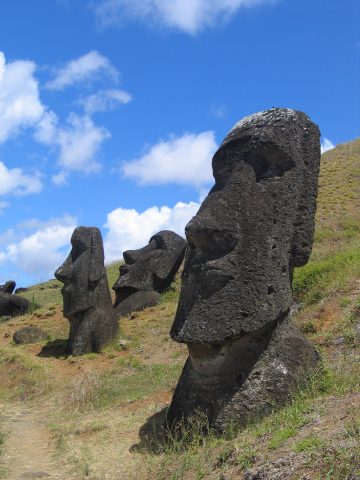
The location of Ahu Tongariki was chosen with purpose. Situated on the island’s eastern coast, it lies just a few kilometers from Rano Raraku, the volcanic quarry where the moai were carved. The platform faces the ocean, with rolling green hills stretching behind it, a stark contrast to the deep blue of the Pacific. On clear days, the horizon blurs into the sky, and the vastness of the landscape makes the statues seem even more monumental. There’s a stillness here, a sense of reverence that lingers in the air, as if the land itself is holding its breath.
The moai at Ahu Tongariki vary in size and detail, each with its own character. The tallest stands nearly ten meters high, while the smallest is closer to five. Some still bear traces of their original *pukao*—the red scoria cylinders that once crowned their heads, symbols of status and authority. These stones were quarried from a different site, transported and placed atop the moai in a display of craftsmanship and devotion. Interestingly, not all the statues face the same direction. One stands turned inward, as if watching over the platform and those who visit, a silent observer of the centuries passing by.
The best time to visit Ahu Tongariki is during the soft light of early morning or late afternoon, when the crowds thin and the statues take on a different quality. At sunrise, the first rays catch the faces of the moai, casting long shadows and bathing them in a warm glow. By evening, the setting sun stretches their silhouettes across the platform, the fading light giving them an almost lifelike presence. Many travelers come specifically for these moments, when the play of light and shadow transforms the site into something even more haunting and beautiful.
Despite its fame, Ahu Tongariki retains a sense of solitude. Unlike some of the island’s more crowded spots, this is a place where you can sit quietly on the stones, listening to the wind and the distant crash of waves. There are no tour groups here, no loud voices breaking the silence—just the occasional presence of locals, who might stop by to pay their respects or simply enjoy the view. The land feels alive in a way that’s hard to describe, as if the past and present coexist in the same space, separated only by the thin veil of time.
For the Rapa Nui people, Ahu Tongariki is more than just a historical site—it’s a living connection to their ancestors. Many traditions tied to the moai endure, especially during the annual Tapati festival in February, when ceremonies and dances are held in honor of the past. Even outside of these events, the site carries a spiritual weight. The wind carries whispers of old stories, and the statues, though silent, seem to speak in their own way, a reminder of a culture that has endured despite centuries of change.
Reaching Ahu Tongariki requires a drive from Hanga Roa, a journey of about twenty kilometers along a winding dirt road that cuts through the island’s volcanic heart. The route itself is part of the experience, passing by half-buried moai and ancient stone walls, remnants of a time when this land was alive with activity. As the road nears the coast, the ocean comes into view, and then, suddenly, the platform appears—no signs, no barriers, just the statues standing against the vastness of the sea. It’s a humbling sight, one that makes the noise of the modern world feel very far away.