Ahu Akivi
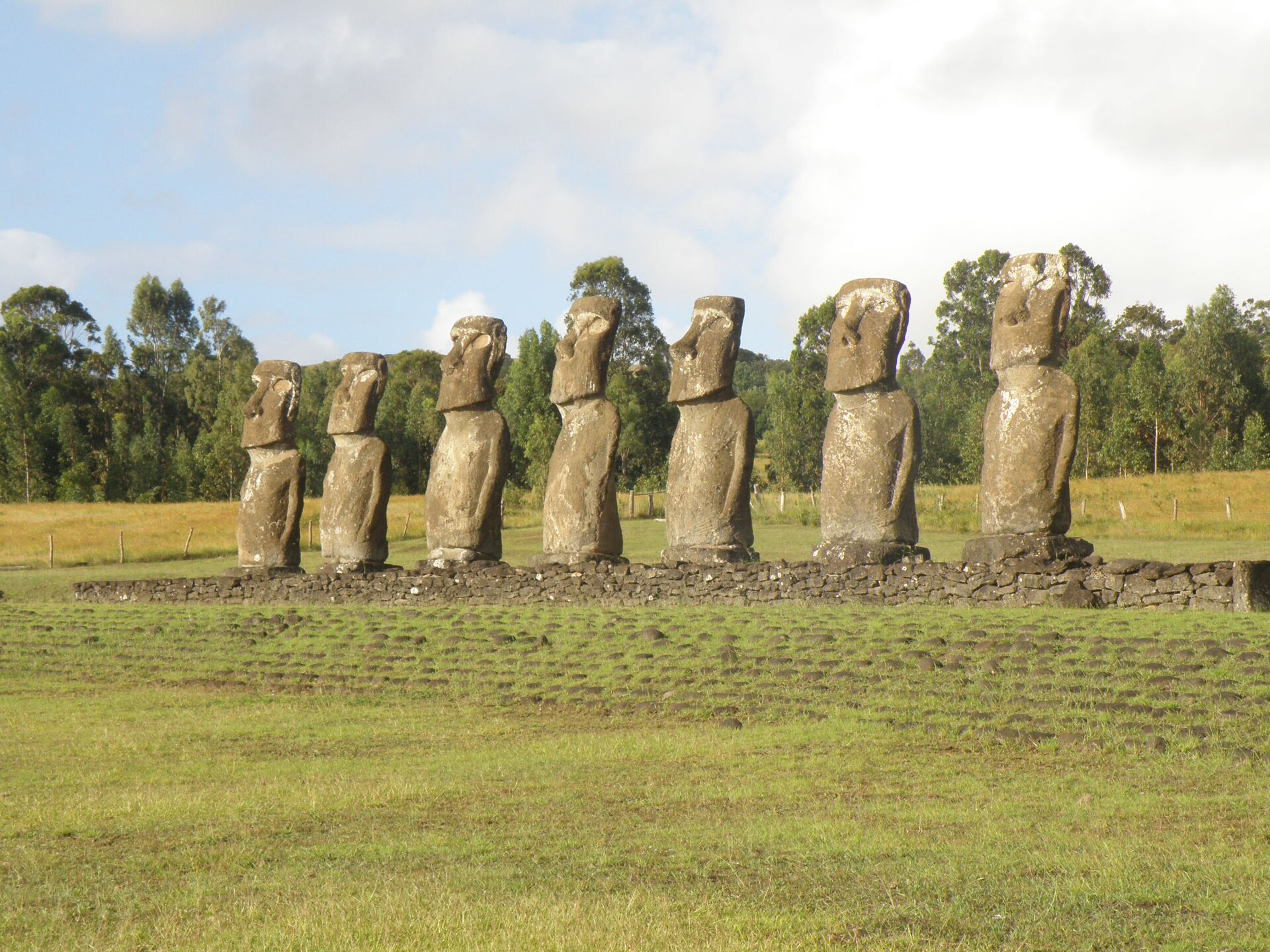
Ahu Akivi stands apart on Easter Island. Here, seven moai face inland, not the ocean. Their backs are to the sea, their gaze fixed on the horizon where the sun sets during the equinox.
This site is quieter than Ahu Tongariku or Rano Raraku. Fewer visitors come here, so the statues feel closer, as if their secrets are still intact.
The moai were raised in the 16th century, when Rapa Nui culture was at its peak. Their alignment suggests they marked the seasons—an astronomical calendar carved in stone. Some believe they honor ancestors who arrived from the east, their origins tied to the rising sun. The precision of their placement shows a society that watched the skies, linking celestial movements to ritual and time.
The platform is built from basalt blocks, fitted together with care. The statues, carved from tuff, are smaller than some of their counterparts but balanced in proportion. Their red scoria topknots are missing, though the figures still hold a quiet presence. All seven are nearly identical, hinting at a shared purpose—perhaps ceremonial, perhaps something else entirely.
Ahu Akivi sits on a gentle slope, away from the coast. The hills around it roll softly, and no other major structures stand nearby. The isolation makes the site feel suspended in time.
Standing before the moai, the wind moves through the grass. The sun shifts overhead. The statues remain still, as they have for centuries. It’s not hard to imagine this place as it once was—gatherings, chants, offerings to gods and ancestors.
Centuries took their toll. After Rapa Nui civilization declined in the 18th and 19th centuries, many moai were toppled. Ahu Akivi’s restoration began in the mid-20th century. Archaeologists re-erected the statues by hand, lifting each stone without machinery. Today, the site looks much as it did in its prime, though the stone bears the marks of time.
Visiting Ahu Akivi isn’t about checking off a landmark. It’s about stepping into the island’s past. There’s space to wander, to touch the rough stone, to sit in silence. Local guides speak of the moai as ancestral spirits, still watching over the land. Some call it folklore. Others feel it’s real. Either way, the place makes you pause.
How many secrets does this island still hold?
The site is a few kilometers from Hanga Roa. The road winds through plains of coarse grass and scattered shrubs. Wild horses graze along the way. The ocean glints in the distance. A car or bicycle makes the trip easier, but walking lets you take in the landscape. Bring water—there are no cafes nearby.
Easter Island’s past is never far beneath the surface. Ahu Akivi makes that connection feel stronger. Maybe it’s the solitude. Maybe it’s the way these moai look inland, not toward the sea, as if reminding us that Rapa Nui’s roots run deep. Whatever the reason, this is a place to visit slowly.
Listen. The island’s voice is quiet, but it speaks to those who take the time to hear it.