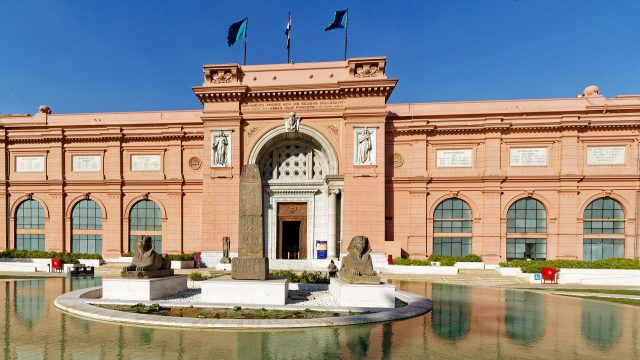
Cairo
Egypt · 18 places
Photo: KennyOMG, CC BY-SA 4.0
Cairo is a city where time doesn’t just pass—it layers itself, stacking centuries like the stones of its oldest buildings. The past isn’t preserved here; it’s alive, breathing through the cracks of the present. Ancient mosques stand shoulder to shoulder with glass skyscrapers, their minarets piercing the same sky that once watched over pharaohs. The streets hum with a rhythm that feels both eternal and fleeting—vendors shouting over the clatter of carts, the scent of spices mingling with exhaust fumes, the Nile’s slow current carrying the weight of millennia. This is a place where history isn’t something you visit; it’s something you step into, like a river you can’t help but wade through.
Few cities can claim such an immediate connection to antiquity. Just beyond Cairo’s edges, the pyramids of Giza rise from the desert, their silhouettes as familiar as they are surreal. But the city itself is no less steeped in the past. Wander through Islamic Cairo, and you’ll find yourself in a labyrinth of medieval alleyways where the air is thick with the scent of old wood and incense. The walls of Al-Azhar Mosque, one of the oldest universities in the world, have heard whispers of scholars who shaped entire civilizations. Even the dust here feels ancient, swirling in the sunlight like a reminder that this land has seen empires rise and fall. It’s easy to imagine that if you turned a corner too quickly, you might stumble upon a caravan of merchants or a procession of priests, their robes fluttering in the same wind that carries the call to prayer today.
Yet Cairo is far from frozen in time. It’s a city of stark contrasts, where wealth and poverty exist side by side, where the quiet of a hidden courtyard can shatter into the chaos of a bustling market in seconds. In Zamalek, sleek cafés serve artisanal pastries to well-dressed crowds, while just across the river, the streets of Bulaq teem with life in a way that feels untouched by modernity. There’s no single Cairo to discover—only fragments, each with its own pulse. A wrong turn might lead you to a tiny shop where an old man paints hieroglyphs onto papyrus, or to a rooftop where neighbors gather to drink tea as the sun sets over the city. The best way to experience Cairo is to let it surprise you, to accept that you won’t see it all, and that’s the point.
This is also a city that refuses to slow down. Even at night, when most places quiet, Cairo keeps moving. Cafés spill onto sidewalks, their patrons arguing over backgammon or sipping thick, sweet coffee. The streets buzz with motorbikes and the occasional donkey cart, a reminder that old and new don’t just coexist here—they collide. For visitors, it can be overwhelming. Cairo doesn’t cater to tourists; it demands that you meet it on its own terms. There’s no script to follow, no neatly packaged experience. You might spend an afternoon haggling in Khan el-Khalili, only to find yourself later in a traffic jam, surrounded by honking cars and the distant echo of a muezzin’s voice. It’s messy, it’s loud, and it’s exhausting—but that’s what makes it real.
Of course, Cairo isn’t for everyone. The heat can be oppressive, the crowds suffocating, the noise relentless. It’s a city that tests your patience, that doesn’t apologize for its chaos. But those who stay long enough to look beyond the surface will find something rare: a place that doesn’t just show you its history, but makes you feel it. You might leave with more questions than answers, with a sense that you’ve only scratched the surface of something vast and unknowable. That’s the magic of Cairo—it doesn’t give itself away easily. It lingers in your memory, not as a postcard image, but as a living, breathing presence, one that stays with you long after you’ve left its streets.
See & Do
18 places

Places on the map
Marker colour follows the categoryClimate and weather
Detailed weather: Cairo- Average temperature
- 23 °C
- Precipitation per year
- 34 mm
Average air temperature
°C
15
16
19
23
27
29
30
30
29
25
21
17
Jan
Feb
Mar
Apr
May
Jun
Jul
Aug
Sep
Oct
Nov
Dec