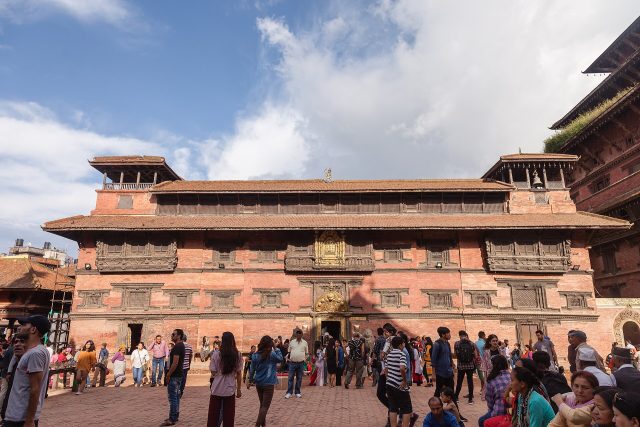
The Golden Temple in Patan is one of those rare places that feels suspended in time, untouched by the rush of the modern world. Tucked away in the heart of the old city, it sits quietly on a small square, surrounded by narrow lanes where life moves at the same unhurried pace it has for centuries. The temple doesn’t announce itself with grand gates or towering spires—its modest entrance is almost hidden behind the surrounding houses, and only the glint of its gilded roof hints at what lies beyond. But step inside, and the world shifts. The noise of the city fades, replaced by an atmosphere of quiet reverence, craftsmanship, and deep spiritual tradition.
Officially known as Hiranya Varna Mahavihar, or the Monastery of the Golden Splendor, the temple dates back to the 12th century, built during the reign of King Bhaskar Malla, one of the last rulers of the Malla dynasty. This was a golden age for the Kathmandu Valley, when Patan—then an independent kingdom—competed with Kathmandu and Bhaktapur for cultural and artistic supremacy. The city was a hub of craftsmanship, where artisans created works of such refinement that they still astonish visitors today. The Golden Temple stands as a testament to that era, a place where history feels alive in every carved detail.
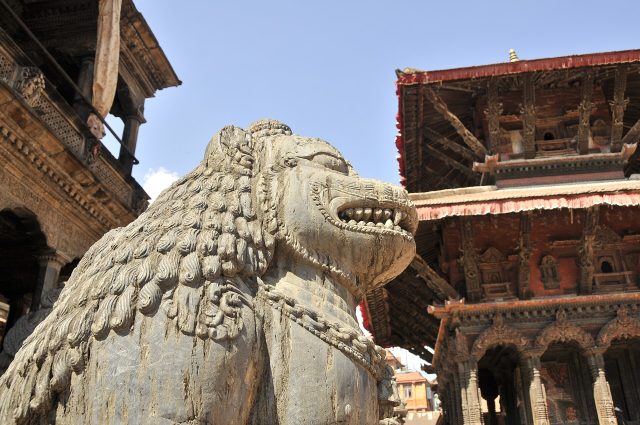
The architecture is a masterpiece of Newari design, the traditional style of the Kathmandu Valley. The main structure is a three-tiered pagoda, its copper roofs layered with gold leaf, giving the temple its name. Each level is adorned with intricate woodwork—gods, mythical creatures, and scenes from Buddhist lore rendered with such precision that they seem almost organic, as if shaped by nature rather than human hands. Inside, the walls are covered in faded but still-vibrant frescoes depicting the life of the Buddha, while at the center of the hall, a large statue of Shakyamuni sits surrounded by smaller figures of bodhisattvas. The craftsmanship isn’t just decorative; it’s a form of devotion, every curve and line a prayer in wood and stone.
This isn’t a museum piece but a living monastery, home to Buddhist monks who still perform daily rituals. Mornings and evenings are marked by the sound of bells, drums, and the low chanting of mantras, a rhythm that has echoed through these halls for centuries. The temple’s atmosphere is one of quiet focus, and even casual visitors find themselves slowing down, drawn into the meditative calm. In the summer, the temple draws pilgrims from across Nepal and Tibet, as well as travelers curious to see the work of medieval artisans. Yet despite the visitors, the place never feels crowded—there’s a sense that the temple absorbs those who enter, rather than the other way around.
What makes the Golden Temple particularly fascinating is how it embodies the religious harmony of Nepal. While it’s a Buddhist site, you’ll also find Hindu symbols and deities woven into its design, a reflection of the country’s unique blend of traditions. Inside, there’s even a small shrine to Saraswati, the goddess of wisdom, revered by both Hindus and Buddhists. This coexistence isn’t unusual in the Kathmandu Valley, where the two religions have intertwined for centuries, each influencing the other without conflict. The temple isn’t just a place of worship; it’s a microcosm of Nepal’s cultural identity, where different faiths share space without tension.
The temple courtyard offers a quiet retreat from the city’s bustle. Here, you’ll find small stupas and shrines, each with its own story. One of the most famous is the Ashoka Stupa, said to have been built by Emperor Ashoka himself during his visit to Nepal in the 3rd century BCE. While there’s no definitive proof of this, the legend persists, and many believe the emperor left his mark here. Nearby, stone Buddhas stand watch, often draped in flower garlands by locals. The courtyard isn’t grand, but it’s a place where you can sit for a while, watching the light play on the temple’s golden roofs or listening to the distant hum of the city.
Visiting the Golden Temple is more than just seeing a historic site—it’s a chance to step into a living tradition. The worn stone steps, the darkened frescoes, the scent of incense lingering in the air—all of it feels like a direct connection to the past. Unlike many tourist spots, where the atmosphere is often diluted by crowds, this place retains a sense of authenticity. Perhaps that’s because the temple isn’t trying to be anything other than what it is: a place of worship, a work of art, and a quiet corner of the world where time moves differently.
Patan itself is a city that rewards slow exploration. The old quarter’s narrow lanes are lined with houses featuring intricately carved windows, and small workshops where artisans still craft traditional masks and statues using age-old techniques. The Golden Temple serves as a perfect starting point for discovering the city. From here, many visitors head to Durbar Square, where other Malla-era monuments stand, or stop at a local café to try Newari cuisine—rich, spicy, and full of flavor. The temple isn’t just a destination; it’s a gateway to understanding the city’s soul.
There’s something about the Golden Temple that lingers long after you leave. It doesn’t demand attention with grandeur or spectacle, but in its quiet way, it leaves an impression. There are no crowds jostling for photos, no pushy guides offering tours—just the stillness, the golden glow of the roofs, and the sense that time here follows its own rhythm. Maybe that’s why people return. Not for the architecture alone, but for the feeling of stepping outside the rush of the world, if only for a little while. It’s a place where beauty isn’t just seen but felt, where the past isn’t just remembered but lived.