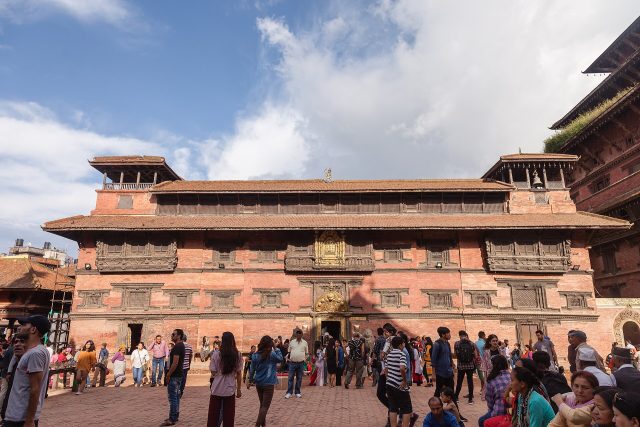
Tusha Hiti is one of those quiet corners of Patan where time seems to have paused, leaving behind the unmistakable spirit of the Newar people. Tucked away in the maze of narrow lanes that make up the old city, not far from the famous Fifty-Five Window Palace, this stone water reservoir feels like a hidden relic of another era. In Nepal, water has always been more than just a resource—it carries sacred meaning, woven into daily life and religious practice. Places like Tusha Hiti were never just functional; they were where the ordinary met the divine, where people gathered not only to draw water but to connect with something deeper.
The history of Tusha Hiti stretches back to the Malla dynasty, the golden age of Patan when the city flourished as a center of art, architecture, and spirituality. From the 13th to the 18th century, the Malla rulers transformed the Kathmandu Valley into a hub of creativity, commissioning intricate stone water tanks, temples, and public spaces. Tusha Hiti is one such example, though no one knows exactly when it was built. Most believe it dates to the 17th century, a time when Patan was already dense with pagodas, shrines, and communal structures, each telling a story of the city’s prosperity.
Like other Newar *hiti*, Tusha Hiti follows a simple yet deliberate design—a square stone basin surrounded by steps leading down to the water. The walls are adorned with carvings, some worn by time, others still sharp enough to make out figures of *nagas*, the serpent deities believed to guard water sources. On one side, a small shrine once held statues of gods, though now it stands empty. Water once flowed into the tank through an intricate network of underground channels, part of a sophisticated system that supplied the entire city. These channels, long since dry in many places, were a marvel of engineering, ensuring that even in the dry season, the people of Patan had access to clean water.
In the past, *hiti* like this were the heart of neighborhood life. Women came to wash clothes, children played on the steps, and elders rested in the shade, exchanging stories. Before prayers, people would perform ritual ablutions here, purifying themselves in the sacred water. The tanks were social spaces, too—places where news was shared, where friendships were forged, and where the rhythms of daily life unfolded. Tusha Hiti no longer serves these purposes, but the echoes of that life remain. The water is still clear, though not as pristine as it once was, and the stone steps bear the marks of centuries of use.
Patan moves at a slower pace than Kathmandu, and that difference is palpable even in a place like Tusha Hiti. There are fewer tourists here, fewer distractions, just the quiet hum of the city going about its day. The tank is often empty of visitors, save for the occasional local stopping by or a stray traveler wandering through. In the morning, sunlight filters through the surrounding buildings, casting long shadows across the carvings. By evening, the air cools, and the place takes on a peaceful, almost meditative quality. If you’re lucky, you might see someone leaving an offering—a handful of flowers, a lit oil lamp—keeping alive traditions that have endured for generations.
Water in Nepal has always been sacred, and many *hiti* are still used in religious ceremonies. During the festival of Teej, for example, women gather at these tanks to bathe and pray for the well-being of their families. Even outside of festivals, Tusha Hiti feels alive with history. The stones themselves seem to whisper stories of the people who once relied on this place, who built their lives around its presence. There’s no grand monument here, no plaque explaining its significance—just the quiet weight of time, etched into every crack and crevice.
To reach Tusha Hiti, you have to navigate the labyrinth of Patan’s old city, where red-brick houses line narrow alleys and small shrines appear around every corner. The tank sits in a residential neighborhood, far from the tourist crowds, surrounded by the everyday life of the city. This makes it all the more special—there’s no performance here, no sense of being on display. Just the quiet dignity of a place that has seen centuries pass, yet remains largely unchanged.
Many of the *hiti* in the Kathmandu Valley have fallen into disrepair, victims of modern plumbing and neglect. Tusha Hiti has fared better than most, though it, too, shows signs of age. Local authorities and community groups occasionally clean and repair the structure, but the real preservation comes from the people who still value it. For them, Tusha Hiti isn’t just a historical site—it’s a piece of their heritage, a link to the past that they’re determined to protect.
Visiting a place like Tusha Hiti is a reminder of how closely Nepal’s past and present are intertwined. There’s no fanfare here, no grand narrative of empire or conquest. Just the quiet persistence of a city that has refused to let go of its traditions. In a world that moves too fast, Patan—and places like Tusha Hiti—offer a rare stillness. They don’t ask for attention; they simply exist, as they have for centuries, holding within their stones the memories of those who came before.