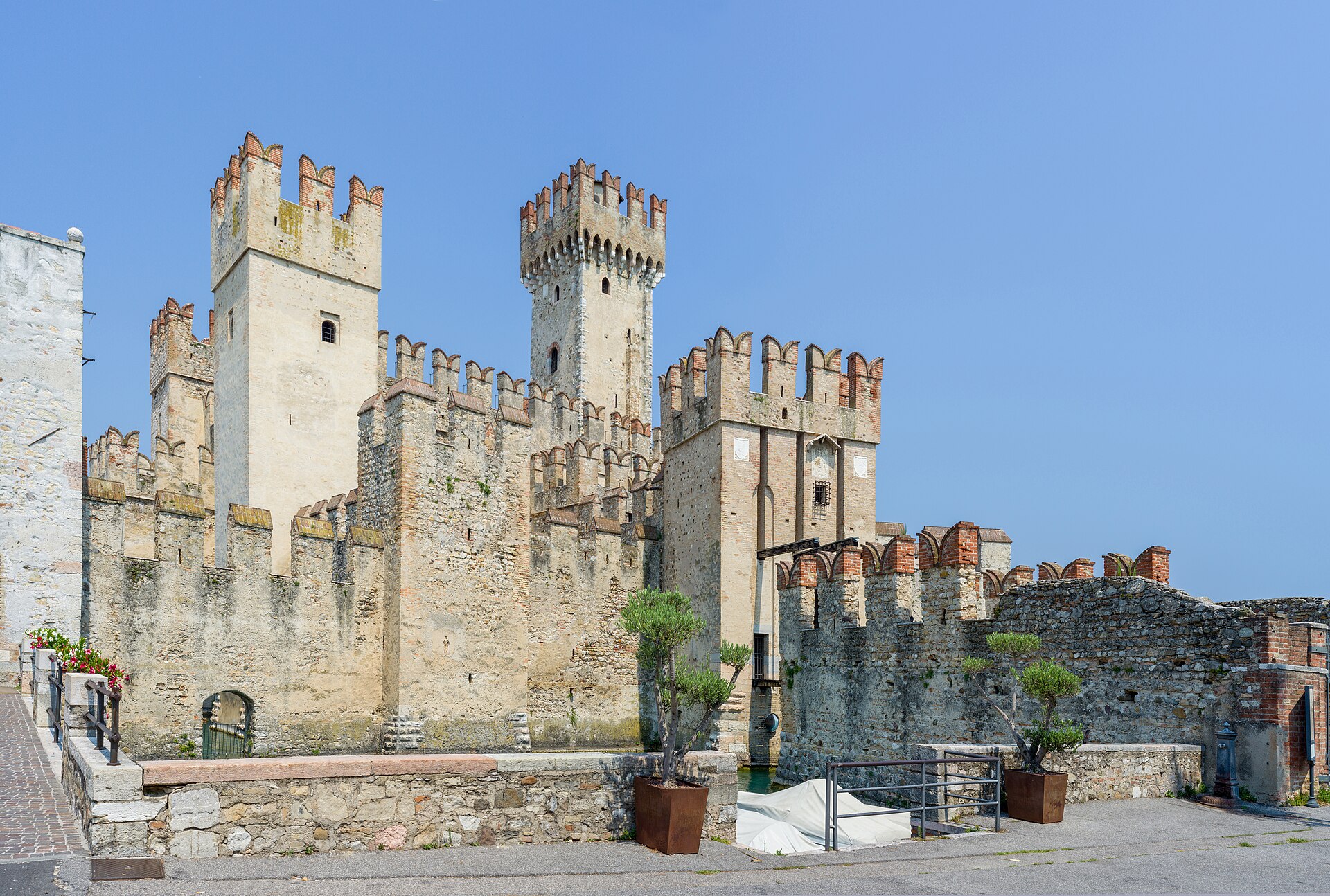
Sirmione stretches along Lake Garda’s shore, its narrow peninsula jutting into the water. At the tip stands the Scaliger Castle, a fortress built where land and lake meet. Its thick walls, worn by time, were never breached—not because they were untested, but because their purpose was different. The castle was a declaration: of dominance over trade routes that once cut through these waters. Now, it’s a landmark that lingers in memory long after the visit.
The castle’s beginnings
The Scaliger family ruled Verona in the 13th century, and their fortresses still dot the region. In Sirmione, the castle started as a defensive post, its towers and walls meant to repel attacks from the lake. Later, it became a residence, its design balancing function and ambition. The keep, the battlements, the arched galleries around the courtyard—each element was deliberate, built for an era where stone carried weight beyond its structure.
The harbor is what makes this castle different. It’s the only surviving medieval dock on Lake Garda, carved into the fortress walls to shelter ships during storms or raids. The water here changes with the seasons—deep blue in summer, shifting to green when the light hits it just right. From the towers, the view spans the lake, sometimes clear enough to see the opposite shore. On calm days, the reflection in the water is so sharp it feels unreal.
Inside the fortress
Narrow staircases lead to the watchtowers, where guards once scanned the horizon. Some rooms still hold fragments of frescoes, though time has faded them to faint outlines. The main tower offers the best view: the lake, the old town’s tangled alleys, the red-tiled roofs pressed together like a puzzle.
After the Scaligers, Venice took control in the 15th century. The castle’s role shifted from military to administrative. By the 19th century, as Italy unified, it became a symbol of local identity. Now, it’s state-owned and open to visitors, quieter than Italy’s more famous landmarks. The past here isn’t just preserved—it’s present.
The castle at dusk
Evenings bring a different kind of light. As the sun sinks behind the mountains, the walls glow gold. The harbor water stills, doubling the fortress in its surface. Tourists thin out, and the town slows. Locals walk along the waterfront, their voices mixing with the waves.
In summer, the courtyard hosts concerts. Violins and pianos drift through the air, the music settling into the stones.
The Scaliger Castle isn’t grand like the Loire’s châteaux or dramatic like Scotland’s ruins. But it has its own pull. You stand where others stood centuries ago, looking at the same lake. The tourists come for photos, for the view, for the checkbox. The real reason to visit? The way the castle still belongs here, as if it’s always been part of the town—and always will be.