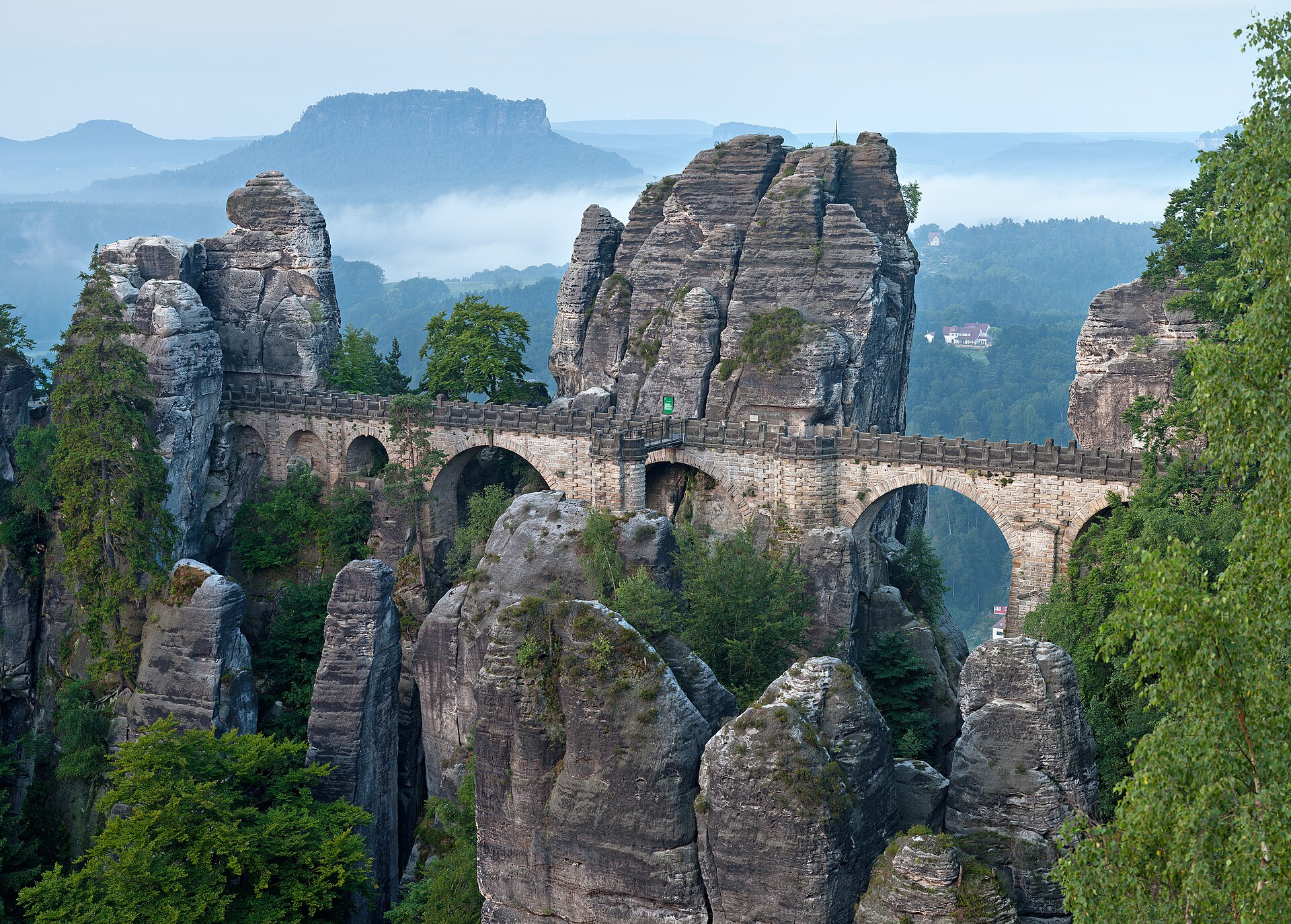
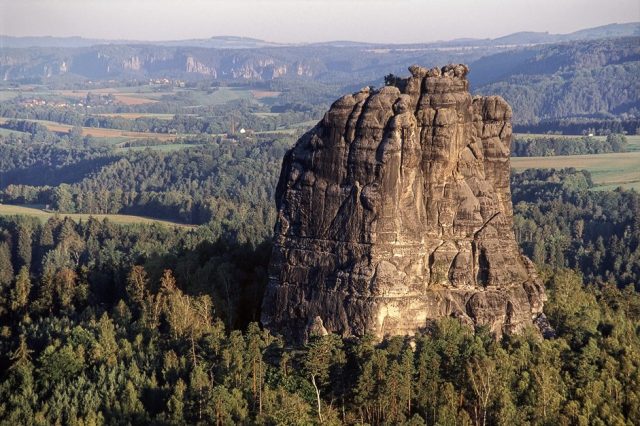
Perched atop a mushroom-shaped rock in the heart of Saxon Switzerland, Pfaffenstein feels like something plucked from a fairy tale rather than a man-made fortress. The sandstone formation rises abruptly from the surrounding forest, its narrow base flaring outward into a broad plateau that seems almost too perfect to be natural. Even among the region’s famously bizarre rock formations, Pfaffenstein stands out—less a castle in the traditional sense and more a sentinel carved by time and human hands into the landscape itself. No one knows exactly when the first fortifications appeared here, but by the Middle Ages, the rock was already serving as both a lookout and a refuge, its strategic position offering sweeping views over the Elbe Valley and the dense forests beyond.
The early history of Pfaffenstein is shrouded in the kind of gaps that make medieval ruins so intriguing. The first structures likely date to the 12th or 13th century, when this stretch of land marked the uneasy border between Saxony and Bohemia. From its heights, watchmen could monitor trade routes along the Elbe and spot approaching armies long before they became a threat. Chronicles from the 14th century mention the fortress as a holding of the Berka von der Daube family, but by the 15th century, it had already begun its slow decline into ruin. Unlike the grand castles built to impress, Pfaffenstein was always more about function than form—its walls and towers designed to blend into the rock rather than dominate it.
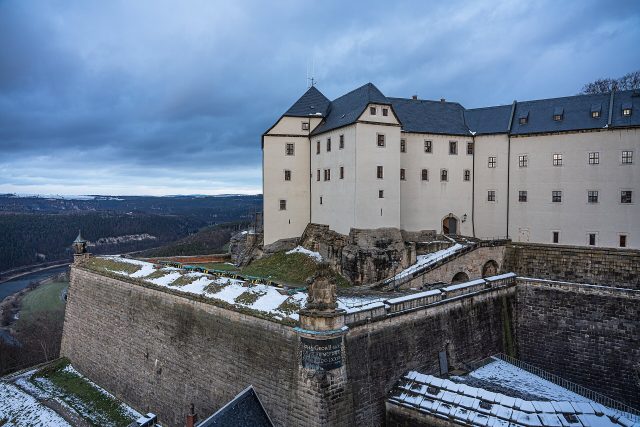
What remains today are fragments: crumbling foundations, the stubs of walls, and the occasional archway half-swallowed by ivy. The real draw, though, is the ascent. A narrow path winds up the rock face, its steep sections reinforced with metal ladders and railings that cling precariously to the stone. The climb isn’t for the faint-hearted, especially after rain when the steps grow slick, but the view from the top makes the effort worthwhile. Below, the forest stretches in every direction, a sea of green broken only by the distant ribbon of the Elbe. On the opposite bank, Königstein Fortress looms like a darker twin—another relic of Saxony’s military past, its massive walls a stark contrast to Pfaffenstein’s quiet decay.
There’s something unassuming about Pfaffenstein that makes it all the more compelling. It was never a place of royal opulence or grand battles, and no famous sieges or heroic deeds are tied to its name. Instead, it feels like a secret, a place where history lingers in the cracks of the stone rather than in the pages of textbooks. The rock itself seems to breathe, its porous surface warm to the touch in summer, its crevices sheltering ferns and wildflowers. Even now, with only a handful of ruins left, the site carries the weight of centuries. Locals and visitors come here as much for the atmosphere as for the history—the way the wind rustles through the trees, the scent of pine and damp earth, the sense of stepping into a quieter, older world.
By the 19th century, as tourism began to take hold in Europe, Pfaffenstein had transformed from a forgotten ruin into a destination. Paths were cleared, signs posted, and the rock became one of the many natural wonders that drew travelers to Saxon Switzerland. Unlike some of the region’s more famous sites, though, Pfaffenstein never became overrun with souvenir stands or cafes. Even the brief attempt to turn it into a guesthouse in the 18th and 19th centuries fizzled out, likely due to the difficulty of hauling supplies up the steep slope. Instead, it remained a place for artists and wanderers, its rugged beauty captured in paintings and travelogues. Today, it’s still that kind of place—uncommercialized, a little wild, and all the more special for it.
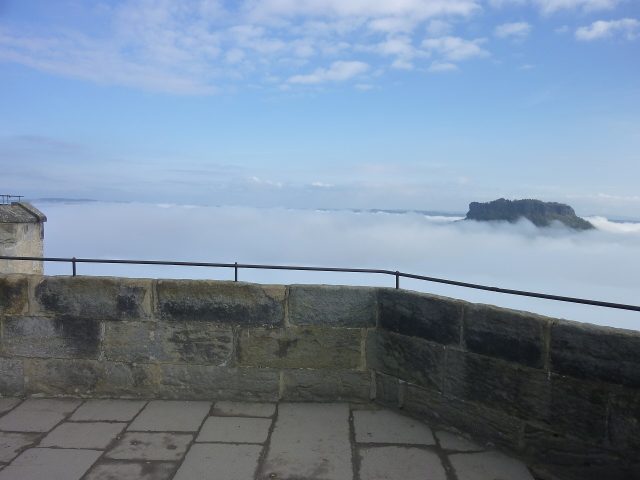
The best time to visit is early morning, when mist still clings to the treetops and the rock emerges from the haze like an island in the sky. The forest is hushed, the only sounds the occasional call of a bird or the crunch of leaves underfoot. Once you reach the summit, the wind is almost always present, a cool counterpoint to the stillness below. From here, the landscape unfolds in layers: the dense woods giving way to patchwork fields, the Elbe glinting in the distance, and on clear days, the faint outline of mountains on the horizon. It’s a view that makes you understand why people once fought to control this land—not for its riches, but for its vantage.
Pfaffenstein isn’t the kind of castle that inspires awe with its grandeur. There are no soaring towers, no lavish halls, no legends of ghosts or chivalry. What it offers instead is something rarer: a sense of authenticity, of time worn smooth by the elements. You can spend hours picking your way through the ruins, tracing the outlines of long-gone walls, or simply sitting on the edge of the rock, watching clouds drift over the valley. It’s a place that rewards patience, where the real discovery isn’t in the stones themselves, but in the quiet moments between them. For those who prefer history’s quiet corners to its grand stages, Pfaffenstein feels like a gift—a reminder that sometimes, the most memorable stories are the ones half-erased by time.