Karlštejn isn’t just a castle—it’s a stone chronicle of Czech history, perched on a rocky hill above the Berounka Valley, less than an hour from Prague. Built in the mid-14th century at the command of Charles IV, one of Bohemia’s most visionary rulers, it was meant to safeguard the royal regalia, holy relics, and state documents. The locals still say it was designed to be an impregnable fortress, capable of protecting its treasures from even the most powerful enemies. But Charles IV likely had more than security in mind. The castle’s architecture was meant to reinforce the divine right of kings, every stone a testament to the empire’s grandeur.
The approach to Karlštejn winds through dense forest, where tall, sturdy trees cast long shadows, keeping the air cool even on the warmest days. The first glimpse of the castle’s walls—massive towers, crenellated battlements, and a deep moat—makes it clear why it stood unconquered for so long. In the Middle Ages, it withstood sieges, though its true purpose was never purely military. More than a fortress, it was a statement of power and piety, a physical manifestation of the crown’s authority.
The architecture blends Gothic and Romanesque styles, but with a distinct character that sets it apart from other European castles. The Great Tower dominates the skyline, its height emphasizing the castle’s importance. Inside lies the Chapel of the Holy Cross, one of Karlštejn’s most breathtaking spaces. Its walls are adorned with gold and precious stones, the ceiling painted with scenes from the life of Christ. This was where the most sacred relics were kept, including a fragment of the True Cross, and Charles IV spared no expense, bringing in the finest craftsmen of his time to create a space worthy of divine treasures.
Walking through the castle feels like stepping back in time. The Knight’s Hall, with its soaring vaulted ceilings and thick columns, once hosted feasts and royal councils. Today, it displays replicas of medieval weapons and armor, their weight and craftsmanship a reminder of the era’s brutality and artistry. The royal chambers are furnished simply—oak tables, carved chests, heavy tapestries—but even these modest pieces speak of a time when durability mattered more than comfort. The library, though now mostly empty, once held manuscripts and chronicles, their pages scattered across Prague’s museums long ago.
Karlštejn hasn’t always looked as it does today. By the 17th century, it had fallen into disrepair, and it wasn’t until the 19th century that restoration began, guided by the romanticized ideals of the Middle Ages. The restorers aimed to preserve the original details, though some elements were recreated with a touch of artistic license. Certain frescoes and paintings, for instance, were reconstructed based on old descriptions but with a 19th-century sensibility. These choices don’t diminish the castle’s authenticity; if anything, they add another layer to its story, showing how each generation interprets the past.
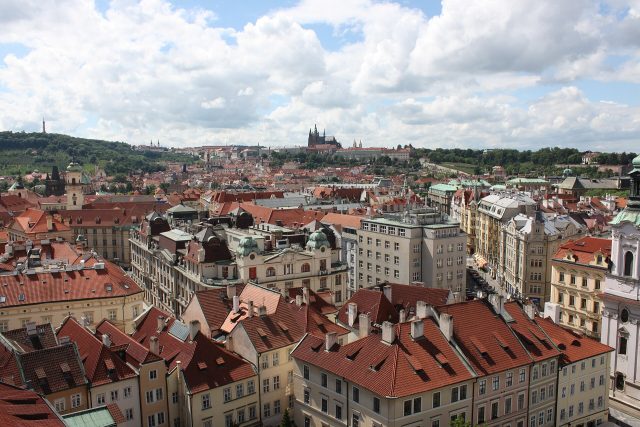
At the foot of the castle lies a small village, a quiet contrast to the bustle of Prague. The streets are narrow, lined with houses topped with red-tiled roofs, and a handful of cafés serve traditional Czech dishes. The locals go about their lives unhurriedly, unbothered by the steady stream of visitors. In the evenings, when the last tourists leave, the village grows still, the only sounds the rustling of leaves and the distant chime of church bells.
What makes Karlštejn special is the way history lingers here. Climbing the steep steps to the lookout point, you can see the same valley Charles IV gazed upon seven centuries ago. The Berounka River winds through the hills, the forests remain untouched, and in the distance, villages dot the landscape with their red roofs. It’s easy to understand why this castle became a symbol of the Czech lands—not just because it preserves the past, but because it makes that past feel alive.
Today, Karlštejn is one of the country’s most visited sites, yet it never feels crowded, even in peak season. Unlike Prague Castle, it doesn’t rely on gimmicks or interactive exhibits to draw a crowd. It simply exists—majestic, slightly mysterious, and undeniably real. That’s why people return. There’s something about standing within these walls, surrounded by centuries of history, that makes the past feel closer than anywhere else.