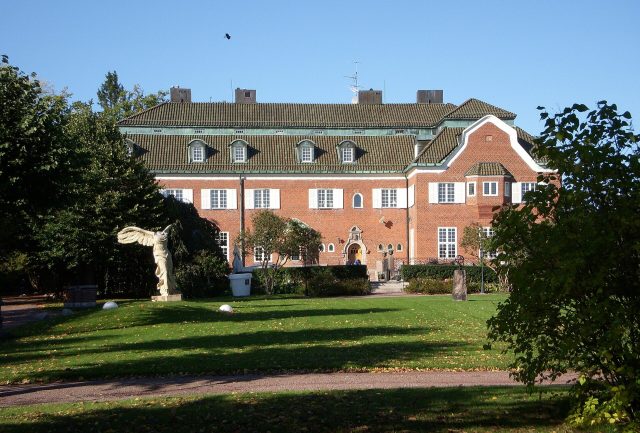
Djursholm Castle is one of those rare places that feels both timeless and alive, as if it has quietly endured through the centuries without ever losing its connection to the present. Perched on the shores of Edsviken Bay, just north of Stockholm, it stands where the water gently laps against ancient stone walls, surrounded by a park that whispers of a past when nobility strolled its paths and decisions shaping a nation were made within its halls. Today, the castle is more than a relic—it’s a living part of Djursholm, a place where history and everyday life intertwine effortlessly.
The story of Djursholm begins in the 14th century, when a fortified manor first rose here as a strategic stronghold along Sweden’s coastline. At the time, the country was still taking shape, and such fortresses were vital for controlling trade routes and defending against raids. But the castle we see now is a far cry from those early medieval defenses. Its transformation began in the 17th century, when the estate passed into the hands of the Oxenstierna family, one of Sweden’s most powerful aristocratic dynasties. Under their ownership, the fortress was reborn as a grand Renaissance palace, reflecting the ambitions and tastes of an era when Sweden was asserting itself as a major European power.
The architecture of Djursholm Castle is a blend of influences, each layer telling a story of its own. The main building, with its steep roofs and symmetrical facades, bears the hallmarks of Dutch Renaissance style, which found favor in Scandinavia during the 17th century. Tall windows framed in stone, corner towers, and a sense of restrained elegance give the castle a stately yet inviting presence. While the interiors aren’t always open to the public, those who have stepped inside describe opulent rooms adorned with carved ceilings, antique furnishings, and art collections that hint at the wealth and refinement of its former owners. The grand staircase, in particular, stands as a reminder of the balls and receptions once held here, where Sweden’s elite gathered under crystal chandeliers.
Surrounding the castle is a sprawling park that locals simply call the castle garden, a favorite spot for walks and quiet reflection. Gravel paths wind through the grounds, leading to a small pond where ducks glide across the water, and benches tucked beneath the shade of old oak trees offer a place to sit and unwind. In summer, roses and peonies bloom in vibrant clusters, while autumn paints the park in fiery hues of gold and crimson. When winter arrives, the snow-dusted landscape transforms the castle into something out of a fairy tale, its silhouette softened by frost. The park is open to everyone, and many visitors come not just for the history, but for the chance to escape the city’s pace and lose themselves in the quiet beauty of the place.
Djursholm Castle has long been tied to Sweden’s national narrative, serving as a backdrop to moments that shaped the country’s destiny. Over the centuries, it has been home to figures who played pivotal roles in Swedish history. Kings have stayed here, political decisions have been debated within its walls, and in the 19th century, the castle even hosted foreign diplomats. One of its most famous owners was Axel Oxenstierna, the chancellor under King Gustavus Adolphus, whose leadership during the Thirty Years’ War helped cement Sweden’s place as a dominant force in Europe. The castle still carries the echoes of that era, a tangible link to a time when Sweden stood at the center of the continent’s power struggles.
Today, the castle belongs to the municipality of Djursholm and serves as a venue for public events. Exhibitions, concerts, weddings, and corporate gatherings are held here, breathing new life into its historic halls. In the summer, small fairs sometimes pop up in the courtyard, offering local delicacies and handcrafted goods. Though it’s no longer a private residence, the castle remains a symbol of prestige and heritage for the area. Locals take pride in it, and visitors to Stockholm often make the short trip to Djursholm to catch a glimpse of Sweden’s aristocratic past, preserved in stone and surrounded by nature.
Djursholm itself is a world apart from the bustle of Stockholm. Known as one of the city’s most exclusive suburbs, it’s a place of quiet streets, meticulously kept villas, and an atmosphere of understated elegance. Diplomats, business leaders, and artists have long been drawn to its peaceful charm, and the castle sits at the heart of this community, both literally and symbolically. Walking through the park or sitting by the water’s edge, it’s easy to imagine the generations of people who have passed through here, each leaving their own mark on the place.
For those visiting Stockholm who want to step off the well-trodden tourist path, Djursholm Castle offers a different kind of experience. There are no crowds here, no rush to snap the perfect photo—just the quiet rhythm of a place that has stood the test of time. It’s a spot where history feels tangible, yet not frozen in the past. The castle invites you to slow down, to wander its grounds, and to appreciate the beauty of a moment that exists somewhere between then and now. Perhaps that’s why it continues to draw people in—not just as a monument, but as a place where the weight of centuries feels a little lighter.