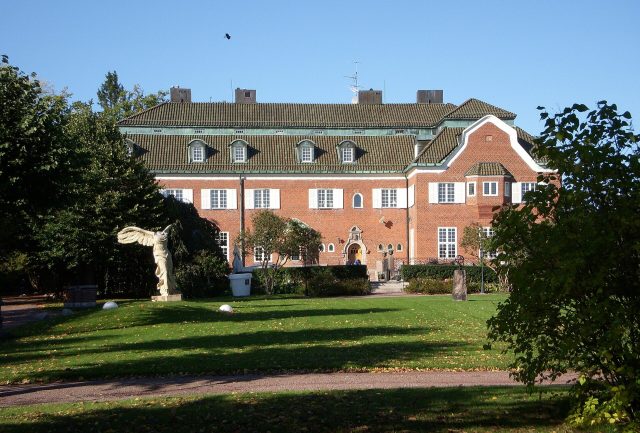
Ulriksdal Palace sits quietly on the shores of Edsviken Bay, just a short distance north of Stockholm. It’s one of those rare places where history doesn’t feel like something preserved under glass—it’s alive, woven into the very air, the trees, the stillness of the water. The palace has seen kings and queens come and go, artists and gardeners leave their mark, and ordinary people find moments of peace along its paths. Today, you can walk through its rooms, stroll across its lawns, or simply sit by the water watching boats glide past, but the walls here have witnessed far more than quiet afternoons.
The story of Ulriksdal begins in the early 1600s, when the estate was known as Jakobsdal and belonged to Jacob De la Gardie, one of Sweden’s most powerful men. A chancellor and patron of the arts, De la Gardie built the first stone structures here, laying the foundation for what would become a royal retreat. But the estate’s transformation into a palace truly began when Queen Hedvig Eleonora, widow of Charles X Gustav, acquired it in the late 17th century. She renamed it Ulriksdal in honor of her son, Prince Ulrik, and set about reshaping it into a residence fit for royalty. The changes she initiated would echo through the centuries, turning a nobleman’s estate into a place intimately tied to Sweden’s monarchy.
The palace itself is a patchwork of architectural styles, each layer revealing the tastes of its time. The original Renaissance structure was rebuilt in the Baroque style, then altered again in the 18th and 19th centuries, blending neoclassical elegance with romantic touches. Today, its pale facade, tall windows, and mansard roof give it a graceful, understated presence. Inside, the rooms tell their own stories—ornate plasterwork, antique fireplaces, and furniture spanning several eras. One chamber holds portraits of Swedish monarchs, painted by court artists, while another displays a collection of porcelain gathered during Hedvig Eleonora’s time. The details are subtle, but they hint at the lives that once filled these spaces.
The park surrounding the palace is just as much a part of its history. Planted in the 17th century, it has evolved from formal gardens into an English-style landscape, with winding paths, ancient trees, and open meadows. In summer, roses and lilacs bloom along the walkways, while autumn turns the leaves to gold and crimson. The orangery, built in the 19th century, was once used to grow exotic plants for the royal table. Now, it hosts exhibitions and concerts, though even on quiet days, it retains a sense of timeless calm. The park feels like a place where time moves differently—slower, softer, as if the trees themselves are keeping watch over the years.
For much of its history, Ulriksdal was a private retreat, a place where royalty could escape the demands of court life. King Charles XV, known for his eccentric personality and love of the arts, spent summers here, filling the palace with paintings that still hang in his private rooms. Later, in the early 20th century, Gustav VI Adolf made Ulriksdal his home, not just a seasonal residence but a place where he raised his family. His reign spanned turbulent times, and the palace offered a refuge—a place where he could step away from the weight of the crown, if only for a moment.
Today, Ulriksdal is open to the public, but it doesn’t feel like a typical museum. There are no ropes or signs warning visitors to keep their distance. You can wander through the rooms, peek into the king’s study, or even touch some of the furnishings. In summer, the palace comes alive with classical concerts, while the park fills with picnickers and festival-goers. Winter, though quieter, has its own magic—the snow-dusted paths, the frozen bay, the way the palace seems to hibernate until spring. It’s a place that changes with the seasons, yet always feels the same in its essence.
For many Stockholmers, Ulriksdal isn’t just a tourist spot—it’s part of everyday life. People come here to jog, to walk their dogs, to sit by the water with a book. Couples meet for first dates on the palace steps, families celebrate birthdays under the old oak trees, and friends gather for picnics on the lawn. There’s a warmth to the place that sets it apart from other royal residences. It doesn’t feel distant or untouchable; instead, it’s as if the past and present exist side by side, each leaving room for the other.
If you find yourself in Stockholm, Ulriksdal is worth a visit. It’s an easy trip from the city center—take the bus or, in summer, a ferry across the water. Weekdays are best if you prefer quiet, but even on weekends, the park has enough space to lose yourself in. Spend an afternoon wandering the grounds, exploring the palace, or sipping coffee at the estate café. And if you’re lucky, you might catch the sunset over the bay, when the light turns the water and sky into something almost unreal. It’s the kind of place that lingers in your memory long after you’ve left.