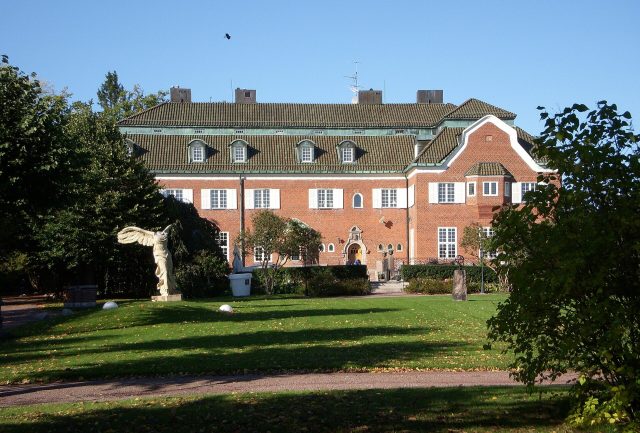
Djursholm Church sits on a low hill in one of Stockholm’s quieter suburbs. The streets around it are lined with old oaks and houses that have stood for decades, their brick and wood softened by sunlight and rain. Built in the late nineteenth century, the church was never meant to be grand, but it has become a place people return to—a quiet part of the neighborhood where generations have gathered.
The building is small but distinct. Designed in the neo-Gothic style, it has pointed arches and warm brick that has darkened with time. The clock tower rises above the trees, its spire visible from the road. Inside, the ceilings are high, the wooden pews worn smooth, and the stained-glass windows cast colored light across the stone floor. When the organ plays, the sound fills the space, deep and resonant.
Djursholm’s history is tied to the church. In the late 1800s, this area was a retreat for Stockholm’s wealthy, a place of summer estates. Landowners, including members of the Wallenberg family, helped build the community, funding the church, roads, and schools. The architect was Gustaf Amman, who designed other buildings in Stockholm at the time. The church opened in 1895 and became a gathering place for the growing town, a role it still has today.
Beyond services, the church hosts concerts, lectures, and small exhibitions. On Sundays, the congregation includes locals and visitors from Stockholm. The churchyard, with its paths and benches, is a place to walk or sit in warmer months. Families come, children play on the grass, and in the evenings, people talk quietly under the trees.
Next to the church is the cemetery. The graves are spaced apart, many under trees or with fresh flowers. Some belong to well-known Swedes—industrialists, scientists, artists—while others mark the lives of people who lived and worked in the community. Walking among them, you see names from different times, a record of who has passed through here.
Djursholm Church doesn’t stand out like famous landmarks. There are no grand stories of battles or royalty, no architectural feats that draw crowds. Instead, it offers something quieter: a place where the past and present meet without fuss. It has stood for over a century, unchanged in ways that matter.
If you’re curious about Djursholm, the church is a good place to start. The neighborhood has many houses from the early 1900s, built in the National Romantic style. These villas have wooden balconies, carved details, and steep roofs, reflecting the tastes of the time. Walking the streets, you see how the area has shifted from a summer retreat to a permanent home.
What makes Djursholm Church special is its lack of pretense. It doesn’t try to impress; it simply is. You can sit on a bench outside, listen to the birds, and let the quiet settle. In a world that moves quickly, places like this offer a chance to pause and feel connected to something that lasts.