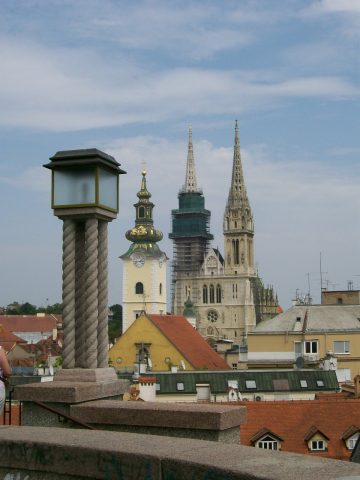
Zagreb Cathedral is one of those places that instantly defines the city. Its twin neo-Gothic spires rise sharply above the old town, visible from nearly every corner of Upper Zagreb, guiding visitors through the maze of narrow streets. More than just an architectural landmark, the cathedral is a living record of the city’s past—its triumphs, disasters, and quiet resilience. Over the centuries, it has absorbed layers of history, from medieval legends to Baroque renovations and modern restorations, each leaving its mark on the stone and the atmosphere within.
The first church on this site dates back to the 11th century, when Zagreb was still a divided settlement of Gradec and Kaptol, with the Romanesque basilica standing between them. By the 13th century, it had been rebuilt in the Gothic style, but its fate was far from peaceful. Earthquakes, fires, and invasions repeatedly damaged the structure, with the most devastating blow coming in 1880, when a powerful tremor nearly reduced it to rubble. The reconstruction that followed gave the cathedral its current neo-Gothic appearance, though traces of earlier eras remain, hidden in the details.
The architecture is a conversation across time. The façade, with its soaring 108-meter towers, is adorned with intricate carvings and statues of saints, while the interior balances grandeur and lightness in a way that feels almost effortless. The high vaulted ceilings, stained-glass windows, and rich ornamentation create a sense of solemnity, yet the space never feels oppressive. This might be because the post-earthquake restoration incorporated newer architectural ideas, softening the weight of medieval tradition. The marble altar, gilded and elaborate, draws the eye, as does the organ, its music filling the nave during services and concerts.
The cathedral’s history is deeply woven into Croatia’s own. It has witnessed coronations, royal weddings, and state ceremonies, while its crypt holds the remains of Zagreb’s bishops and other notable figures. The walls bear memorial plaques commemorating key moments in the nation’s story. Like many European churches, it suffered damage during World War II but was carefully restored in the decades that followed. Today, it remains not just a spiritual center but a symbol of endurance, a place where the past is never truly past.
Stepping inside is like entering a different rhythm of time. Even those who aren’t drawn to religious architecture often find themselves lingering, struck by the quiet that settles over the space. The only sounds are the occasional footsteps of visitors or the distant notes of the organ. In summer, the cathedral attracts crowds, yet it never feels overrun—there’s a stillness here, a sense of contemplation that persists even in the busiest seasons. Locals come not just for services but to sit in silence, to think, or to watch the light play across the stained glass.
The surrounding Kaptol district is one of Zagreb’s oldest, its narrow streets and historic houses offering a contrast to the cathedral’s imposing presence. Small shops and cafés line the way, selling local sweets and crafts, while the air carries the scent of fresh bread and coffee. Kaptol and the cathedral have grown together over the centuries, and today the area feels like a bridge between history and modern life. Nearby, Dolac Market buzzes with activity—vendors calling out prices, shoppers haggling over produce, the vibrant chaos of daily commerce unfolding just steps from the cathedral’s quiet grandeur.
This is no museum. The cathedral is an active place of worship, and that vitality is palpable in every corner. Services, weddings, and baptisms take place regularly, while major religious holidays transform the space into a focal point for the faithful across Croatia. Christmas and Easter are especially moving, with the building adorned in flowers and candles, the choir’s voices rising in traditional hymns. Even for the non-religious, these moments offer a glimpse into something deeper—a sense of community, of shared history, of celebration.
The cathedral continues to evolve. Recent decades have seen extensive restoration work, particularly focused on reinforcing the structure against future earthquakes. Zagreb sits in a seismically active zone, and preserving the building requires constant effort. From the outside, it looks much as it did a century ago, but behind that timeless façade lies ongoing care. It’s a place that refuses to be frozen in time, one that remains relevant to the city and its people.
For many, Zagreb Cathedral is the first image that comes to mind when thinking of Croatia. It has become more than a landmark—it’s a symbol of the nation’s cultural and spiritual identity. Within its walls, different eras, architectural styles, and human stories intertwine, creating something greater than the sum of its parts. The cathedral is history told through stone, light, and silence, a story that isn’t finished yet.